
History Lesson Plans for Effective Classroom Teaching
An effective history lesson plan aligns a clear learning purpose with the historical content and evidence students need, a teaching method and classroom activity that serve that purpose, a feasible sequence and timing, and checks for learning. Use the plan as a flexible guide: adjust support, pacing, or activity order when classroom evidence justifies it, while keeping the intended learning stable.
History lesson plan alignment map
Use the learning purpose as the anchor, align the four planning dimensions around it, verify the plan before teaching, and adjust delivery from student responses during the lesson.
- Historical content and evidence
- Select material that directly supports the purpose and is workable for the learners.
- Method and classroom activity
- Choose an approach and task that require students to work with the relevant content or evidence.
- Sequence and timing
- Fit the scope, transitions, activity, and checks for learning within the available lesson time.
- Checks for learning
- Use student responses as evidence of progress and as a basis for proportionate instructional adjustment.
Conditions that change the plan: learner readiness, prior knowledge, available resources, lesson time, and classroom conditions.
The plan coordinates decisions; it does not guarantee learning. Teaching quality, learner readiness, classroom context, and implementation still affect what students learn.
Table of Contents
What Makes a History Lesson Plan Effective?
An effective history lesson plan aligns a clear learning purpose with suitable historical content or historical evidence, purposeful activity, feasible timing, and checks for learning.
Effectiveness also depends on classroom context: these choices need to fit the intended learning, learner readiness, available time, resources, and teaching conditions rather than follow a fixed formula.
The criteria interact rather than operate independently.
Clear purpose and aligned evidence support coherence, while appropriate challenge, workable activity, realistic timing, and checks for learning help make the plan teachable in its specific classroom context.
The image illustrates how these criteria connect within a plan rather than prescribing how a particular template should be completed.
- Clear learning purpose: The intended learning should be specific enough to guide teacher decisions about content and activity; when the purpose is unclear, those choices can lose instructional focus.
- Aligned historical content and evidence: Historical evidence should help students address the learning purpose rather than appear simply because it relates to the topic; closer alignment supports a more coherent lesson.
- Purposeful activity: The classroom activity should require students to work with the relevant content or evidence in a way that fits the intended learning; an interesting activity that does not serve that purpose can weaken alignment.
- Appropriate challenge: The level of challenge should fit the learning purpose and learner readiness. A task that is inaccessible can restrict participation, while insufficient challenge may not give students an adequate opportunity to demonstrate the intended learning.
- Feasible timing: The planned activity, transitions, and checks for learning should fit the available lesson time. Realistic timing supports lesson completion without treating pace as more important than the learning purpose.
- Checks for learning: The plan should give the teacher a relevant way to examine student responses against the intended learning. This helps the teacher judge progress and decide whether an adjustment is needed.
For example, a lesson is aligned when students examine historical evidence through an activity that directly addresses the stated learning purpose and the teacher checks their responses against that purpose.
A lesson can be misaligned when its activity is engaging but does not require students to use the selected evidence or demonstrate the intended learning.
Which choices are effective varies with the learners, lesson purpose, available resources, time, and wider classroom context.
How the Main Parts of a History Lesson Plan Work Together
The main parts of a history lesson plan work together when each part supports the same intended learning.
A learning objective gives the plan its instructional direction, while historical content, historical evidence, sources, materials, classroom activity, sequence, timing, and checks for learning connect that direction to what students will encounter and do.
Lesson-planning frameworks may group or count components differently, so use the planning function each part serves and whether the parts remain aligned rather than treating a particular component count as a quality standard.
Intended learning establishes what the lesson is meant to develop or demonstrate; detailed guidance on writing history lesson objectives belongs to that narrower planning task.
Historical evidence and sources influence suitable materials and classroom activity, while sequence and timing constrain what can be completed feasibly.
Changing a source, activity, or time allocation may therefore require adjustment elsewhere so that the parts continue to serve the same learning purpose.
| Component | Planning function | Connection to other parts |
|---|---|---|
| Intended learning | Defines the learning objective the lesson is organised to address. | Guides the selection of content, evidence, activity, and relevant checks for learning. |
| Historical content/evidence | Provides the historical knowledge, evidence, or sources students work with. | Needs to support the intended learning and provide suitable material for the classroom activity. |
| Materials/resources | Make the selected content, evidence, and sources usable in the lesson. | Need to fit the planned activity, available time, and way students will work with the evidence. |
| Teaching or student activity | Defines how students encounter, examine, discuss, or use the historical content or evidence. | Connects the intended learning to student responses and affects materials, sequence, and timing. |
| Sequence/timing | Organises classroom activity and transitions within the available lesson time. | Constrains the amount of content, evidence, activity, and checking that can be handled feasibly. |
| Checks for learning | Provide evidence from student responses about progress toward the intended learning. | Connect back to the learning objective and can indicate whether teaching or activity needs adjustment. |
The diagram makes this dependency visible by keeping the learning purpose central and showing how historical evidence, classroom activity, timing, and checks for learning connect around it.
A change to one part can affect the fit of the others without implying a fixed step-by-step planning sequence.
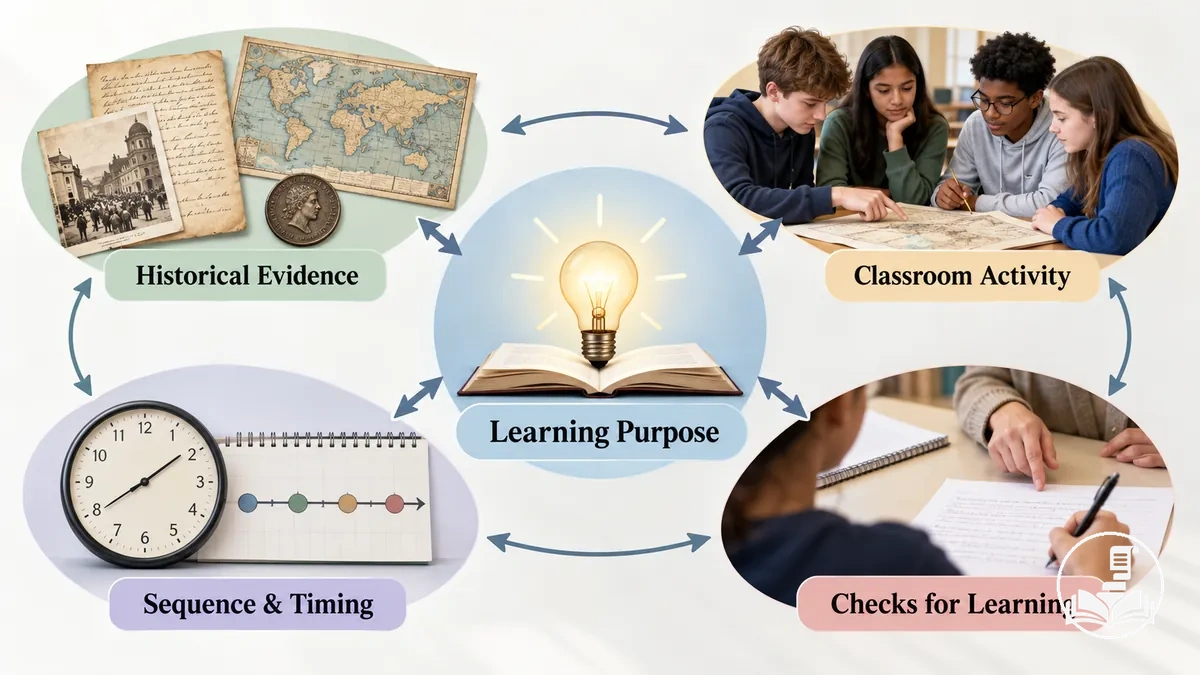
For example, if the learning objective asks students to interpret differing accounts of the same event, selected sources can provide those perspectives, the classroom activity can ask students to compare the evidence, and the check for learning can examine whether student responses address the intended interpretation.
This connection also explains why assessment in history lessons needs to relate back to intended learning; detailed objective writing and assessment design remain separate planning topics.
The History Lesson Planning Process at a Glance
The history lesson planning process moves from establishing the learning purpose to selecting historical content and historical evidence, choosing a teaching method and classroom activity, arranging timing and sequence, and verifying alignment and feasibility.
Different teachers and planning frameworks may divide these decisions into different numbers of steps, so this five-stage sequence is a practical overview rather than a universal formula.
Prior knowledge helps determine what historical content and historical evidence are appropriate for the intended learning, while learner needs and classroom conditions influence the teaching method and classroom activity.
Available resources constrain what evidence and activities can be used, and lesson time constrains their scope, timing, transitions, and sequence.
Verification then checks whether the learning purpose, content, evidence, activity, resources, and available time form a feasible lesson and whether checks for learning can provide relevant evidence of student learning.
- Establish the intended learning. Define the learning purpose in relation to learner needs and relevant prior knowledge so later planning decisions have a clear instructional direction.
- Select essential historical content and evidence. Choose the historical content, historical evidence, or sources needed for the learning purpose while considering relevance, available resources, and what can be handled within the lesson.
- Choose a fitting method, activity, and resources. Select a teaching method and classroom activity that let students work with the chosen content or evidence, taking learner needs, resource readiness, and classroom conditions into account.
- Arrange timing and sequence. Organise the activity, transitions, and checks for learning within the available lesson time, adjusting the scope when the planned content or activity cannot be handled feasibly.
- Verify alignment and feasibility. Check whether the learning purpose, historical content and evidence, classroom activity, resources, timing, and checks for learning support one another; revise any decision that creates a mismatch or an impractical demand.
The visual condenses these connected planning decisions and shows how final verification closes the loop by testing alignment and feasibility.
It also highlights dependency between decisions without presenting the sequence as a universal planning standard.
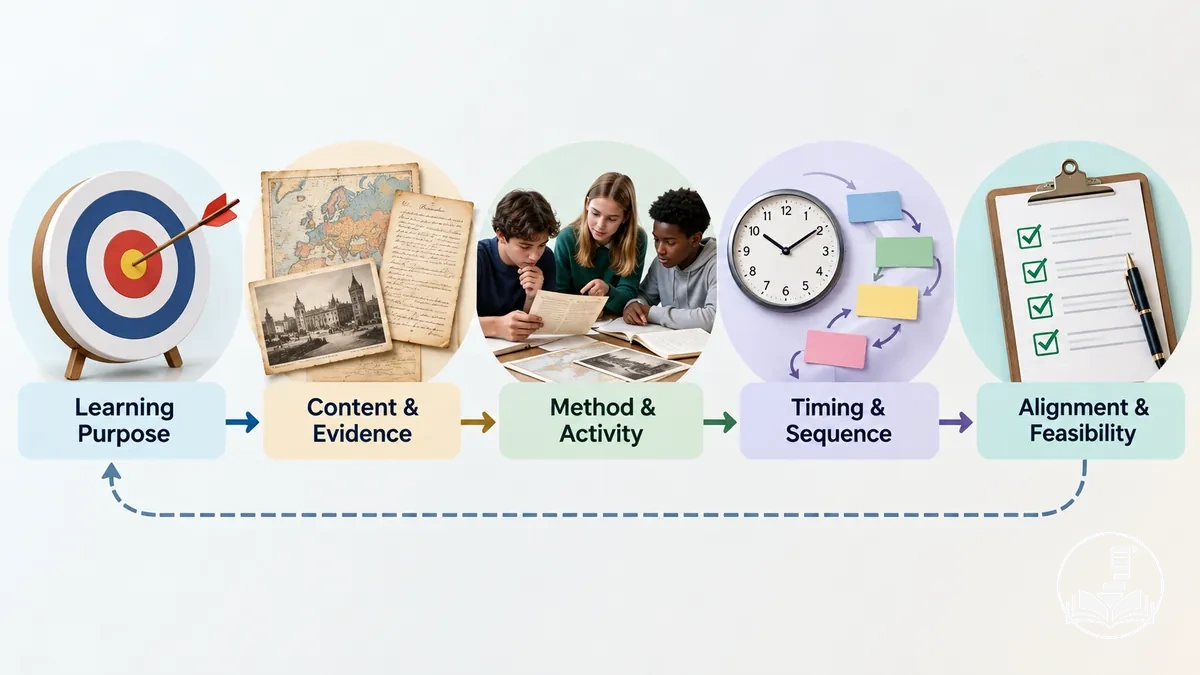
For example, if less lesson time is available than originally planned, the teacher may need to narrow the historical content or evidence, shorten the classroom activity, or adjust the sequence while preserving the same learning purpose.
This overview stops at those major dependencies; planning and structuring history lessons covers the deeper procedural decisions involved in building the lesson.
Matching Teaching Methods and Classroom Activities to the Lesson Purpose
Teaching methods and classroom activities should fit the lesson purpose and the content knowledge or historical reasoning students are expected to develop or demonstrate.
The choice also depends on learner readiness, prior knowledge, available historical evidence, resources, lesson time, and classroom conditions rather than on novelty alone.
A teaching method is the broader instructional approach used to organise learning, while a classroom activity is the specific task students perform within that approach.
Knowledge-building purposes can call for explanation and retrieval, while interpretation can call for discussion or debate and evidence-focused purposes can call for source analysis.
Synthesis or application may use a timeline, mapping, simulation, or another task that requires students to organise or apply historical information.
Choosing among history teaching methods therefore requires attention to what students are expected to know or do and to the conditions in which the lesson will take place.
- Knowledge building: Explanation and retrieval can be used when students need to establish or recall content knowledge before undertaking a more demanding task. Suitability depends on the required knowledge, students' prior knowledge, and the time available.
- Interpretation or discussion: Discussion or debate can fit a lesson purpose that asks students to interpret an issue, compare perspectives, or explain a historical claim. Students need enough relevant content or evidence to support their contributions rather than relying only on unsupported opinion.
- Evidence use: Source analysis fits purposes that require students to examine historical evidence, compare sources, or use evidence in historical reasoning. The selected sources need to be accessible for the learners and relevant to the question or claim being investigated.
- Synthesis or application: A timeline, mapping task, simulation, or synthesis task can be used when students need to organise relationships, apply knowledge, or bring information together. The activity is suitable only when its demands, resources, and classroom conditions serve the intended learning rather than becoming the lesson purpose itself.
The visual demonstrates purpose-to-activity fit across these learning demands rather than ranking one classroom approach above another.
It shows that suitability changes with what students are expected to learn or do.
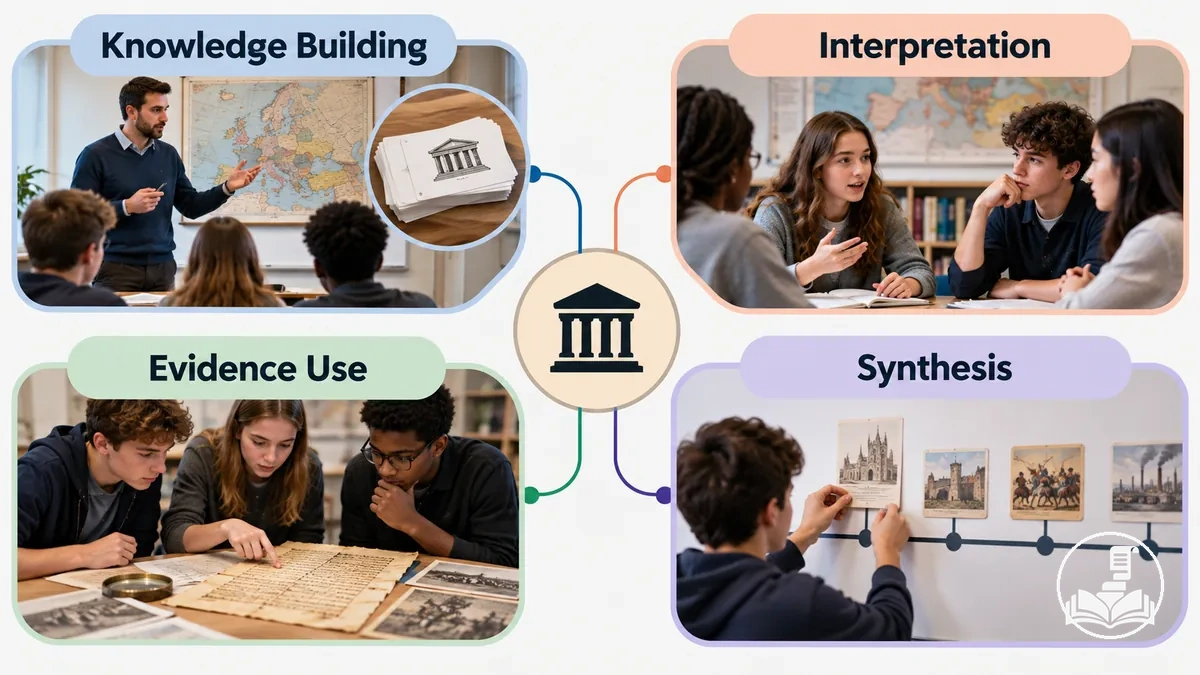
For example, source analysis can be appropriate when students need to compare historical evidence or support an interpretation, and deeper guidance on teaching with primary sources addresses that evidence-focused context.
The same source-analysis activity may be a weak fit when the immediate purpose is simply to establish essential background knowledge that students do not yet have.
Similarly, a simulation may serve a defined synthesis or application purpose when learners have the necessary knowledge and resources, but novelty alone does not make it suitable.
Checking a History Lesson Plan Before Teaching
A pre-teaching history lesson plan check verifies whether the proposed lesson is coherent, feasible, prepared, and aligned before classroom delivery.
The check should confirm that the learning purpose, historical evidence, classroom activity, timing, materials, transitions, challenge and access, and checks for learning are ready to work together under the expected classroom conditions.
- Is the learning purpose clear? Confirm that the intended learning is specific enough to guide the lesson; if not, revise it before checking the remaining elements against it.
- Are the historical evidence and classroom activity aligned with the learning purpose? Verify that students will work with content or evidence in a way that addresses the intended learning; if not, review the evidence, activity, or their connection to the purpose.
- Is the timing realistic? Check that the planned activity, transitions, and checks for learning can fit within the available lesson time; if not, revise the scope or time allocation.
- Are the materials and sources prepared? Confirm that required resources are available, usable, and ready for students when needed; if not, prepare them or adjust the planned task.
- Are transitions workable? Verify that students can move between activities, materials, or classroom arrangements without creating an impractical demand on lesson time; if not, simplify the transition or revise the arrangement.
- Is the level of challenge appropriate and accessible? Check that students have a workable way to engage with the task and historical evidence given their readiness and relevant prior knowledge; if not, adjust the task, support, or materials.
- Is there a practical check for learning? Confirm that the lesson includes a way to examine student responses against the intended learning; if not, add or revise a learning check that can provide relevant evidence of student understanding.
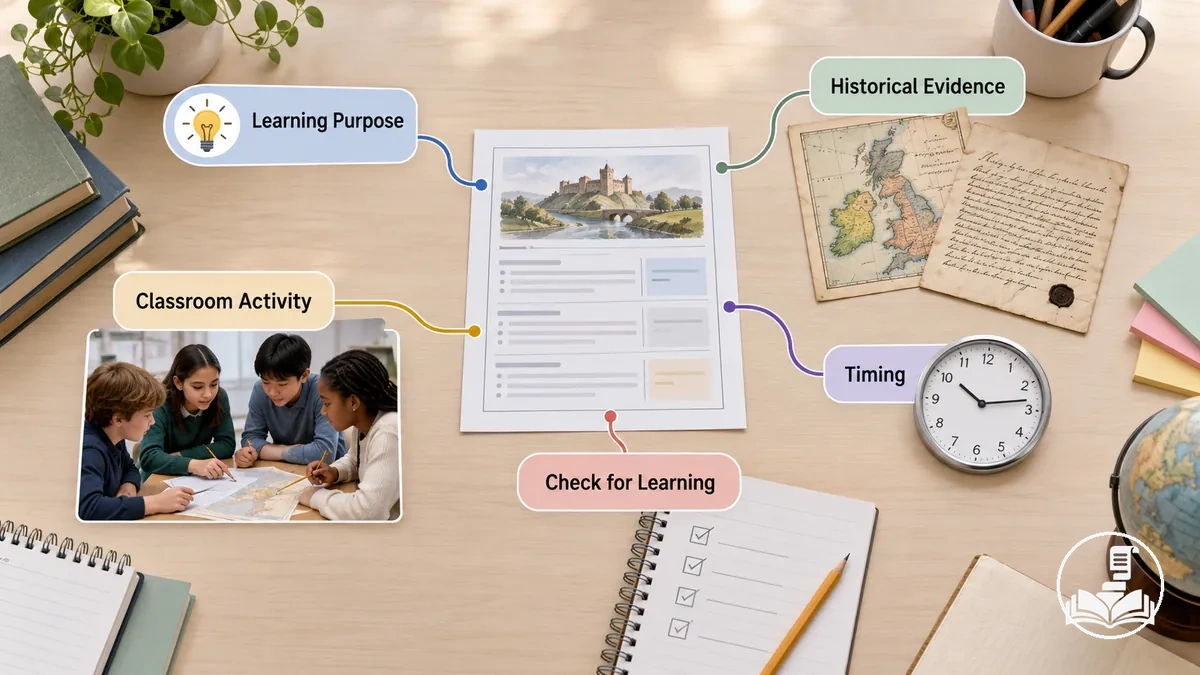
The annotated example makes these readiness checks concrete by showing where purpose, activity, timing, materials, sources, and checks for learning can be inspected on a lesson plan.
It also shows that a missing condition is a cue for revision rather than a readiness score.
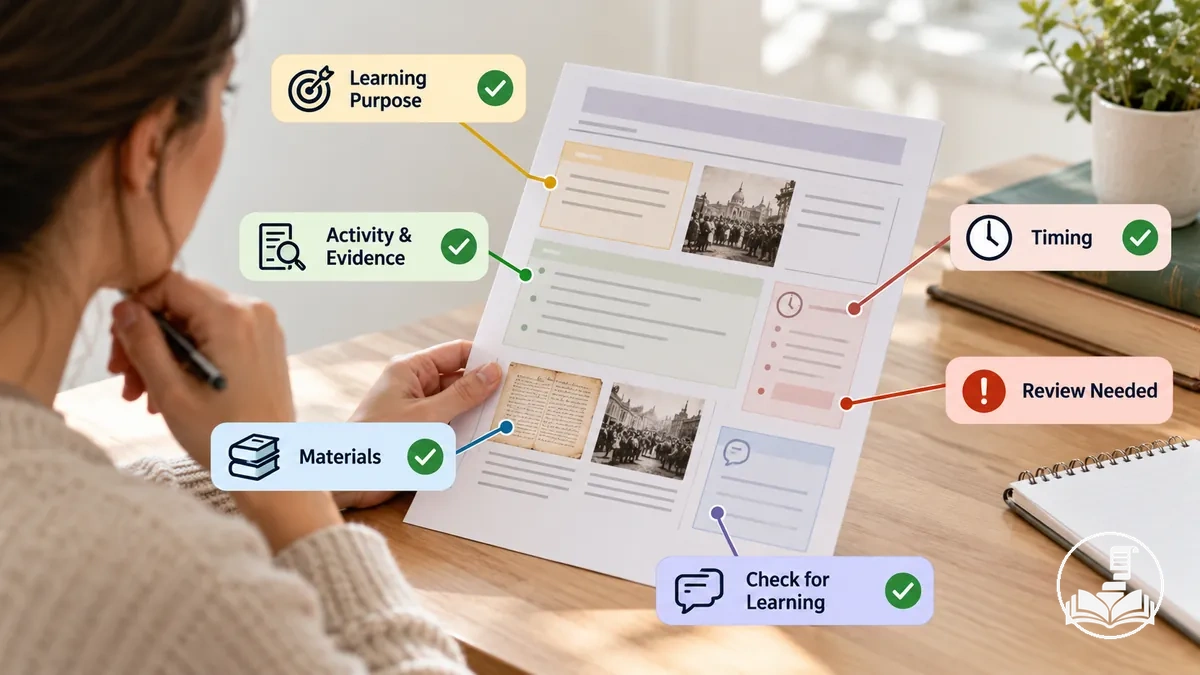
A checked condition means the plan is prepared on that dimension, while an unchecked condition identifies a specific area for review before teaching.
An unchecked item does not by itself mean that the entire lesson will be ineffective; it identifies where readiness needs further verification or revision.
This pre-teaching check is preventive verification rather than a catalogue of recurring errors and corrections.
A deeper review of common history lesson planning mistakes addresses those recurring planning problems separately.
Using the Lesson Plan During Classroom Teaching
During classroom teaching, a lesson plan functions as a flexible guide for maintaining the learning purpose, pacing, transitions, and attention to student responses rather than as a rigid script.
The teacher can monitor what is happening in the lesson and adjust timing, support, or activity order when classroom conditions differ from what was anticipated.
Observable conditions such as slower or faster progress, misconceptions, uneven participation, resource difficulties, or unexpectedly productive discussion can justify proportionate adjustments.
Not every student response requires a change; the teacher should check whether the condition affects progress toward the learning purpose before adjusting the plan.
The appropriate adjustment depends on the observed condition, available time and resources, and learner needs while keeping the intended historical learning stable.
- Progress is slower than expected: Shorten or narrow a classroom activity, reduce a transition, or defer a non-essential extension while retaining the historical evidence and task needed for the learning purpose.
- Progress is faster than expected: Extend the planned analysis or discussion when additional time can deepen work toward the same learning purpose rather than introduce an unrelated activity.
- A misconception becomes visible: Pause or reorder the lesson sequence to clarify the relevant content or historical evidence, then check student responses before continuing.
- Participation is uneven: Scaffold the existing activity or adjust how students contribute when access to the task differs, while keeping the intended historical reasoning or content knowledge unchanged.
- A resource difficulty interrupts the activity: Adapt the materials, reorder the activity, or use another prepared source when possible, provided the substitute still supports the same learning purpose.
- Discussion becomes unexpectedly productive: Extend it when student responses remain relevant to the intended learning, balancing that extension against the timing needed for later checks for learning.
The classroom view makes this flexible use visible: the teacher can refer to the lesson plan, monitor student responses, and adjust pacing or activities while teaching.
The plan continues to provide direction even when timing or the lesson sequence changes.
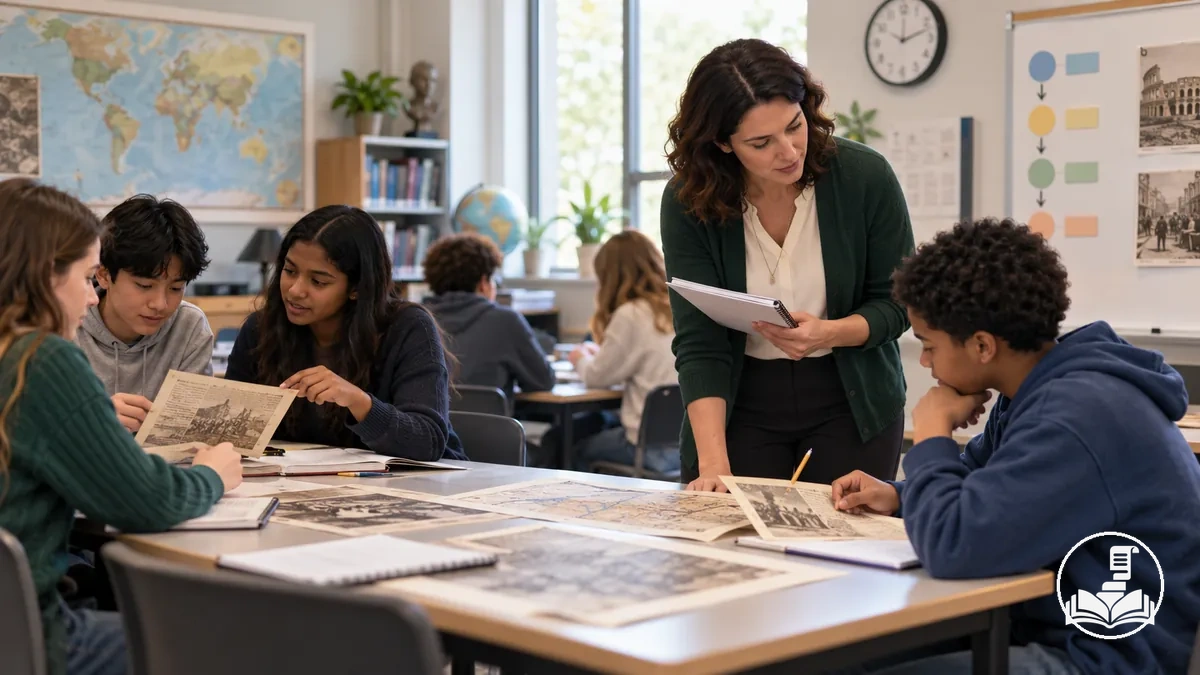
When participation, understanding, or access differs across learners, the teacher can scaffold the existing task without automatically replacing its learning purpose.
More detailed decisions about differentiating history lesson plans belong to the broader work of adapting instruction for learner needs.
For example, if some students struggle to interpret a historical source, the teacher might provide a focused prompt or reorder a supporting explanation before returning students to the same evidence-based task.
Purposeful in-class adjustment should respond to what the teacher observes rather than change activities merely for novelty.
Deeper work on participation and making history lessons more engaging is a separate optimisation task; during the lesson, adjustments should continue to serve the intended learning.
How History Lesson Plans Support Student Learning
Well-aligned history lesson plans can support student learning by coordinating the learning purpose, sequence, historical evidence, classroom activity, and opportunities to check understanding.
This coordination can make the lesson more coherent by connecting what students are expected to learn with what they encounter and do.
Planning alone does not cause or guarantee learning. Its contribution depends on how the plan is implemented during classroom teaching.
- Clear learning purpose
- Focuses attention on relevant content and gives evidence, activity, and checks for learning a common target.
- Coherent sequence
- Connects new material with relevant prior knowledge and can support knowledge building.
- Historical evidence + purposeful activity
- Create opportunities for interpretation and historical reasoning when the task requires students to work with the evidence.
- Checks for learning
- Use student responses to inform whether instruction, support, pacing, or sequence needs adjustment.
The purpose asks students to interpret historical evidence, but the activity focuses on unrelated recall and the checks for learning measure something different.
The historical evidence, classroom activity, and checks for learning all address the same intended learning.
What changes the result: teaching quality, learner readiness, classroom context, and how well the planned elements are implemented together in practice.