Troubleshooting History Lesson Plan Flow, Timing, and Alignment
When a history lesson plan is not working, diagnose three relationships separately: flow asks whether activities and transitions connect coherently, timing asks whether the planned sequence fits the available lesson period, and alignment asks whether the objective, practice, and assessment demand compatible learning. Fix the strongest supported breakdown with the smallest targeted change, then verify all three relationships before teaching the lesson again.
Troubleshooting triage: find the broken relationship
Use the observable symptom to choose a branch, then confirm it with the distinguishing check before changing the plan.
Flow
Typical signal
Activities feel disconnected, transitions are abrupt, or the closure does not clearly follow from preceding work.
Confirm by checking
Whether each preceding activity prepares students for the next task and whether the transition makes that connection clear.
First correction
Repair, reorder, remove, or clarify the broken connection while preserving parts of the sequence that already support the objective.
Timing
Typical signal
Later work, assessment, or closure is repeatedly compressed because earlier demands consume the available lesson time.
Confirm by checking
Activity duration, setup, instructions, transitions, discussion variability, and total scope against the available lesson period.
First correction
Reduce the supported source of time pressure while preserving objective-critical work; narrow whole-lesson scope when the combined load is the problem.
Alignment
Typical signal
Students complete the activity, but the resulting evidence does not demonstrate what the learning objective requires.
Confirm by checking
Content, cognitive demand, expected performance, and evidence across the objective, activity, and assessment.
First correction
Revise the minimum mismatched component so practice and assessment evidence correspond to the intended learning.
Decision rule: a symptom is a signal, not proof. When signs overlap, use the branch-specific check before choosing the corrective direction.
A rushed ending, weak student evidence, or a stalled transition can fit more than one branch. Treat the first classification as provisional and use the detailed checks below to confirm what is actually breaking down.
Table of Contents⌄
Diagnose Where the History Lesson Plan Is Breaking Down
Classify the history lesson plan breakdown before choosing a fix.
An observable symptom or signal may suggest a flow problem, timing problem, or alignment problem, but the diagnosis should remain provisional until a differentiating check supports the likely cause class.
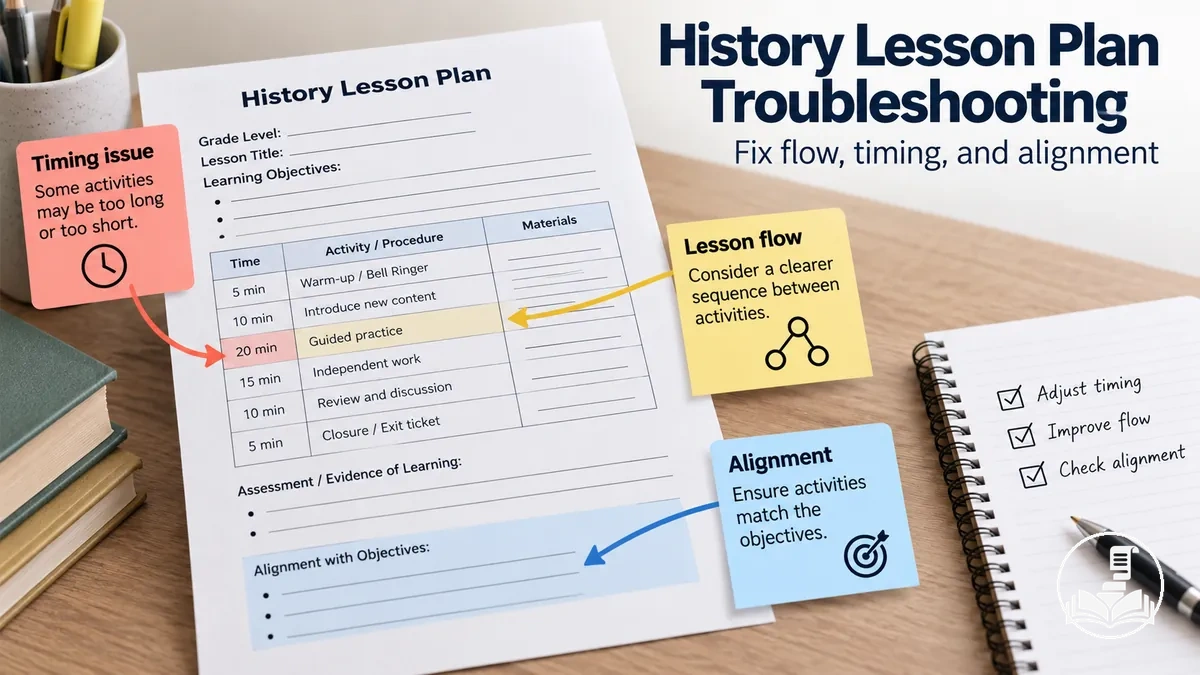
The accompanying illustration shows the lesson sequence, available-time cues, and objective–activity–assessment relationship that can be reviewed during this diagnosis.
The diagnostic flow connects each observation to a possible cause class, a check, and a corrective direction rather than treating the symptom as proof.
For flow, check whether the sequence and transitions remain coherent; for timing, check whether the planned activity duration and pacing fit the available time; for alignment, check whether the objective, activity, assessment, and expected evidence demand the same learning.
The three branches below organise those distinctions without prescribing the full repair.
Signal: the lesson feels disconnected at a transition. Possible cause class: flow problem. Check: examine whether the preceding activity establishes a clear connection to the next task. Corrective direction: inspect the sequence or transition before changing unrelated parts of the lesson.
Signal: later work is compressed or displaced. Possible cause class: timing problem. Check: compare the planned activity duration, transitions, and pacing with the available time. Corrective direction: inspect where the planned time fit breaks down.
Signal: students complete the activity but the resulting evidence does not demonstrate the objective. Possible cause class: alignment problem. Check: compare what the objective requires with what students practise and what the assessment asks them to demonstrate. Corrective direction: inspect the mismatch among objective, activity, and assessment.
A rushed ending, for example, could indicate a timing problem, but it could also follow an earlier flow disruption that consumed available time; the signal alone does not confirm the likely cause.
This diagnosis concerns breakdowns observed in how the lesson operates, while broader common planning mistakes require a wider review of the plan.
Signs of a Lesson Flow Problem
Lesson flow shows a problem when the lesson sequence loses coherence between activities or across a transition.
Observable breaks can make one activity feel disconnected from the work before or after it, but these signs do not by themselves establish a definite cause.
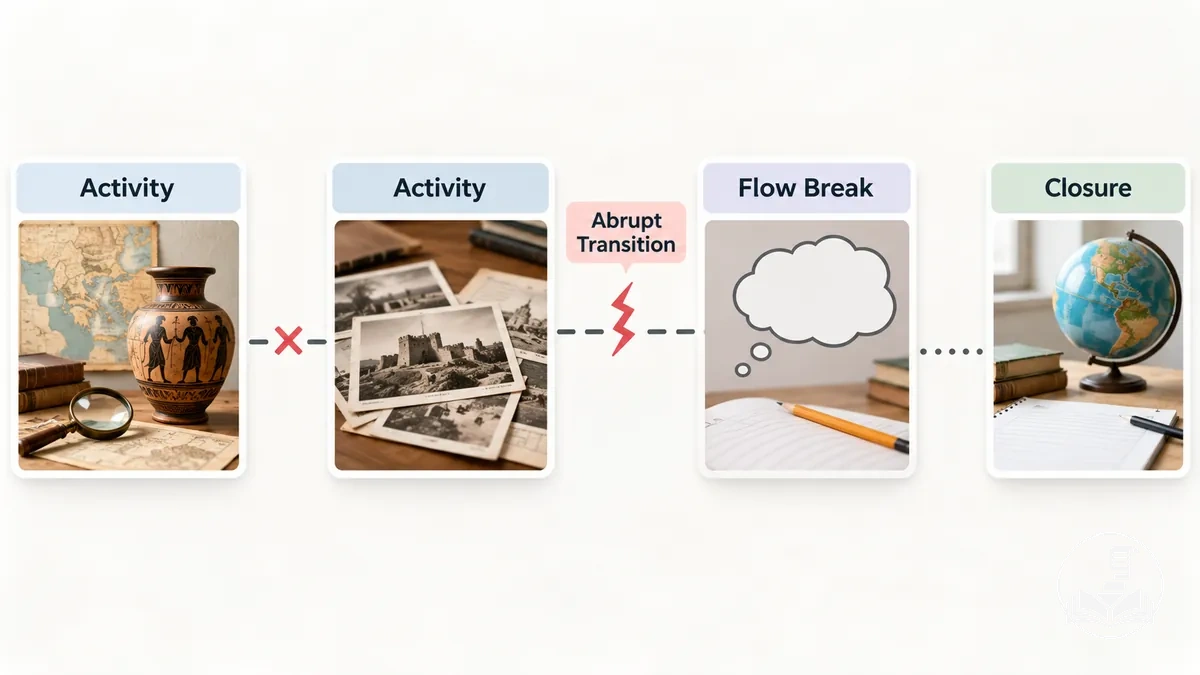
The illustration shows where coherence can break within a lesson sequence, including an abrupt or missing transition and a closure that is weakly connected to the preceding activity.
The following manifestations indicate where lesson flow may be disrupted rather than why the disruption occurred:
Disconnected activities: one activity ends without a clear link to the next, suggesting that the sequence lacks continuity at that point.
Abrupt transitions: the lesson moves to a new activity without an evident connection, interrupting sequence coherence.
Repeated reorientation: students need renewed explanation of what they are doing or how the next activity relates to earlier work, suggesting that the connection between parts of the sequence is unclear.
Stalled momentum: the lesson sequence repeatedly pauses while the connection or next direction is re-established, indicating a possible break in flow.
Disconnected closure: the closure does not clearly follow from the preceding activity or lesson sequence, leaving the final part weakly connected to the work that came before it.
Key distinction: flow is not pace
Slow but coherent
A lesson can move slowly and still have coherent lesson flow when each activity and transition maintains a clear connection.
Fragmented sequence
A fragmented sequence has unclear or disconnected relationships between lesson parts, regardless of how fast or slowly the lesson moves.
Signs of a Lesson Timing Problem
Lesson timing shows a problem when planned work repeatedly does not fit the available time in the lesson period.
An overrun may compress later activities, transition time, closure, or assessment, but a single late activity does not by itself establish a recurring timing problem.
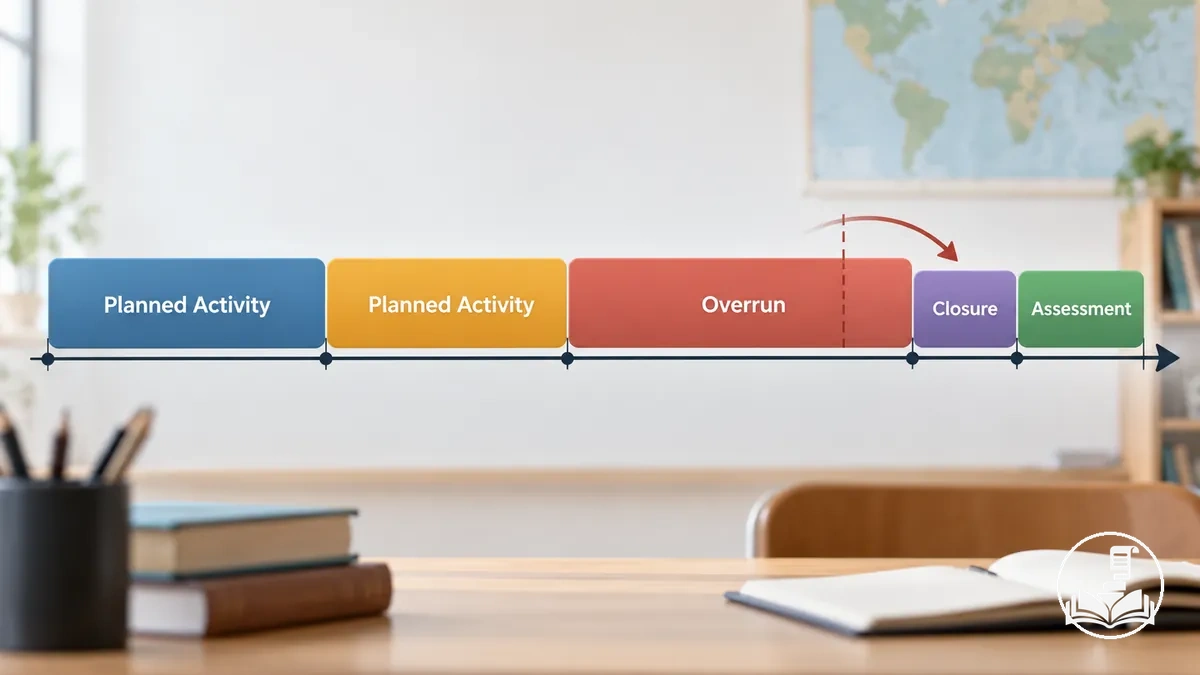
The illustration shows how an activity extending beyond its planned slot can displace later lesson components, making the timing symptom and its downstream effect visible without assigning a cause.
The following observable states can signal a lesson timing issue, but they do not identify whether activity duration, scope, setup, instructions, or transition demands produced the mismatch:
Repeated overruns: an activity regularly runs beyond its planned place in the lesson period, leaving less available time for later work.
Unfinished tasks: an unfinished task recurs because planned activities do not fit within the available time, suggesting a time-fit mismatch rather than proving poor pacing.
Excessive transition time: transitions or setup repeatedly occupy more of the lesson period than planned, compressing the remaining sequence.
Rushed explanation: later instructions or explanations become compressed after earlier work runs long, indicating that the overrun is affecting subsequent activity duration.
Reduced closure or assessment: closure or assessment is repeatedly shortened or displaced because earlier lesson components have consumed the remaining available time.
Pattern check
Isolated overrun
A one-off delay can push an activity late without establishing a recurring timing problem.
Recurring mismatch
When overruns and their downstream effects recur across comparable lessons, they suggest a persistent mismatch between the planned sequence and the available time.
Signs of an Objective, Activity, and Assessment Alignment Problem
Objective–activity–assessment alignment becomes a problem when the learning objective, student activity, and assessment evidence require different knowledge, cognitive demand, or expected performance.
Alignment requires the activity to practise and the assessment to measure learning that is compatible with the demand expressed by the objective.
Check alignment by comparing content match, cognitive demand, and expected performance across the three components.
The objective provides the reference demand, the activity shows what students practise, and the assessment shows the evidence of learning they are expected to produce.
A mismatch appears when one component changes the content or level of thinking required rather than maintaining a compatible learning demand.
Objective demand
Activity demand
Assessment evidence
Mismatch signal
Analyse causes of a historical event
Analyse relationships among causes using historical information
Explain and support a causal analysis
No mismatch is evident in cognitive demand: analysis is practised and measured
Analyse causes of a historical event
Recall names, dates, or isolated facts
List remembered facts
The objective requires analysis, while the activity and assessment require recall
For example, an objective requiring analysis is misaligned if students only practise recall and the assessment only asks them to reproduce facts, even when all three concern the same historical topic.
A task being difficult for students does not by itself prove misalignment; the relevant check is whether the objective, activity, and assessment require compatible content and cognitive demand.
Fix Lesson Flow When the Sequence or Transitions Break Down
Repair lesson flow when a break in the sequence or transition prevents one activity from preparing students for the next.
The correction should target the broken connection rather than redesigning parts of the lesson that still support coherence and the lesson objective.
Identify what the preceding activity is meant to establish and what the following activity requires students to do.
If an intervening activity interrupts that connection, removing or reordering it may be the smallest appropriate change; if the order is already appropriate, clarifying the transition may be enough to restore flow.
The aim is to keep each activity relevant to the next step and to the lesson objective without substituting an engagement change for a structural correction.
The ordered repair sequence targets the smallest change that can restore coherence.
Use each step to check the connection before making a broader change.
Locate the break: identify the activity or transition where the sequence stops preparing students clearly for what follows.
Identify the intended connection: state what the earlier activity should contribute to the next activity and how that connection supports the lesson objective.
Remove or reorder the conflicting element: remove an activity that does not contribute to the intended connection, or reorder activities when their current position disrupts the logical sequence.
Clarify the transition: make the handoff between activities explicit when the sequence is appropriate but the connection is not clear.
Recheck the path to the objective: verify that the revised sequence carries students from one activity to the next coherently and remains relevant to the lesson objective before making further changes.
The illustration shows a local activity or transition adjustment and how it restores the intended connection without reproducing the ordered repair process.
For example, before the repair, a source-analysis activity might be followed by an unrelated task before students use the source evidence to explain a historical claim; after the repair, reordering the evidence-based explanation directly after the source analysis restores the intended connection without changing the whole lesson.
If the problem extends beyond that local sequence or transition, review the broader lesson planning and structure rather than continuing to make isolated flow changes.
Fix Timing When Activities Take Too Long or the Lesson Runs Out of Time
Correct lesson timing by identifying what is consuming the available time before changing the lesson.
Preserve objective-critical work while checking whether the overrun comes from activity duration, setup, instructions, transition overhead, discussion variability, or excessive scope rather than assuming that faster delivery is the appropriate correction.
The illustration shows how an activity block and setup or transition overhead can consume more of the lesson period and compress closure or assessment, alongside a revised allocation that targets the specific time load.
It represents a proportionate timing correction rather than a universal allocation of minutes.
Different timing sources require different checks.
Activity duration concerns how long the task itself occupies; setup and instructions can add overhead before substantive work begins; a transition can consume available time between activities; and discussion can extend unpredictably depending on participation and the task.
Excessive scope creates a broader time demand across the lesson, while compressed closure indicates that earlier demands have displaced time intended for final objective-critical work.
The diagnostic branches below separate these possible sources before a corrective direction is chosen.
Activity overrun → Check: compare the activity duration with the available time and identify which parts directly support the lesson objective. Likely source: the activity itself is taking more of the lesson period than planned. Corrective direction: shorten or simplify a non-essential part while preserving objective-critical work.
Substantive work starts late → Check: examine the setup and instructions required before students begin. Likely source: preparation or explanation is adding time demand before the activity. Corrective direction: simplify setup or make instructions more concise where doing so does not remove information students need.
Time is lost between activities → Check: observe the handoff, material changes, and reorientation required at each transition. Likely source: transition overhead is compressing the remaining lesson period. Corrective direction: simplify the transition or reduce unnecessary handoff demands.
Discussion extends beyond its planned place → Check: distinguish productive discussion connected to the objective from repetition or expansion beyond the intended question. Likely source: discussion variability is increasing the time demand. Corrective direction: narrow the discussion focus or define a clearer stopping point while retaining objective-relevant contributions.
Several lesson components repeatedly compete for time → Check: compare the combined scope with the available time and identify which content and tasks are essential to the objective. Likely source: whole-lesson scope exceeds what fits in the lesson period. Corrective direction: narrow or resequence scope rather than applying arbitrary cuts across every activity.
A single-component overrun points first toward shortening that activity or simplifying its setup, whereas a whole-lesson time load points toward checking scope or sequencing.
For example, if setup consumes the time needed for closure, simplifying material distribution may be more proportionate than shortening the objective-critical task; if several activities collectively exceed the available time, narrowing scope may be the more relevant correction.
Reduce an Activity That Consumes Too Much Lesson Time
Shorten an overlong activity by preserving the objective-critical task and trimming time demands that do not produce necessary evidence for the lesson objective.
Do not assume that the longest component should be cut; its function determines whether it is a necessary step or an optional step.
Separate the activity into components and identify what each contributes before reducing its duration.
Retain necessary steps that let students perform the core historical thinking task, while optional extensions, low-value repetition, or avoidable setup can be trimmed when they do not provide essential learning evidence.
Set a workable stopping point so the activity does not continue beyond the evidence needed for its purpose, and retain a brief learning check to verify what students can demonstrate.
The sequence below protects the activity's instructional purpose while reducing its time demand.
Each action links a component to the reason for retaining, reducing, or limiting it.
Identify the objective-critical task: identify the action students need to perform to produce evidence for the lesson objective, and retain that core task.
Separate necessary and optional actions: keep each necessary step that enables the core task, while treating an optional step as removable only when it does not contribute essential evidence.
Trim low-value time demands: reduce repetition or simplify setup when those components add duration without being necessary for the activity's instructional purpose.
Set a stopping point: define where the activity can end after students have completed the required work, rather than allowing optional extension to consume the remaining lesson time.
Preserve a learning check: retain a brief check that verifies whether students produced the intended evidence before moving on.
For example, a source-analysis activity can retain the objective-critical task of interpreting evidence while reducing repeated discussion of similar observations or simplifying setup.
The activity then stops after students have produced the required interpretation and completes with a brief learning check, rather than replacing the historical thinking task with passive coverage solely to reduce duration.
Narrow the Lesson Scope When It Does Not Fit the Available Time
Narrow lesson scope when the combined breadth and conceptual depth of objective-linked and supporting content exceed the available time, rather than assuming one activity is inefficient.
Preserve the stated lesson objective and the essential content required to achieve and assess it, then reduce material whose function is useful but not necessary for that lesson.
Essential content directly supports the objective, provides a required conceptual foundation, enables necessary practice, or produces evidence needed for the assessment.
Nonessential detail may include an additional example, extra source, elaboration, or extension task that enriches the lesson but is not required for students to complete the core task.
Whether material can be removed therefore depends on its objective relevance and conceptual or assessment dependency, not simply on how much time it consumes.
The criteria below protect the lesson's core learning while identifying where breadth can be reduced to fit the available time.
Direct objective relevance: retain content that students need to address the stated lesson objective because removing it would change the intended learning task.
Required conceptual foundation: retain concepts or information that students need to understand before they can perform the objective-linked thinking.
Necessary practice: retain enough practice for students to perform the core task rather than replacing that work with passive coverage solely to reduce breadth.
Assessment dependency: retain content or practice that students need to produce the intended assessment evidence.
Optional illustration: an additional example, source, or nonessential detail can be removed or deferred when it reinforces rather than enables the objective-critical work.
Extension value: an extension task can be deferred when it adds enrichment but is not required for the objective, core task, or assessment.
For example, a history lesson may include several sources illustrating the same issue even though students need only enough evidence to complete the intended analysis and assessment.
Reducing the number of supporting examples can narrow breadth while preserving the conceptual depth, objective-linked thinking, and assessment evidence that the lesson requires.
Correct Misalignment Between Objectives, Activities, and Assessment
Correct objective–activity–assessment alignment by making the objective, activity, and assessment demand compatible content, cognitive demand, and performance.
Identify the weak link and revise the minimum necessary component so that student practice and assessment evidence correspond to what the objective requires.
Compare the three components on content, cognitive demand, and evidence type rather than assuming that using the same historical topic makes them aligned.
The objective establishes the intended knowledge or performance, the activity provides practice, and the assessment asks students to produce evidence of learning.
A weak link exists when one component requires different content, a different level of thinking, or an evidence type that does not demonstrate the intended performance.
The comparison below identifies the mismatch and the smallest correction needed to restore a coherent chain.
Objective verb or performance
Practice task
Assessment evidence
Correction
Analyse causes of a historical event
Recall names, dates, and isolated facts
Explain and support a causal analysis
Revise the activity so students practise analysing relationships among causes before producing the assessment evidence
Analyse causes of a historical event
Analyse relationships among causes using historical evidence
Explain and support a causal analysis
Recheck alignment; the activity now practises the cognitive demand and evidence needed for the objective and assessment
For example, before correction, an analysis objective and analytical assessment can be separated by an activity that asks students only to recall facts; the activity is the weak link because its cognitive demand does not match the intended performance.
Revising that activity so students analyse relationships among causes changes one component while retaining the objective and assessment.
After the correction, recheck the content, cognitive demand, and evidence type across all three components rather than rewriting them all at once.
Check Whether Activities Practise the Intended Objective
A lesson activity is aligned when students practise the knowledge, reasoning, or performance required by the learning objective.
The activity should elicit work that matches the objective's intended demand rather than merely sharing its topic.
Check the action verb and content focus first, then compare the activity's cognitive demand with what students are actually required to do.
Observable student work shows whether the task rehearses the intended reasoning or performance.
Topic overlap alone is insufficient, so use the criteria below to move from the learning objective to the evidence produced during practice.
Action verb: compare the learning objective's action verb with the action students perform in the activity; a mismatch exists when the objective requires one kind of performance but the task rehearses another.
Content focus: verify that the activity applies the required knowledge to the content specified by the objective rather than addressing only a related topic.
Cognitive demand: compare the level of reasoning required by the objective with the thinking elicited by the activity; for example, identifying facts differs from analysing evidence.
Student performance: observe what students actually do during the activity because the performed task indicates whether they practise the intended knowledge, reasoning, or performance.
Evidence produced during practice: inspect the student work generated by the activity; when that work reflects the objective's intended demand, it supports an alignment judgment, while different evidence indicates a possible mismatch.
An activity can address the same historical topic without matching the same learning demand.
For example, if the learning objective requires students to analyse evidence, an activity limited to identifying facts practises a different cognitive demand even though both tasks concern the same content.
Check Whether Assessment Measures the Intended Objective
An assessment is aligned when it elicits evidence of the same target learning expressed by the learning objective.
The assessment task should require students to demonstrate the intended knowledge, reasoning, or performance so that the resulting evidence can support an interpretation about attainment of that objective.
Content match
Compare what the learning objective addresses with what the assessment actually asks students to address.
Cognitive demand
An objective requiring explanation or analysis needs an assessment task that elicits that level of thinking rather than recall alone.
Response mode and evidence
The response mode should let students demonstrate the intended performance, and the resulting evidence should be usable for judging that performance.
Mismatch state
An assessment may be too narrow, too broad, or pitched at a different cognitive demand when its content, response requirements, or evidence do not correspond closely enough to the objective.
For example, if the learning objective requires students to analyse causes of a historical event, an assessment that only asks them to recall names or dates has a topical match but does not elicit evidence of the required analysis; asking students to explain relationships among causes using historical evidence would more closely match the intended demand.
A low score alone does not establish misalignment, because the local check concerns what the assessment measures and what evidence it produces.
Questions about choosing or designing a broader history lesson assessment belong to assessment planning rather than this alignment diagnosis.
Check Why Students Are Not Meeting the Intended Lesson Objectives
After alignment has been checked, students not meeting the intended lesson objective may reflect several execution or learner-access conditions rather than one single cause.
Treat the observed student performance as a signal and check plausible conditions before choosing a corrective direction.
The diagnostic distinction separates execution conditions, such as the clarity of instructions and available practice time, from learner-access conditions involving prerequisite knowledge, task difficulty, scaffolding, and participation.
The same signal can fit more than one condition, so each plausible cause needs a distinguishing check based on what students were asked to do and what occurred during the task.
Use the table below to compare the signal, plausible cause, check, and corrective direction without treating one weak performance as confirmation.
Signal
Plausible cause
Distinguishing check
Corrective direction
Students begin the task incorrectly or repeatedly seek clarification
Instructions may be unclear
Check whether students can restate the task and required response after the instructions are given
Clarify or simplify the instructions while preserving the intended lesson objective
Students understand the task but struggle to use knowledge the task assumes
Prerequisite knowledge may be incomplete
Check whether students can demonstrate the specific prerequisite knowledge needed to begin the objective-linked work
Re-establish the necessary prerequisite knowledge before continuing the task
Students understand what to do but struggle with the required reasoning or performance
Task difficulty or insufficient scaffolding may be limiting access
Check whether students can complete an intermediate part of the task independently and where performance begins to break down
Adjust task demands or provide targeted scaffolding without replacing the objective-critical thinking
Students show emerging understanding but produce too little objective-linked work
Practice time may be insufficient
Check whether students had an adequate opportunity to practise the required knowledge, reasoning, or performance before the learning evidence was collected
Increase or refocus practice time on the objective-critical performance
Only part of the group produces observable objective-linked work
Participation conditions may be limiting the available evidence
Check who actually performed the required task and whether all students had an opportunity to produce relevant evidence
Adjust participation structures so more students can perform the objective-linked task and provide observable evidence
For example, the same weak explanation of a historical cause could reflect insufficient practice time, unclear instructions about what the explanation must include, or a gap in prerequisite knowledge needed to connect evidence with the cause.
Checking whether students understood the task, possessed the required prior knowledge, and had an adequate opportunity to practise distinguishes these plausible explanations before a corrective direction is selected.
Verify the Revised History Lesson Plan Before Teaching It Again
Verify the revised lesson plan against the corrected flow, timing, and alignment relationships before teaching it again.
The check should confirm that the revised sequence and transition work as intended, activities fit the available time, and the objective, activity, assessment, and closure remain compatible.
The checklist verifies the relationships already corrected rather than introducing new planning tasks.
Each item should be checked against something observable in the revised lesson plan.
Pre-teaching verification
After verification, observe the next delivery and record where the sequence, transition, activity duration, assessment evidence, or closure differs from the revised plan; those observations can provide evidence for improving history lesson effectiveness.
Use that classroom evidence to guide subsequent changes rather than reopening corrected parts of the plan on guesswork alone.