
Improving Student Engagement and Effectiveness in History Lessons
To make a history lesson more engaging and effective, identify the specific point of disengagement, give students a clear historical purpose, build participation around evidence and reasoning, and check whether students’ responses show stronger historical understanding. More activity, talk, or enjoyment alone is not proof of learning.

Whole-lesson guide
Engagement improvement cycle
Use the cycle to connect what you observe in the room with what students are actually doing with historical content and evidence.
- 1 · Diagnose Locate the weak lesson moment. Compare participation across explanation, source work, discussion, independent work, and closure. Check response quality before inferring why students disengage.
- 2 · Give purpose Anchor the lesson in a historical question. Connect the topic to a meaningful problem or human stake while keeping historical context, evidence, and differences between past and present explicit.
- 3 · Activate Require a visible reasoning action. Ask students to interpret, compare, question, justify, explain, or use evidence, and provide a realistic route for each learner to respond.
- 4 · Evaluate Check learning, not activity level. Read behavioural, cognitive, and history-specific indicators together: who participates, what they explain, and how they use evidence and historical reasoning.
- 5 · Refine Change one plausible variable and observe again. Adjust pacing, task demand, scaffolding, relevance, evidence-task clarity, or participation structure, then compare the same signals across repeated lessons.
Decision rule: retain an adjustment when participation becomes more productive and students’ responses show stronger evidence use or historical reasoning; revise it when activity increases without a corresponding improvement in the intended learning signal.
No single adjustment works the same way in every class. Interpret engagement through patterns across lesson moments, students’ prior knowledge, task demands, access to participation, and the quality of historical reasoning shown in their responses; treat visible passivity as a signal to investigate, not as a confirmed cause.
Table of Contents
Identify Why Students Disengage During a History Lesson
Student disengagement during a history lesson can reflect several different underlying conditions, so visible passivity should be treated as an observable signal rather than proof of a cause.
Low participation may be consistent with unclear purpose, limited prior knowledge, inaccessible task demand, weak relevance, or too little opportunity to contribute.
The same behaviour can also occur alongside wider motivational or contextual factors that cannot be established from classroom observation alone.
An instructional check is therefore needed before choosing an engagement strategy.
Students who stop contributing during extended listening may be responding to limited opportunities for participation, while students who withdraw during source analysis may lack the prior knowledge or access needed to interpret the material.
Lesson design can also make the purpose of a task unclear or leave students unable to see its relevance to the historical question being studied.
These interpretations remain hypotheses because the same observable signal can fit more than one explanation.
Looking for patterns across tasks and lesson moments helps narrow what should be checked without treating behaviour as confirmation.
The illustration shows different participation states that a teacher might observe during a history lesson; these visible differences indicate what to investigate, not confirmed causes.
The diagnostic criteria that follow pair each observable signal with a plausible interpretation and a next instructional check, and more than one interpretation may fit the same behaviour.

- Little response during teacher explanation: limited participation may indicate that students have few opportunities to contribute or that the lesson purpose is unclear; check whether students can state the historical question and have a meaningful way to respond.
- Withdrawal when reading or examining historical evidence: the task demand may exceed current access or prior knowledge; check whether students understand the source, key context, and what they are being asked to interpret.
- Participation drops when a new task begins: unclear instructions or weak perceived relevance may be contributing; check whether students can explain what the task requires and how it connects to the historical learning.
- A student contributes in some activities but not others: the pattern may indicate that lesson design, task demand, or opportunity to contribute changes across activities; compare the conditions in which participation increases and decreases.
- Low participation persists across different lesson tasks: lesson-level adjustments may not fully explain the observable signal; check understanding and task accessibility first, while avoiding conclusions about wider personal circumstances that classroom behaviour alone cannot establish.
One observable signal is insufficient to establish why disengagement is occurring because similar behaviour can arise under different conditions.
Students' responses across tasks, explanations of what they understand, and changes in participation provide more useful evidence for the next instructional check.
The aim is to narrow the plausible source of disengagement before selecting a strategy, not to infer a definitive cause from passivity alone.
Distinguish Low Participation From Low Understanding
Low participation does not necessarily mean low understanding because visible contribution and demonstrated comprehension are different classroom states.
A student may contribute little to discussion yet provide observable evidence of understanding through an accurate explanation, written response, or historical reasoning.
Participation should therefore be interpreted alongside response quality rather than used alone as evidence of learning.
The comparison below separates how often a student contributes from what the student can explain, write, or justify.
It helps distinguish participation state, evidence of understanding, and the instructional implication without treating talk frequency as proof of comprehension.
The image contrasts visible participation with evidence of understanding across different classroom responses; appearance alone does not establish what a student understands.
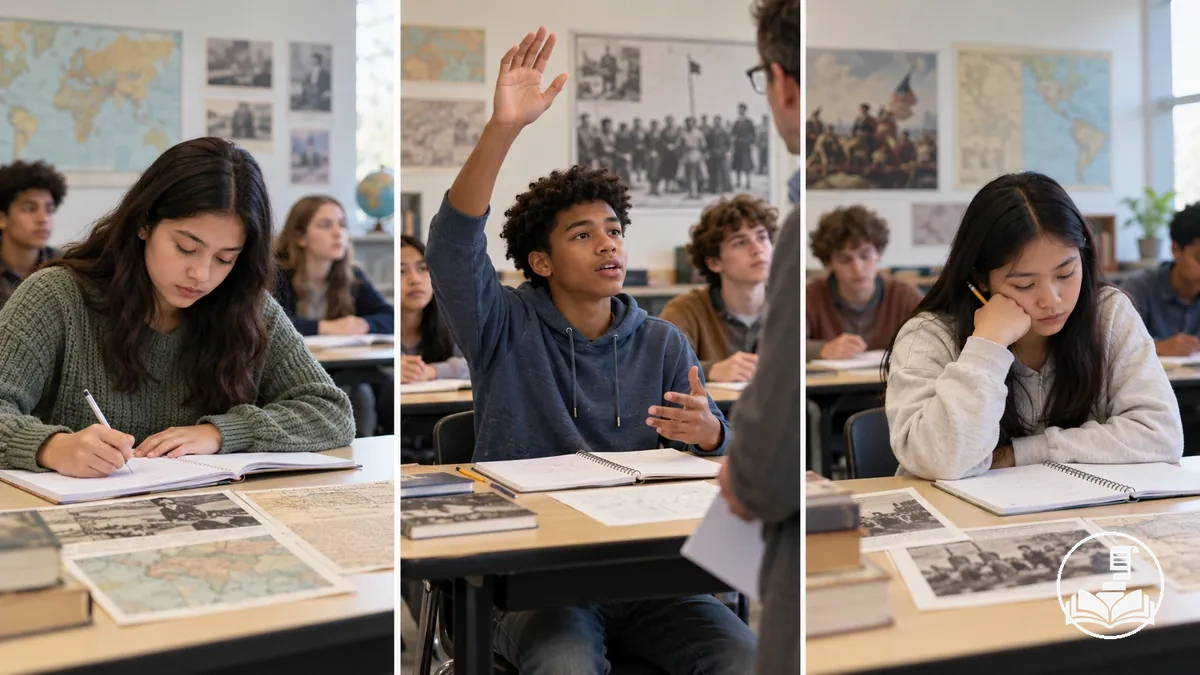
- Low participation with adequate understanding: a quiet student contributes rarely in discussion but produces an accurate written explanation supported by historical evidence. The work demonstrates understanding despite low public participation, so the instructional response should not assume that silence reflects weak comprehension.
- High participation with weak understanding: a student contributes frequently but gives incomplete explanations or historical reasoning that does not adequately support the response. Frequent contribution provides evidence of participation, while the response quality suggests that understanding still warrants checking.
- Low participation with weak understanding: a student contributes little and also struggles to explain, write, or justify the historical reasoning required by the task. Both patterns warrant an instructional check of understanding rather than an inference based on low participation alone.
- High participation with adequate understanding: a student contributes frequently and also produces accurate, evidence-supported explanations or interpretations. The pattern shows both visible participation and demonstrated understanding, so maintain the historical thinking demand while continuing to judge learning from response quality rather than contribution frequency alone.
Separate Lesson-Design Causes From Wider Causes of Disengagement
Lesson-design causes of disengagement are conditions a teacher can reasonably check and refine within the history lesson, while wider influences may require a response beyond lesson design.
The practical distinction is whether an observable signal changes with task demand, pacing, lesson flow, participation opportunities, or learner access, rather than whether classroom behaviour appears to reveal a personal cause.
Task demand may limit participation when students cannot access what the task requires, while pacing may reduce opportunities to process historical material before responding.
Lesson flow can contribute when transitions or activity sequences make the purpose of the work difficult to follow, and limited participation opportunities can leave few ways for students to contribute.
When these patterns recur at particular lesson moments, troubleshooting history lesson problems can focus the instructional adjustment on the observable pacing, flow, access, or task condition rather than on an assumed student characteristic.
Wider motivational or contextual influences may be associated with disengagement, but classroom observation alone does not establish trauma, mental-health conditions, home circumstances, or another personal explanation.
The image distinguishes observable lesson-design conditions from broader influences without implying that classroom behaviour diagnoses a wider cause.
The grouped criteria separate variables that can reasonably be adjusted within the lesson from broader influences that may require support beyond lesson design, with each observable effect serving as a signal for what to check next rather than a definitive diagnosis.

- Task demand: withdrawal or stalled work during a demanding historical task may indicate that learner access or task requirements need checking; clarify the task and check whether students can access the source, context, and required response before changing the wider lesson.
- Pacing and lesson flow: participation that drops after rapid explanation, compressed processing time, or unclear transitions may indicate a lesson-level condition; check whether students have enough opportunity to process the historical material and understand how one activity connects to the next.
- Participation opportunities: low contribution when only a narrow response format is available may reflect limited opportunity to participate; check whether the lesson provides appropriate ways for students to explain, discuss, write, or otherwise contribute.
- Learner access: disengagement concentrated around particular texts, sources, instructions, or response demands may indicate an accessibility barrier; check what students can understand and do with the material before interpreting the behaviour as a wider motivational issue.
- Wider influences: disengagement that persists across different lesson-design adjustments may be associated with conditions beyond the immediate lesson, but the classroom signal does not identify what those conditions are; keep the instructional response within observable evidence and recognise when the concern extends beyond lesson-level adjustment.
Identify Lesson Moments That Make Students Passive
Passivity can emerge at a particular lesson stage even when students participate well elsewhere in the same history lesson.
To locate the weak moment, examine what students are being asked to do at each stage and identify where the participation opportunity shifts toward passive listening or another form of limited response.
The sequence maps participation demands across common lesson moments rather than prescribing a fixed lesson structure.
The image shows how opportunities to retrieve, question, interpret, discuss, or respond can increase or decrease as the lesson moves between teacher explanation, source work, discussion, independent work, and closure.

- Entry or hook: an opening that asks students only to receive information creates little immediate participation demand; check whether students have an opportunity to retrieve prior knowledge, notice evidence, form a question, or make an initial response.
- Teacher explanation: explanation can support learning, but uninterrupted passive listening can reduce opportunities to retrieve, question, or interpret historical content; check what students are expected to do with the explanation rather than applying a fixed teacher-talk limit.
- Reading or source work: source work can encourage passivity when students mainly move through material without a clear interpretive demand; check whether the task requires them to identify, compare, question, or use historical evidence.
- Discussion: discussion can create a participation opportunity for some students while requiring little response from others; check who is contributing and whether students need to explain, justify, question, or respond to historical reasoning.
- Independent work: independent work creates a stronger participation demand when students must produce an explanation, interpretation, or evidence-based response, but it can become passive when the task requires mainly copying or mechanical completion; check the response students are actually producing.
- Closure: a closure dominated by teacher summary can leave students with little opportunity to demonstrate what they understood; check whether students are asked to retrieve, explain, connect, or apply the historical learning before the lesson ends.
For example, students may participate strongly during source discussion but become passive during an extended explanation that requires only listening.
The instructional response should target that weak lesson stage and its participation demand rather than treating the whole lesson as uniformly disengaging.
Make Historical Content Relevant Without Losing Historical Context
Historical relevance is a meaningful connection that helps students understand the significance of the past while preserving historical context.
It is not simply a way to make history entertaining or familiar.
A useful connection links a historical question, event, decision, or consequence to students' prior knowledge without erasing differences in circumstances, beliefs, values, or available choices.
Meaningful relevance can begin with a question that gives students a reason to investigate why an event mattered, then connect that question to human stakes such as choices, constraints, consequences, or competing interests.
Prior knowledge can provide an entry point, but historical evidence should determine how far the connection can be taken.
Multiple perspectives help prevent one present-day viewpoint from being projected onto everyone in the past, while consequence and continuity and change help students examine what persisted, what changed, and for whom.
A present-day connection is therefore most useful when it clarifies significance while making both genuine similarity and historically important difference explicit.
The criteria below distinguish context-preserving relevance from superficial analogy.
Each criterion asks whether a connection improves interpretation of the past rather than merely making the topic seem familiar.

- Historical grounding: connect the topic to the conditions, events, beliefs, and constraints relevant to the people being studied; a connection is weaker when present assumptions replace the context in which historical choices were made.
- Genuine similarity: use a present-day connection when the compared situations share a relevant feature, such as a type of decision, conflict, consequence, or human stake; do not treat a surface resemblance as evidence that the situations are equivalent.
- Explicit difference: identify where the past and present diverge in circumstances, values, institutions, technology, knowledge, or available choices; this boundary keeps relevance from becoming present-centred simplification.
- Evidentiary support: test the connection against historical sources and contextual knowledge rather than assuming that people in the past understood their situation as people today would.
- Multiple perspectives: check whether the connection accommodates different historical experiences and viewpoints instead of treating one group's perspective as representative of everyone involved.
- Interpretive usefulness: retain the connection when it helps clarify significance, consequence, or continuity and change; discard it when familiarity becomes the main point and the historical explanation becomes less precise.
A productive connection might ask students to compare a familiar type of social or political dilemma with a historical case while identifying the different institutions, beliefs, evidence, and constraints that shaped historical choices.
A misleading version would treat the shared dilemma as proof that people in the past thought or acted exactly as people do today, because similarity in one feature does not erase differences in historical context.
Relevance-building is one method principle within a lesson; decisions about inquiry, direct instruction, source analysis, discussion, and other history teaching methods remain a broader instructional question.
Connect the Lesson to a Meaningful Historical Question or Problem
A meaningful historical question gives students a reason to use evidence toward an interpretation rather than receive disconnected facts.
The question frames a historical problem that students can investigate while keeping the lesson focused on the historical content they need to understand.
Question quality depends on genuine historical tension, evidentiary answerability, curricular relevance, and manageable scope.
Historical tension gives students something to explain, compare, or interpret rather than merely recall, while relevant evidence makes a reasoned response possible.
The scope should be narrow enough for the available background knowledge and source material to support an interpretation within the lesson.
A suitable historical question can support participation by directing students toward a clear investigative purpose, but it does not by itself guarantee engagement.
The sequence below keeps the historical question, background knowledge, evidence, and reasoned response connected to the same content focus.
The image illustrates students working with historical source material around a bounded question, while the ordered sequence defines the implementation steps.

- Frame the historical problem: turn the content focus into a bounded question with something historically meaningful to interpret. For example, instead of asking students to recall the causes of a historical event, ask which of the causes they have studied best explains why the event occurred, keeping the same causal content while requiring a supported interpretation.
- Activate only necessary background knowledge: establish the people, events, conditions, and concepts students need to understand the historical problem and make sense of the evidence. Keep this context focused on what the question requires rather than expanding into unrelated background information.
- Examine relevant evidence: direct students to source material that can inform the historical question, asking them to identify evidence that supports, complicates, or challenges a possible interpretation.
- Produce and check a reasoned response: require students to answer the historical question with a claim or interpretation supported by the evidence they examined. Check whether the response addresses the original problem and whether the cited evidence actually supports the reasoning.
This local sequence does not require every lesson to become a full inquiry process; when the historical question becomes the organising basis for a broader investigation, inquiry-based history lessons address that wider design.
Use People, Stories, and Multiple Perspectives to Build Connection
Individuals, stories, and multiple perspectives can make an abstract historical event more concrete by showing its human stakes, but they remain useful only when they are grounded in historical evidence and connected to wider structures.
A personal narrative can illustrate how an event was experienced without reducing the event to one person's biography or treating emotional appeal as a substitute for historical explanation.
- Whose perspective?
- Identify whose viewpoint is represented, what surviving evidence supports it, and the historical context in which that evidence was produced.
- What shaped it?
- Use documented interests and constraints to explain differences between viewpoints. Do not invent unsupported private motives or feelings.
- What does comparison add?
- Use differences between perspectives to interpret the historical problem; do not imply that every viewpoint has equal evidentiary support.
- Where is the boundary?
- The surviving record sets the interpretive limit: infer what the evidence reasonably supports, but not what it does not reveal.
Use Present-Day Connections to Clarify Rather Than Replace the Past
A present-day connection can clarify historical significance, continuity, and change, but a similarity between past and present does not make the two contexts equivalent.
A useful comparison therefore states both what resembles the present-day reference and what differs because of the historical context.
Start with one genuine shared feature, such as a recurring type of political debate, social tension, migration experience, or institutional problem, and then identify the contextual differences that limit the analogy.
Differences in institutions, laws, technologies, social categories, available choices, beliefs, or power relations can change what the shared feature meant to people at the time.
Claims about continuity should therefore follow historical evidence rather than surface resemblance, while change should be made explicit when the modern reference depends on conditions that did not exist in the historical period.
The contrast below shows how the same connection can either support or distort interpretation.
- Careful connection: a past event and a present-day reference may resemble each other in one defined respect, such as conflict over migration or belonging, while differing in the laws, institutions, social categories, and circumstances shaping each case. The similarity can clarify the historical issue's significance, but the contextual differences limit what can legitimately be inferred across periods.
- Overextended analogy: a past event and a present-day reference may share the same surface feature, but treating that similarity as equivalence ignores differences that may alter causes, experiences, choices, and consequences. The analogy then replaces historical context with a modern frame and can weaken interpretation rather than clarify it.
The present-day reference should remain a brief point of comparison, not become the subject of the lesson.
Once the similarity and limiting difference are established, interpretation should return to the historical evidence and context to determine what the comparison can and cannot explain.
Build Active Participation Into the History Lesson
Active participation in a history lesson should require students to perform meaningful historical thinking rather than merely stay busy.
The participation task should specify what students must do with historical content or evidence, such as interpret, compare, question, justify, or explain, and then create an opportunity for a response that makes that thinking observable.
Activity level alone is not evidence of learning; the useful check is what students' responses reveal about their historical reasoning.
Participation conditions can be designed around think time, evidence handling, questioning, response options, collaboration, and accountability.
Think time should last long enough for students to formulate an initial response before contribution; if only the fastest responders can enter the discussion, increase preparation time or use a written first response. Evidence handling gives students historical material to examine rather than asking for unsupported reactions.
Questioning should elicit the intended historical thinking, and response options can include speaking, writing, annotating, or another appropriate way to contribute instead of requiring every student to speak publicly.
Collaboration can broaden participation when roles and accountability require students to contribute to the shared historical task rather than simply remain in a group.
Movement, games, or technology can also be used when they serve the historical thinking demand, but their presence does not by itself demonstrate engagement or learning.
Access should be adjusted when the participation structure prevents a learner from demonstrating the intended historical thinking.
Teachers can vary support, response options, grouping, or the way evidence is presented while keeping the historical reasoning demand explicit; when learners require different forms of support, differentiating history lessons addresses that broader design.
The adjustment should be evaluated through the responses it elicits: if students can access the task but their responses still show weak reasoning, the next change should address the question, evidence, or participation structure rather than increase activity for its own sake.
The sequence below organizes active participation around a defined thinking demand, a response opportunity, and evidence that the response can be inspected.
Each stage connects participation to historical learning rather than to visible activity alone.
- Define the historical thinking demand: specify what students must interpret, compare, question, justify, or explain about the historical content or evidence.
- Create the response opportunity: provide appropriate think time, evidence, and response options so students have a practical way to perform the required thinking.
- Elicit contribution: use questioning, individual responses, or collaboration with clear roles and accountability to make students' reasoning observable.
- Inspect response quality: check what the contribution shows about students' use of evidence and historical reasoning rather than judging participation by how active the room appears.
- Adjust access or structure: change support, response options, grouping, evidence presentation, or the participation structure when those conditions limit students' ability to demonstrate the intended thinking, then inspect the resulting response for evidence of historical learning.
Replace Extended Passive Listening With Historical Evidence Tasks
Extended passive listening becomes more participatory when students must inspect or use historical evidence to perform a defined reasoning task.
A source therefore earns a place in the activity when students must do something substantive with it, such as identify relevant evidence, compare accounts, make an inference, or support a claim, rather than simply receive or handle the document.
Historical evidence tasks can range from noticing and identification to more interpretive uses of evidence.
Noticing asks students to locate relevant details, while sourcing asks them to consider information about a source and its context when interpreting it.
Comparison and corroboration require students to examine relationships between sources, while sequencing asks them to organise evidence in a historically meaningful order.
Inference and claim-defence require students to use evidence to develop or justify an interpretation, keeping the reasoning task explicit rather than treating document handling as evidence of historical thinking.
The grouped tasks below organise evidence operation, reasoning action, and the student response each operation is intended to elicit.
- Notice or identify: students inspect historical evidence for details relevant to a defined question and identify what in the source warrants attention, producing a focused observation rather than merely reading or viewing the material.
- Source: students consider relevant information about who created a source, its context, purpose, or audience when those attributes affect interpretation, producing a response that connects source conditions to how the evidence should be read.
- Compare: students examine two or more pieces of evidence for a specified similarity or difference, producing a comparison tied to the historical question rather than separate summaries of each source.
- Corroborate: students examine where evidence from different sources agrees, differs, or adds information, producing a judgement about how the sources relate without assuming that agreement alone establishes historical truth.
- Sequence and infer: students place relevant evidence in an order when chronology matters and infer a relationship that the evidence can reasonably support, producing an interpretation that distinguishes the observed evidence from the inference drawn from it.
- Defend a claim: students select relevant historical evidence and explain how it supports a claim or interpretation, producing a reasoned response rather than an unsupported opinion.
A simple before-and-after conversion can preserve the same content goal: instead of explaining a historical issue entirely through teacher talk, pause after the necessary context and give students a relevant source with one defined reasoning operation, such as identifying evidence that could support a stated interpretation and explaining why it is relevant.
This focused task does not require a full source-analysis sequence; lessons that need sustained source selection, contextualisation, evaluation, and interpretation belong within fuller primary-source teaching.
Structure Discussion and Collaboration So More Students Contribute
Discussion and collaboration can broaden meaningful participation when students are prepared, given a clear historical prompt, and offered structured ways to contribute.
The aim is not simply to increase how much students talk, but to distribute opportunities for evidence-based reasoning so that contribution quality can be examined.
Individual preparation gives students time to form an initial response before discussion begins, while wait time can create more space for students to process the historical prompt before contributing.
Response options can include speaking, writing, annotating, or contributing through a defined group role, so public speaking is not the only valid participation mode.
Use a group size and role structure in which each student has a clear route to contribute. If the same students dominate, reduce the group, assign evidence-linked roles, or add an individual response before discussion; accountability should keep each student connected to the historical reasoning task rather than allowing collaboration to replace individual thinking.
Psychological safety can support participation when students can test ideas without ridicule, but the relevant evidence remains what students actually contribute and how well those responses use historical evidence.
The sequence below manages both who can contribute and what counts as a substantive contribution.
Each step keeps discussion tied to a historical prompt, evidence expectations, and a brief synthesis rather than treating talk volume as the goal.
- Prepare individually: give students individual preparation time to examine the historical material and form an initial response before collaboration begins. This keeps the discussion connected to prior thinking rather than requiring students to generate ideas only after others have spoken.
- Respond to a clear historical prompt: use a focused question that requires interpretation, comparison, explanation, or another defined historical reasoning action. The prompt should make the contribution task clear enough that students know what kind of response is expected.
- Structure turns and response options: distribute contribution opportunities through appropriate group size, role clarity, wait time, and more than one response option when needed. The structure should broaden access without requiring every student to contribute through public speaking.
- Require evidence and monitor reasoning: set explicit evidence expectations so students support claims or interpretations with relevant historical material. Monitor both who is contributing and whether responses address the prompt with evidence and reasoning rather than counting contributions alone.
- Synthesize the discussion: close by drawing together the strongest evidence, differences in interpretation, or unresolved questions that emerged. The synthesis should show what the discussion contributed to historical understanding without treating the number of speakers as evidence of discussion quality.
Evaluate Whether Engagement Is Improving Historical Learning
Lesson engagement is supporting historical learning when behavioural, cognitive, and history-specific indicators move in a useful direction together rather than when one visible sign changes on its own.
More time on task or more frequent participation can suggest involvement, but neither establishes that students are reasoning more effectively about history.
Evaluation should therefore consider what students do, how they think, and what their responses show about historical understanding.
Enjoyment, silence, completion, or participation frequency alone is not sufficient evidence of effectiveness.
The three indicator groups below should be interpreted together rather than as independent scores.
A behavioural indicator describes observable participation conditions such as time on task, participation breadth, or persistence; a cognitive indicator concerns the quality of questions, explanations, and reasoning; and history-specific indicators examine evidence use, explanation of cause or significance, and justification of an interpretation.
No single signal is decisive because similar behaviour can accompany different levels of understanding, and a productive pattern is stronger when observable participation is accompanied by increasingly substantive reasoning and historical evidence use.
These criteria are intended for evaluating engagement in relation to learning, not for creating a formal assessment system or a fixed engagement score.
- Behavioural indicators: consider whether time on task is sustained for the historical work, whether participation breadth extends beyond the same contributors, and whether students persist when historical material becomes challenging. These signals are consistent with productive involvement when they occur alongside evidence that students are thinking about the historical content.
- Cognitive indicators: consider whether question quality and explanations show students identifying problems, making distinctions, connecting ideas, or revising reasoning. A stronger cognitive signal is a response that reveals what students are thinking rather than participation frequency alone.
- History-specific learning indicators: consider whether students use historical evidence to support reasoning, explain cause or significance with relevant context, and justify an interpretation rather than merely state it. These responses provide more direct evidence that participation is connected to historical learning because the contribution performs a history-specific reasoning job.
When the evidence is mixed, interpret patterns across repeated lessons rather than treating one observation as proof of improvement or failure.
For example, broader participation with little change in evidence use or historical reasoning suggests that access to contribution may be improving while the quality of historical learning still requires refinement; stronger reasoning from only a narrow set of students suggests a different participation condition to examine.
Repeated observation can show whether behavioural, cognitive, and history-specific signals begin to align or continue to diverge.
The next evaluation question is therefore not simply how many students participated, but what the distribution and quality of their participation reveal about historical learning.
Observe the Quality of Participation, Not Just Its Frequency
Participation quality depends on what a student's contribution reveals about historical thinking, not simply how often the student contributes.
An observable behaviour is useful when the response itself provides evidence for an interpretation of what the student is doing with a historical question, evidence, a peer response, or a claim.
The table distinguishes observable behaviour from its likely interpretation and the next check needed before drawing a conclusion.
Frequent public talk may coexist with shallow reasoning, while limited public talk may coexist with a strong written response or small-group response, so contribution frequency should not be treated as a proxy for participation quality.
| Observable behaviour | Likely interpretation | What the teacher should check next |
|---|---|---|
| Volunteers answers frequently but gives brief assertions with little explanation or evidence. | Frequent participation demonstrates willingness to contribute publicly, but the responses may indicate shallow historical reasoning. | Check whether the student can explain the reasoning behind an answer and support it with relevant historical evidence. |
| Asks a historical question about cause, significance, perspective, or evidence. | The question may indicate active interpretation when it engages with a substantive historical problem rather than requesting only a recalled fact. | Check how the question connects to the historical material and whether the student can use evidence to investigate it further. |
| Builds on a peer response by referring to evidence or identifying a relevant difference in interpretation. | The contribution may indicate that the student is processing another interpretation and connecting it to historical evidence. | Check whether the added evidence or reasoning genuinely develops, qualifies, or challenges the peer response. |
| Revises a claim after examining new evidence or hearing another interpretation. | Claim revision may indicate responsive historical reasoning when the student can identify what evidence or reasoning warranted the change. | Check whether the revised claim is better supported and whether the student can explain why the interpretation changed. |
| Contributes little during public talk but produces a substantive written response or small-group response. | Limited public contribution does not by itself indicate weak participation quality; the written or small-group response may provide stronger evidence of historical interpretation. | Check the response itself for relevant evidence, explanation, and reasoning rather than inferring disengagement from public speaking frequency. |
No single observable behaviour should be converted into a fixed participation score; participation quality should be interpreted from the historical content and reasoning demonstrated in the contribution.
Check Whether Students Are Using Evidence and Historical Reasoning
Evidence use and historical reasoning provide stronger evidence that participation is disciplinary when students connect a claim to relevant historical evidence and explain the reasoning behind their interpretation.
Activity or a correct factual answer alone does not establish this connection because the response must show how evidence is being used to justify historical thinking.
The checks below verify observable features of evidence-based historical reasoning without turning them into a complete assessment rubric.
Each check considers what the student actually does with historical evidence, source context, justification, and revision so that an evidence mention is not automatically treated as reasoning.
- Relevant evidence: check whether the student selects historical evidence that actually bears on the claim or question. Relevant evidence provides support for the reasoning task; merely mentioning a source does not demonstrate that the source supports the interpretation.
- Claim-evidence distinction: check whether the student distinguishes what is being argued from the historical evidence used to support it. A claim states the interpretation being advanced, while evidence supplies material that can be used to justify that interpretation.
- Source context: check whether the student considers relevant information about a source, such as its creator, circumstances, purpose, or audience, when those features affect how the evidence should be interpreted. Source context matters when it changes what can reasonably be inferred from the material.
- Reasoning link: check whether the student explains how the selected evidence supports, qualifies, or challenges the claim. An explicit connection between claim, evidence, and reasoning demonstrates more than evidence mention because the response supplies a justification for the interpretation.
- Justified interpretation: check whether the student's interpretation remains within what the available evidence can support and acknowledges relevant limitations or competing evidence when these affect the conclusion. A justified interpretation is therefore bounded by the evidence rather than stated as an unsupported assertion.
- Revision when warranted: check whether the student can revise a claim or interpretation when new evidence, counterevidence, or a better-supported explanation warrants change. Revision provides evidence of responsive reasoning when the student can explain what changed and why.
For example, “This policy caused the conflict” is an unsupported claim when no evidence or justification follows, whereas “This source supports the interpretation that the policy contributed to the conflict because it documents a contemporary response to that policy” makes the claim, relevant evidence, and reasoning link explicit without treating the source as proof of the entire interpretation.
Refine Future Lessons From Engagement Evidence
Future history lessons should be refined through small, testable adjustments tied to observed engagement evidence.
Start from the current state, identify one variable or a small number of closely related variables, and change only what the observed signal gives a reason to change.
Isolating the adjustment makes the subsequent observation easier to interpret than changing task demand, pacing, participation structure, and other conditions simultaneously.
Select the variable that most directly corresponds to the weak lesson moment: task demand when students cannot access what the task requires, pacing when processing time appears insufficient, participation structure when contribution opportunities are narrow, or scaffolding when students need more support to perform the intended historical reasoning.
A relevance cue, the amount of uninterrupted teacher talk, or evidence-task clarity can also be adjusted when the observation specifically points to that condition.
Record the current state before the adjustment, then observe the same relevant engagement and learning signals after the change so that the comparison remains focused.
The observation may suggest improvement, no meaningful change, or a new difficulty, but an ordinary classroom comparison should not be treated as experimental proof that the adjustment caused the outcome.
Interpret the adjustment across repeated lessons rather than treating one successful lesson as proof of a universal strategy.
Retain a change when engagement evidence repeatedly supports the intended participation or learning signal, modify it when the response is mixed, and reverse or replace it when the relevant condition does not improve or another problem becomes more evident.
The cycle below isolates the variable being changed so that observation can inform the next refinement before retained changes are incorporated into future history lesson plans.
- Establish the current state: identify the specific lesson moment and observable engagement or learning signal that needs refinement rather than labelling the whole lesson ineffective.
- Choose one variable: select the lesson condition most plausibly connected to that signal, such as pacing, task demand, participation structure, scaffolding, relevance cue, uninterrupted teacher talk, or evidence-task clarity.
- Make a targeted adjustment: change that variable while keeping unrelated lesson conditions as stable as reasonably practical. For example, if students stop contributing during a source task because the evidence instruction is unclear, clarify the evidence operation without simultaneously replacing the source, grouping structure, and lesson sequence.
- Observe relevant engagement and learning evidence: compare the subsequent response with the prior state, focusing on the signal the adjustment was intended to affect. In the example, observe whether students can now identify and use the requested evidence rather than merely whether the classroom appears more active.
- Interpret and retain or revise: retain the adjustment when repeated observation supports the intended change, modify it when evidence is mixed, or reverse it when it does not address the identified condition. Retained changes should be supported by engagement and learning evidence rather than novelty.