
Common History Lesson Planning Mistakes
Common preventable history lesson planning mistakes occur when the learning objective, activities, scope, sequence, timing, or assessment do not support the same intended student learning outcome, or when the plan is unrealistic for the lesson conditions. Avoid them by using the learning objective as the reference point: activities should practise the intended knowledge or historical skill, assessment should elicit evidence of it, and scope, sequence, and timing should fit the available lesson time and learner readiness.
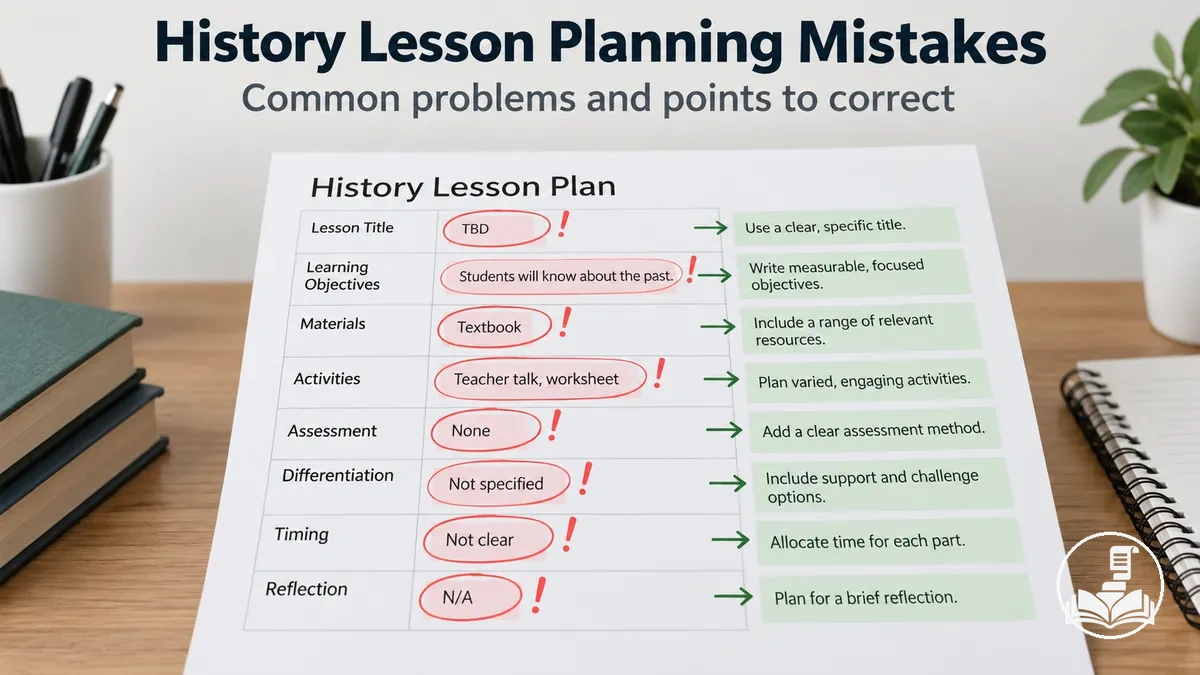
History lesson plan alignment check
Tick a criterion when the plan already meets it. An unchecked item is a revision cue; the boxes are a local self-check and are not saved or scored.
Revision rule: revise any unchecked component before teaching by narrowing the objective or content, changing the student task, reordering tasks, adjusting workload or time, or aligning the assessment. This check identifies preventable planning risks; it does not guarantee how a lesson will unfold.
A difficult lesson is not automatically evidence of a planning error. Student readiness, implementation, and unexpected classroom events can affect what happens even when the plan is reasonable.
Misalignment can make students spend time on work that does not practise or reveal the intended historical learning, while excessive content load or task complexity can make scope, sequence, or timing unrealistic. For example, a lesson may aim for students to evaluate evidence from primary sources but devote most activities to factual recall, leaving the assessment disconnected from the stated objective.
Table of Contents
Mistakes in Setting the Learning Objective
A weak learning objective makes later planning decisions less reliable because it does not give the history lesson plan a sufficiently clear reference point for choosing content, activity, timing, and assessment.
The objective should specify intended student learning clearly enough for activities and assessment to align with the same learning outcome.
Whether its scope is realistic depends on lesson duration, prior knowledge, task complexity, and learner needs rather than on a universal wording formula.
The three recurring failure dimensions are scope, observability, and learner-centred focus.
They matter because each weak state removes information needed to decide what students should do and what evidence can demonstrate the intended learning.
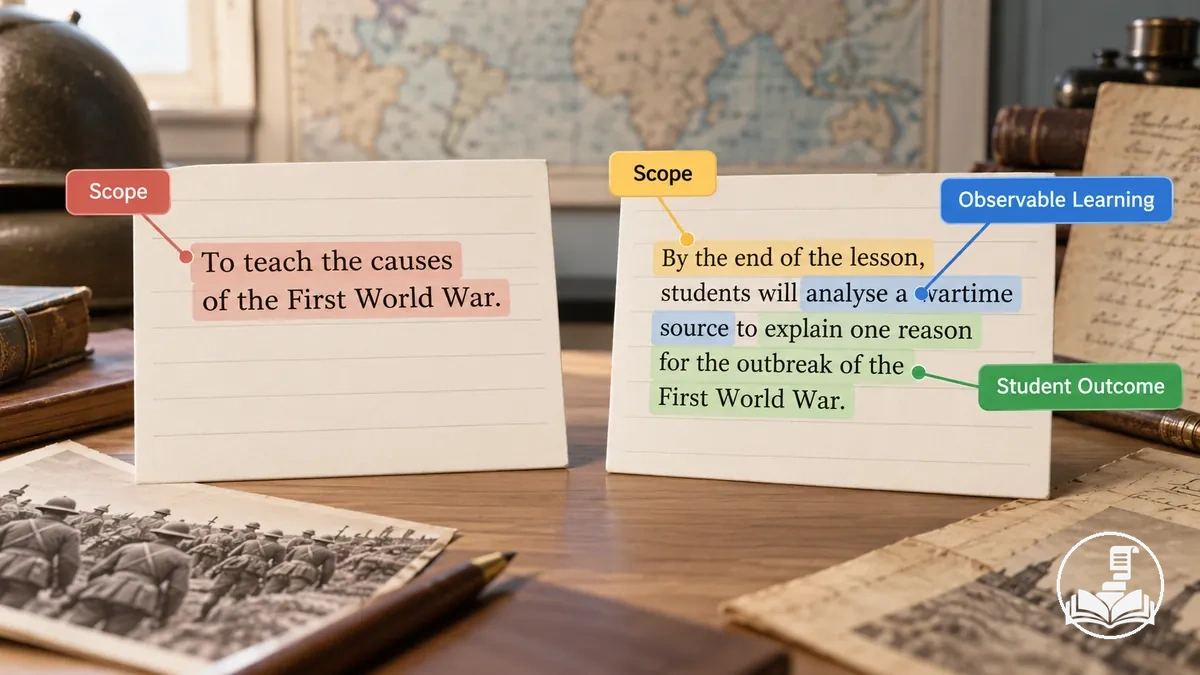
- Scope: The learning objective is too broad when the intended content or performance demands exceed what can reasonably be addressed under the lesson's time, prior knowledge, task complexity, and learner conditions; the resulting activity and assessment choices may cover only part of the intended learning.
- Observability: The learning objective is too vague when it does not identify observable learning or evidence that can show what students are expected to demonstrate; this leaves assessment alignment unclear.
- Learner-centred focus: The objective is teacher-centred when it describes what the teacher will present or do rather than the student learning to be demonstrated; this makes the intended learner outcome a weak basis for selecting activities and assessment.
For example, a weak history objective might state, “Teach students about the causes of the First World War,” which describes teacher activity without specifying the student learning to be demonstrated.
An improved version could state, “Students will explain how selected political and military factors contributed to the outbreak of the First World War using evidence from the lesson,” making the learner outcome and observable performance clearer while leaving the precise scope to the lesson context.
Teachers who need the complete method for writing clear learning objectives can treat that process separately; here, the practical test is whether the objective is sufficiently scoped, observable, and learner-centred to guide activity and assessment choices.
Objectives That Are Too Broad for One History Lesson
Objective scope is too broad when the historical knowledge, number of concepts, or depth of thinking it requires exceeds what the available lesson conditions can reasonably support.
The mismatch may involve too much historical content for the lesson duration, several substantial learning outcomes competing for attention, or cognitive demands that leave insufficient opportunity to produce evidence of learning.
What counts as excessive therefore depends on lesson duration, prior knowledge, task complexity, and student needs rather than on a fixed numerical limit.
The image illustrates how reducing competing content and thinking demands can turn an over-broad history objective into a narrower outcome for which students can produce assessable evidence.
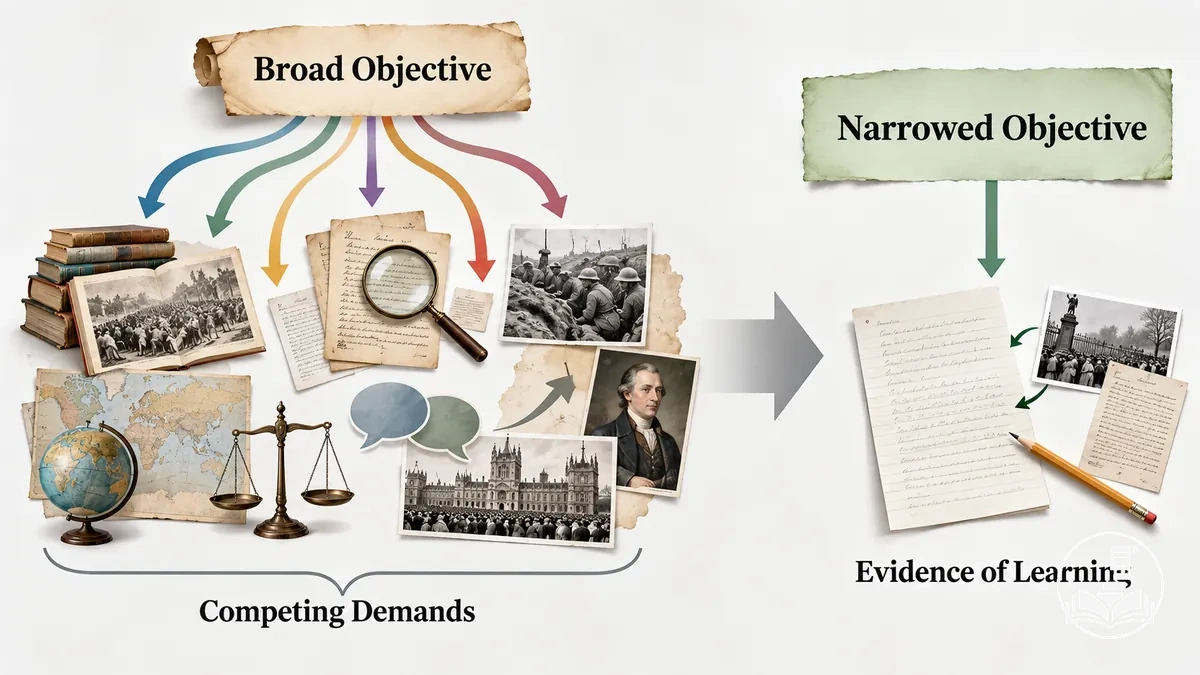
- Multiple major outcomes: Objective scope may be unrealistic when one lesson requires students to acquire substantial new knowledge while also completing several distinct analytical outcomes, because those demands compete for the same lesson capacity.
- Excessive content coverage: An objective that requires broad historical content coverage can leave insufficient opportunity for the intended depth of thinking when the content volume is large relative to the available lesson duration.
- Too many distinct cognitive demands: Requiring students to explain causes, compare interpretations, evaluate evidence, and construct an argument within the same objective may exceed realistic lesson capacity when prior knowledge is limited or task complexity is high, making complete evidence of learning difficult to obtain.
Lesson duration, prior knowledge, task complexity, and the evidence required to demonstrate the learning outcome determine how much breadth is feasible: greater prior knowledge can reduce the amount of unfamiliar historical content students must process, while greater analytical depth or a more complex task places more demands on the available lesson capacity.
For example, rather than asking students in one lesson to explain the causes, course, consequences, and competing interpretations of the First World War, the objective could be narrowed to explaining how selected political and military factors contributed to its outbreak using evidence considered in the lesson.
The narrower objective reduces competing demands and identifies one assessable result without imposing a universal limit on how much a history lesson should cover.
Objectives That Are Too Vague to Guide Observable Learning
Objective wording is too vague when it does not specify what student learning must be observable or what evidence of learning could demonstrate the intended outcome.
A vague statement may name a worthwhile intention yet leave the required student performance unclear, so it provides an uncertain basis for choosing a task or judging whether the intended historical skill has been demonstrated.
The problem is therefore lack of specificity about performance and evidence, not simply that the objective covers a broad topic.
The image compares the same history topic expressed as vague and more observable objective wording, showing what each version allows a teacher to observe as student performance and evidence.
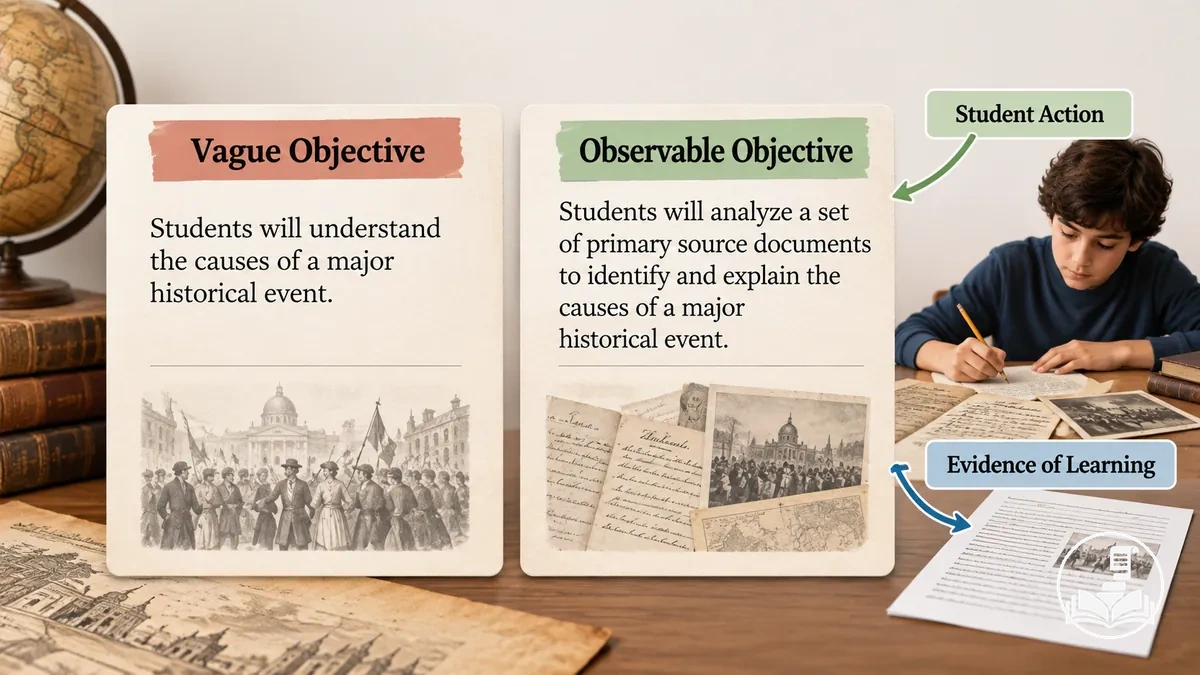
For example, “Students will understand differing perspectives on the causes of the First World War” leaves the intended performance uncertain because the wording does not indicate how students will demonstrate that understanding.
A clearer version is, “Students will compare two perspectives on the causes of the First World War and explain one significant difference using evidence from each account”; this wording specifies an observable historical skill and indicates the evidence of learning that the task should produce.
The change is not valuable merely because “compare” and “explain” are more observable verbs: specificity comes from connecting the historical content, expected student performance, and task conditions closely enough to make the intended evidence clear.
Writing Objectives Around Teaching Activity Instead of Student Learning
A student learning objective states what students are expected to know, explain, analyse, or produce, whereas teacher action describes what the teacher will do as part of instruction.
Teacher actions remain necessary for planning, but they serve a different function from the learner outcome and should not substitute for it.
The image distinguishes who performs the action described by each type of objective, using a history-specific example to make the difference visible.
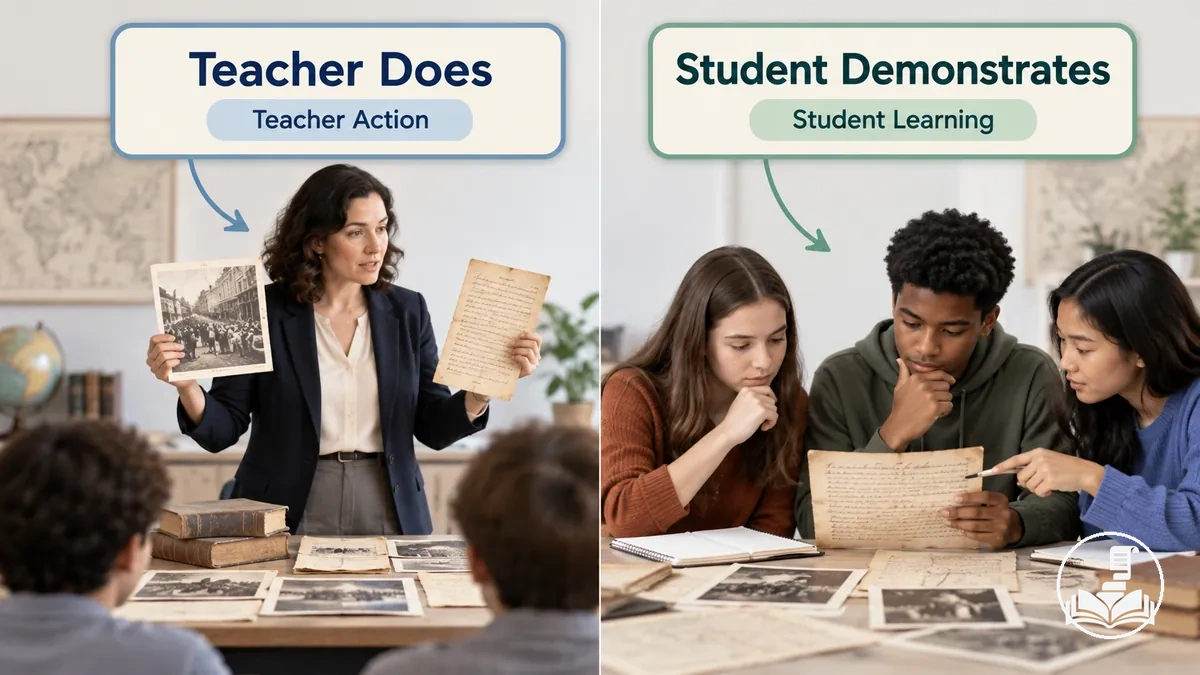
| Objective wording type | What it describes | Planning implication |
|---|---|---|
| Teacher-action wording | States a teacher action or instructional activity, such as presenting primary sources. | Describes the planned instruction but does not by itself state the student performance that practice and assessment should address. |
| Student-learning wording | States the learner outcome students should demonstrate, such as evaluating or interpreting primary sources. | Provides a basis for selecting practice and assessment that elicit evidence of the intended student learning. |
Learner-outcome wording guides alignment by identifying the student performance that practice and assessment should address, while teacher-action wording identifies how instruction may support that outcome.
For example, “Present primary sources about an historical event” describes teacher activity, whereas “Students will evaluate primary sources to identify differences in perspective” states what students should demonstrate and therefore provides a basis for selecting practice and assessment without implying that presenting the sources is unimportant.
Mistakes That Disconnect Activities From the Objective
An activity is misaligned when the student task does not practise or reveal the knowledge or historical skill named in the learning objective.
Topic relevance alone does not establish alignment because two activities about the same historical content can require different cognitive demands and produce different evidence.
The image traces whether an activity practises the objective's intended skill and reveals relevant evidence by contrasting a mismatched activity with an aligned alternative.
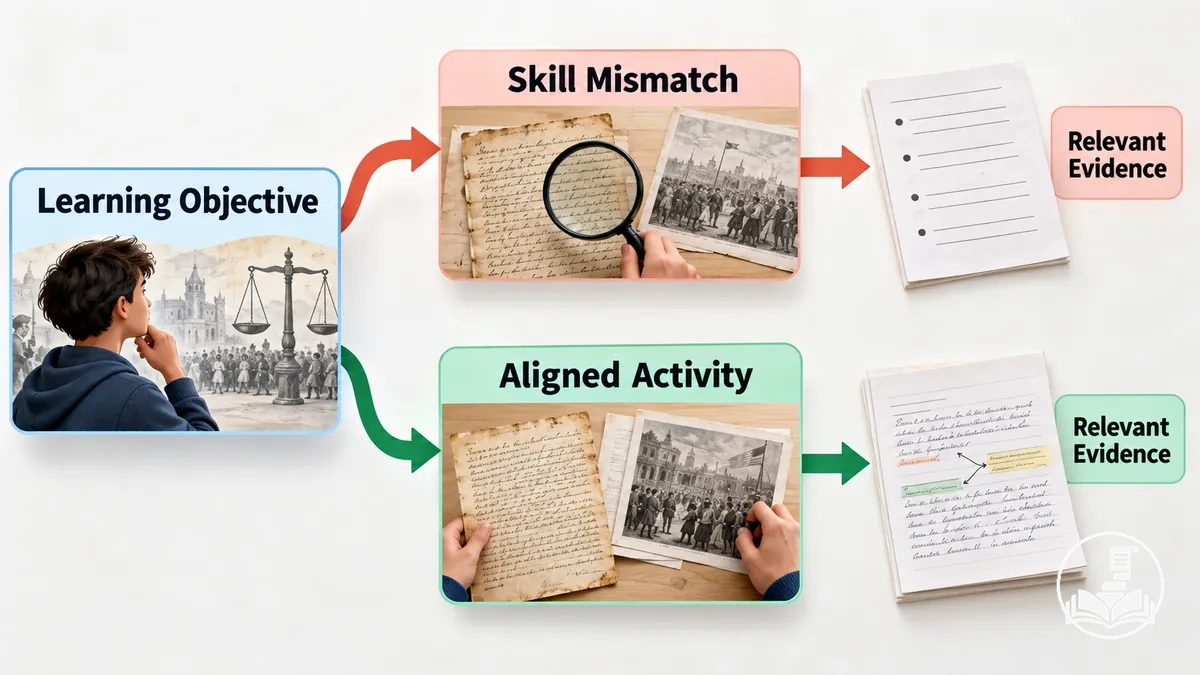
Activity-objective alignment can be checked by following the learning objective from its intended knowledge or historical skill to the cognitive demand of the activity and then to the evidence produced by the student task.
A mismatch at any of these points means the activity does not fully demonstrate the intended outcome, even when the activity addresses the same historical topic.
- Intended knowledge or skill: Does the activity practise the knowledge or historical skill named in the learning objective? If not, the student task is directed at a different learning demand.
- Cognitive demand: Does what students actually do match the cognitive demand of the objective? If the objective requires evaluation but the activity requires only recall, completing the task does not demonstrate the intended evaluative performance.
- Relevant evidence: Does the activity produce evidence that reveals the intended learning? If the resulting work does not show the knowledge or skill specified by the objective, it provides an insufficient basis for judging alignment with that outcome.
For example, if a learning objective asks students to evaluate how two primary sources present an historical event, an activity that asks students only to identify dates and names from those sources is misaligned with the stated evaluative demand, although the topic is the same.
An aligned activity could instead ask students to compare the sources and support an evaluation with evidence from each one.
Before retaining or replacing an activity, check its purpose against the objective, the student task it requires, and the evidence it can produce.
Choosing Activities Before Clarifying Their Learning Purpose
Activity-first planning can lead a teacher to choose an appealing, familiar, or convenient student task and then retrofit the learning objective around that choice instead of first clarifying the learning purpose.
An activity is not a planning mistake merely because it is engaging or familiar; the mistake is choosing it before its instructional purpose is clear.
The image shows how the suitability of a history activity changes when activity choice is evaluated against a stated learning purpose.

Purpose-first evaluation treats activity suitability as conditional: a debate, source analysis, role-play, or worksheet may be appropriate when the student task serves the intended learning, and may be misaligned when it does not.
For example, a debate about an historical decision can be retained when the learning objective requires students to construct and support competing historical arguments, but it may be replaced when the objective instead requires close evaluation of specific primary-source evidence that the debate does not require students to examine.
Alignment asks whether the activity serves the learning purpose, while engagement is a separate planning question; strategies for improving lesson engagement address that adjacent concern.
Using Activities That Practise a Different Skill From the Objective
Topic relevance does not establish skill alignment: an activity can address the same historical content as the learning objective while requiring a different historical skill from the one students are meant to demonstrate.
Same topic, different learning demand
The objective demand identifies the intended student performance; the activity demand determines what students actually practise and what evidence their work can produce.
Misaligned example
- Objective
- Evaluate the reliability of a historical source using evidence.
- Activity
- Recall dates from the same source.
- Evidence produced
- Factual recall, which does not demonstrate the evidence-based reliability judgement required by the objective.
Aligned correction
- Objective
- Evaluate the reliability of a historical source using evidence.
- Activity
- Evaluate the source and support the reliability judgement with relevant evidence.
- Planning implication
- Change the student task to elicit the intended skill and evidence, or change the objective when recall is actually the intended outcome.
Skill choice is conditional: recall, source evaluation, comparison, causal explanation, and argumentation can each be appropriate when the practised skill matches the intended outcome; none is inherently suitable simply because it is more or less demanding.
Mistakes in Lesson Scope, Sequence, and Timing
Lesson scope, sequence, and timing interact because excessive content load can compress lesson time, weak task order can interrupt learning progression, and unrealistic timing may leave insufficient time for complex student thinking.
Scope concerns how much content and depth the lesson attempts, sequence concerns how tasks and prerequisite learning are ordered, and timing concerns the lesson time required for task complexity, instructions, transitions, and student thinking.
A problem in one dimension can therefore place pressure on the others even when individual activities appear reasonable.
The three dimensions can be diagnosed through distinct warning signs while recognising that their consequences depend on lesson length, learner readiness, task complexity, and transitions.
The table organises each planning dimension by its warning sign, likely consequence, and corrective direction.
| Planning dimension | Warning sign | Likely consequence | Corrective direction |
|---|---|---|---|
| Scope | The content load requires more coverage or depth than the available lesson time can support. | Important material may be rushed, or students may have insufficient time to process the intended historical learning. | Reduce or prioritise content so the intended depth and student work can fit the available lesson conditions. |
| Sequence | The task order requires knowledge or reasoning that earlier tasks have not yet established. | The instructional sequence can interrupt learning progression because students encounter a demand before its prerequisite knowledge or preparation. | Reorder tasks so prerequisite knowledge or preparation precedes the activity that requires it, without assuming chronological order is the only valid sequence. |
| Timing | The plan underestimates the time required for task complexity, instructions, transitions, or student thinking. | Later tasks may be compressed or left incomplete when earlier demands consume more lesson time than planned. | Adjust the planned workload, task order, or time allocation according to the demands of the activities and the available lesson time. |
These dimensions should be interpreted together rather than as isolated faults: reducing content load, for example, may create sufficient lesson time for source analysis and the student thinking it requires, while changing task order may reduce delays caused by missing prerequisite preparation.
Diagnosing which dimension is creating the constraint keeps the correction focused; the fuller process of planning and structuring history lessons belongs to the broader lesson-construction stage.
Trying to Cover Too Much Historical Content
Historical content overload occurs when coverage demands compete with the lesson time students need to interpret, discuss, connect, or apply what they encounter.
A larger content volume or source count can increase student processing demands when the material introduces additional events, concepts, perspectives, or evidence that must be understood in relation to the learning objective.
How much historical content is excessive depends on lesson duration, prior knowledge, task complexity, and the intended depth of learning rather than on a fixed number of events or sources.
- Too many events or sources: The content load is a warning sign when students must move through more events or sources than they can meaningfully examine under the available lesson conditions, which may result in rushed or superficial coverage.
- Insufficient processing time: Historical content competes with meaningful processing when coverage leaves too little lesson time for students to interpret evidence, discuss relationships, connect ideas, or apply what they have learned.
- High cognitive load: Multiple unfamiliar events, concepts, sources, or perspectives can increase cognitive load, particularly when prior knowledge is limited or the student task requires several relationships to be processed at once.
- Depth demands beyond the lesson conditions: A lesson may become overloaded when the expected depth of learning requires analysis or application that the planned content volume and available lesson time do not leave sufficient opportunity to complete.
For example, a lesson designed to evaluate evidence about the causes of an historical event may initially include several events and numerous sources, yet the planned source count may leave insufficient time for the required analysis or an unfinished assessment.
The teacher can reduce the material to the events and evidence most necessary for the objective while retaining the contextual information students need to interpret those sources accurately.
Prioritisation therefore keeps historical accuracy and the learning objective as constraints while reducing content that does not need to be processed in the same lesson.
Sequencing Tasks Without a Clear Learning Progression
Task sequence breaks down when a later activity requires prerequisite knowledge or thinking that students have not yet developed through the preceding work.
Individually relevant activities do not create a learning progression unless the task order allows one student action to produce an output that supports readiness for the next demand.
For an objective that requires students to build an evidence-based historical interpretation, an illustrative instructional sequence can therefore move from orientation to evidence work, interpretation, and synthesis.
- Orientation: Students establish the contextual knowledge needed to examine the selected historical evidence; the output is a shared factual and contextual basis that prepares them for evidence work.
- Evidence work: Students examine relevant sources and identify information, perspectives, or features required by the objective; the resulting evidence record supports readiness for interpretation.
- Interpretation: Students use the examined evidence to explain relationships, differences, or significance relevant to the objective; this output prepares them to combine supported interpretations rather than merely collect information.
- Synthesis: Students bring the preceding evidence and interpretations together in the form required by the objective, such as an evidence-based explanation or argument.
The same activities can form a weak sequence when synthesis is required before students have examined the evidence needed to support it, whereas reordering evidence work and interpretation before synthesis makes each prerequisite and output explicit.
This order is appropriate only when those dependencies serve the learning objective; a different objective may require a different task order.
Instructional sequence should therefore follow the learning progression required by the objective rather than assume that historical chronology alone determines pedagogical order.
Allocating Time Without Considering Task Complexity
Task count alone is a poor basis for estimating lesson timing because activities that occupy one line in a lesson plan can place very different demands on classroom time.
Task complexity depends on what students must read, analyse, discuss, organise, and produce, as well as the instructions and transitions needed to complete the activity.
Learner readiness also changes likely task duration, so realistic time allocation depends on these conditions rather than a fixed universal minute allocation.
This subsection concerns time allocated within the lesson, not the time a teacher spends preparing it.
- Source length and reading demand: A longer or denser source requires more time when students must locate, interpret, and connect relevant information before completing the student task.
- Unfamiliar vocabulary: Unfamiliar historical or source-specific vocabulary can add time through clarification and interpretation, particularly when learner readiness does not include the knowledge needed to understand the terms independently.
- Discussion depth: A task requires more time when students must explain reasoning, compare interpretations, respond to evidence, or develop a supported conclusion rather than provide a brief response.
- Group organisation: Forming groups, assigning roles, distributing materials, and coordinating participation can add classroom time before and during the substantive task.
- Instructions and transitions: Multi-stage instructions or transitions between materials, groupings, and activities add time that may be underestimated when lesson timing accounts only for the visible student task.
- Required evidence: Task duration may increase when students must select, analyse, and use several pieces of evidence in a written or spoken response rather than produce a short factual answer.
These variables shape realistic task duration together: greater source length, unfamiliar vocabulary, discussion depth, organisational requirements, or evidence demands may require more lesson time, especially when learner readiness is lower, while simpler demands may require less.
For example, a source-analysis activity may require more time than a short recall activity when students must read an unfamiliar source, interpret its language, evaluate evidence, and construct a supported response, even though each activity appears as a single item in the lesson plan; under-allocating time in that condition may compress the analysis or leave the required evidence unfinished.
Mistakes in Planning Assessment
Assessment planning fails when the assessment evidence collected cannot demonstrate the intended learning stated in the learning objective.
Topic relevance alone does not establish assessment alignment because an assessment may address the same historical content while eliciting different knowledge or a different level of thinking.
The assessment demand therefore needs to produce evidence of learning that can be interpreted against the objective.
Planning that evidence before finalising lesson activities reduces the risk of reaching the end of the lesson with student work that cannot answer the intended learning question.
Assessment alignment can be checked by tracing the relationship from intended learning to the evidence needed, then to the assessment demand and the interpretation that the resulting student response supports.
The practice activity also needs to give students an appropriate opportunity to work with the knowledge or historical skill that the assessment later asks them to demonstrate.
- Intended learning: Identify the knowledge or historical skill in the learning objective; this defines what the assessment evidence needs to demonstrate.
- Practice opportunity: Check whether the practice activity gives students an opportunity to work with the intended knowledge or skill before the assessment; a different practice demand can weaken alignment between instruction and assessment.
- Evidence collected: Check whether the student response actually provides evidence of the intended learning; work on the same historical topic may not demonstrate the required skill.
- Level of thinking: Check whether the assessment demand matches the cognitive demand of the objective; recall evidence may not demonstrate an objective that requires comparison, evaluation, explanation, or argumentation.
A formative check can provide evidence during learning that helps interpret current student understanding and inform what happens next, while end-of-lesson evidence can show what students demonstrate after the planned learning sequence; neither purpose requires one universally superior assessment format.
For example, if the objective requires students to evaluate differing historical interpretations using evidence, an end-of-lesson task that asks only for dates and names from the same topic is relevant in subject matter but does not demonstrate the stated evaluative skill.
The corrective direction is to decide what evidence would answer the learning objective, ensure practice prepares students for that demand, and then finalise activities around that alignment.
Assessing Something Different From the Stated Objective
Sharing the same history topic does not mean an assessment prompt measures the same outcome as the stated objective.
Assessment-objective match depends on whether the prompt elicits the evidence and cognitive demand required by the intended outcome, whether that is factual recall, causal explanation, source evaluation, comparison, or argument.
A recall question is therefore not inherently poor; it is misaligned when the stated objective requires students to produce a different kind of evidence.
Topic match and outcome match must be checked separately, as the following example shows.
- Objective: Students will evaluate two primary sources and use evidence to explain which source provides the stronger support for an historical interpretation.
- Assessment prompt: Ask students to recall dates, people, or events mentioned in the two sources; this elicits factual recall and does not provide evidence of the required source evaluation.
- Aligned alternative: Ask students to compare the two sources, evaluate their evidence in relation to the historical interpretation, and support their judgement with evidence from the sources; this assessment demand matches the source evaluation required by the objective.
The recognition cue is to compare the evidence demanded by the stated objective with the evidence demanded by the assessment prompt: when the required student response differs in knowledge, skill, or cognitive demand, the assessment may not demonstrate the intended outcome even when both refer to the same historical topic.
Leaving Assessment Until After Activities Are Chosen
Late assessment planning can make the activities already chosen determine what student evidence is collected, rather than starting with evidence that would demonstrate the learning objective.
This creates a retrofitting risk: an available task may generate student performance without generating the acceptable evidence needed for the intended outcome.
Deciding what evidence would demonstrate the objective before finalising activity choice can reduce that risk and clarify what practice students need.
The sequence below represents this local planning logic rather than a branded or comprehensive planning framework.
- Define the intended outcome: The learning objective defines the knowledge or historical skill students are expected to demonstrate.
- Identify acceptable evidence: Specify the student evidence that would demonstrate that intended outcome; this clarifies what the assessment needs to elicit.
- Choose or adapt activities: Make the activity choice according to the practice students need to prepare them to produce that evidence.
For example, if a history learning objective requires students to compare two interpretations using supporting evidence, identifying an evidence-based comparison as acceptable evidence can change an initially chosen recall activity into a task that gives students practice comparing claims and selecting support before they produce the intended student evidence.
The planning order is therefore objective → acceptable evidence → activity choice, with each stage informing the next; acceptable evidence can come from an appropriate student response or formative check and does not need to be a formal graded assessment in every lesson.
How to Check for Preventable Planning Mistakes Before Teaching
A pre-teaching lesson-plan check should verify that the learning objective, activity alignment, scope, sequence, timing, and assessment support the same intended learning and remain realistic for the available conditions.
A preventable planning mistake requires attention when a key lesson component fails an alignment or feasibility check after accounting for lesson length, learner readiness, task complexity, or the evidence of learning required.
Pre-teaching verification
- Learning objective: Check that the learning objective states a sufficiently clear and realistic student outcome; revise it if its scope, expected performance, or evidence cannot be identified under the planned lesson conditions.
- Activity alignment: Verify that each major activity gives students practice in the knowledge or historical skill named in the learning objective; revise or replace an activity if its student task practises a different demand.
- Scope: Check that the planned content volume and intended depth are feasible within the available lesson length and learner readiness; reduce or prioritise content if coverage would leave insufficient opportunity for the intended learning.
- Sequence: Confirm that the task order provides prerequisite knowledge or preparation before students encounter a task that requires it; reorder tasks if an earlier output does not support readiness for the next demand.
- Timing: Check that lesson timing accounts for task complexity, instructions, transitions, student thinking, and the work students must produce; revise the workload or time allocation if these demands make the planned sequence unrealistic.
- Learner readiness: Verify that students have, or the lesson provides, the prior knowledge and preparation required by the planned tasks; add necessary preparation or adjust the task demand if the plan assumes readiness that has not been established.
- Assessment: Confirm that the assessment prompt elicits evidence of learning that matches the knowledge, historical skill, and cognitive demand in the learning objective; revise the assessment if it collects evidence of a different outcome.
- Evidence and practice: Check that students have an appropriate opportunity to practise producing the type of evidence expected by the assessment; adapt the activity choice if practice and intended evidence require different student performances.
These checks can identify preventable mistakes that are visible in the plan before teaching, but they cannot establish how every learner or classroom event will affect implementation.
Problems that become visible only while the lesson is being taught belong to fixing history lesson plan problems rather than the pre-teaching verification stage.