
Choosing History Teaching Methods for a Lesson Plan
Choose a history teaching method by starting with the lesson goal, then adjust for students’ prior knowledge, content complexity, evidence demands, desired participation, available lesson time, and the level of teacher guidance required. No single method is universally best; approaches can be combined when different lesson phases serve different instructional functions.
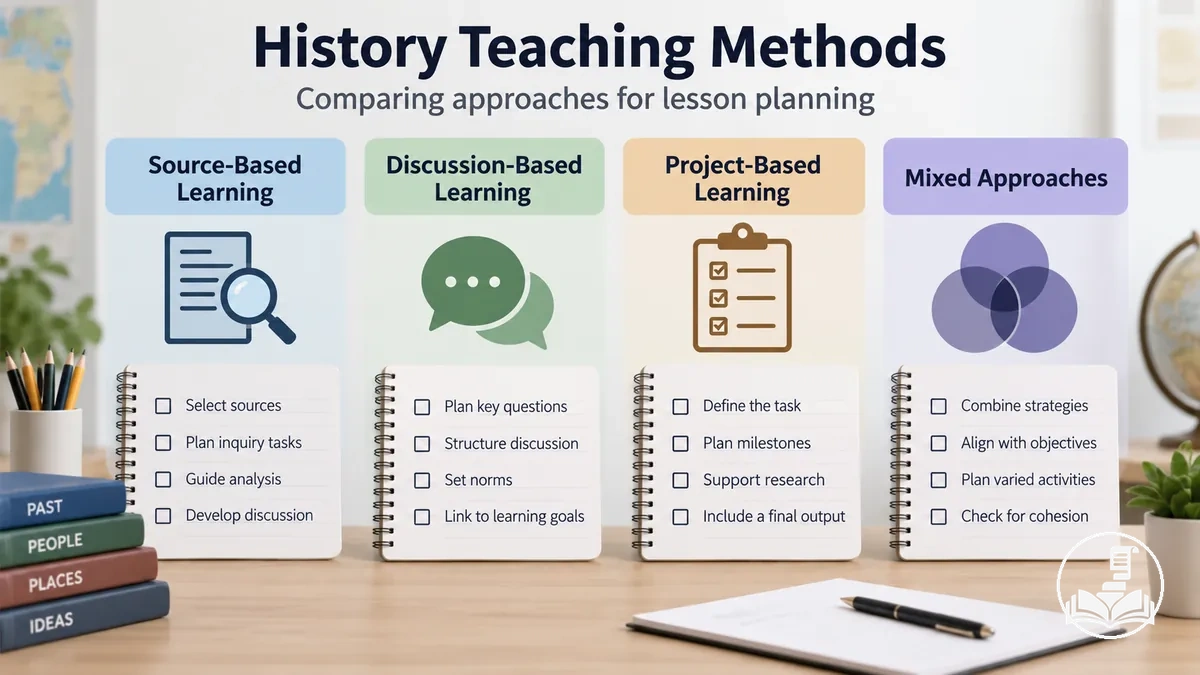
Lesson-method decision map
Use the primary learning function as the first filter. Each option is a starting point rather than a universal prescription; lesson conditions determine how much explanation, inquiry, discussion, activity, or scaffolding is appropriate.
- Build essential background knowledge
- Start with explicit explanation and modelling. Add guided questioning to check understanding and prepare students for later reasoning or evidence work.
- Investigate historical evidence
- Start with guided inquiry. Increase modelling and scaffolding when source complexity is high or prior knowledge is limited; increase independence when students can manage the evidence task.
- Compare or develop interpretations
- Use structured discussion and evidence-based reasoning. Preparation, focused questions, and teacher facilitation matter more than discussion volume alone.
- Apply or consolidate learning
- Use purposeful active learning, explanation, or discussion according to the function. The activity should test, connect, retrieve, or synthesise historical understanding rather than create participation for its own sake.
- Serve several lesson functions
- Combine methods by phase while keeping one central objective. For example, explicit framing can prepare an evidence investigation, which can then feed a structured discussion and a concise consolidation task.
Adjust the starting point with these conditions
- Prior knowledge: lower familiarity generally increases the need for explicit framing and scaffolding.
- Evidence and content complexity: greater complexity increases the value of modelling, source context, and guided questioning.
- Lesson time: tighter time limits constrain the depth of investigation, discussion, and independent work.
- Participation and guidance: high participation can coexist with strong teacher guidance; they are separate selection criteria.
Choose content organisation separately: chronological organisation foregrounds sequence and temporal context, while thematic organisation foregrounds patterns and cross-period comparison. Either can be paired with different instructional methods.
Method suitability changes as the learning objective and classroom conditions change. A new or broad topic may need more explicit framing, while a familiar, evidence-focused task may support greater student independence.
The sections below compare the criteria, instructional approaches, trade-offs, and lesson contexts that help turn that conditional choice into a workable lesson plan.
Table of Contents
Criteria for Comparing History Teaching Methods
Comparison criteria for history teaching methods are useful when they connect lesson conditions to method suitability.
Consistent criteria make the comparison decision-relevant without assuming that each factor carries the same weight in every lesson.
The criteria below separate learning demands, lesson constraints, and participation or guidance conditions.
As these conditions change, the suitability of a teaching approach can change with them.

- Learning objective and historical thinking demand: methods should support the intended outcome, whether students need to build knowledge, interpret evidence, explain relationships, or construct historical reasoning.
- Evidence use: when the learning objective requires students to examine historical sources, suitability increases for approaches that give evidence a substantive role rather than treating it only as illustration.
- Content scope: broad or unfamiliar historical content may require greater selection, explanation, and sequencing before students can work independently with complex questions.
- Lesson time: approaches requiring extended investigation, discussion, or synthesis need sufficient lesson time for those functions; tighter time constraints may require a narrower instructional task.
- Prior knowledge: limited prior knowledge can increase the need for context and scaffolding, while stronger foundations can support more independent interpretation and application.
- Student participation: when the learning objective requires students to discuss, investigate, or justify interpretations, suitability shifts toward approaches that provide meaningful opportunities for active contribution.
- Teacher guidance: greater guidance matters when students need modelling or structured support, while greater independence becomes more feasible when they can manage the historical task with less scaffolding.
The criteria therefore carry different weight according to the lesson goal and classroom conditions.
A lesson introducing unfamiliar content may place more weight on prior knowledge and teacher guidance, while a later evidence-based task may give greater weight to evidence use, historical thinking demand, and student participation.
Learning Objectives and Historical Thinking Demands
The learning objective changes the reasoning and instructional support that a history teaching method must provide.
Background knowledge may call for clearer explanation and modelling, while historical thinking objectives can require questioning, evidence analysis, and student reasoning.
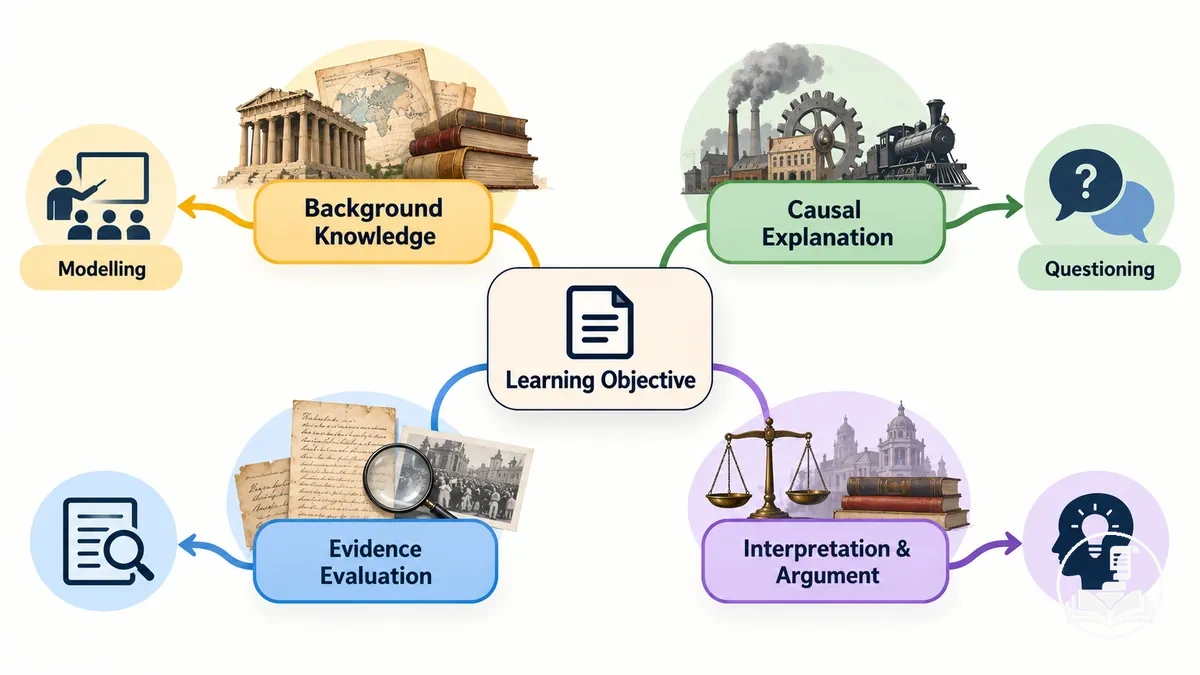
- Factual orientation
- Students first need background knowledge that establishes people, events, chronology, and context before further reasoning.
- Cause, consequence, and comparison
- Students need to identify relationships and justify relevant distinctions, not simply recall separate facts.
- Evidence evaluation and interpretation
- The lesson needs source examination and attention to how evidence supports an interpretation.
- Historical argument
- Students need to connect claims, relevant evidence, and reasoning rather than rely on recall alone.
Method suitability therefore changes with the required balance of modelling, questioning, evidence work, and independent student reasoning.
Detailed instruction in historical thinking skills belongs to the dedicated topic; here, those demands serve only as criteria for selecting an appropriate teaching method.
Content Scope, Lesson Time, and Student Prior Knowledge
Content scope, lesson time, and prior knowledge constrain which method characteristics a lesson can realistically support.
Their interaction changes feasible levels of explicit framing, investigation, scaffolding, and student independence.
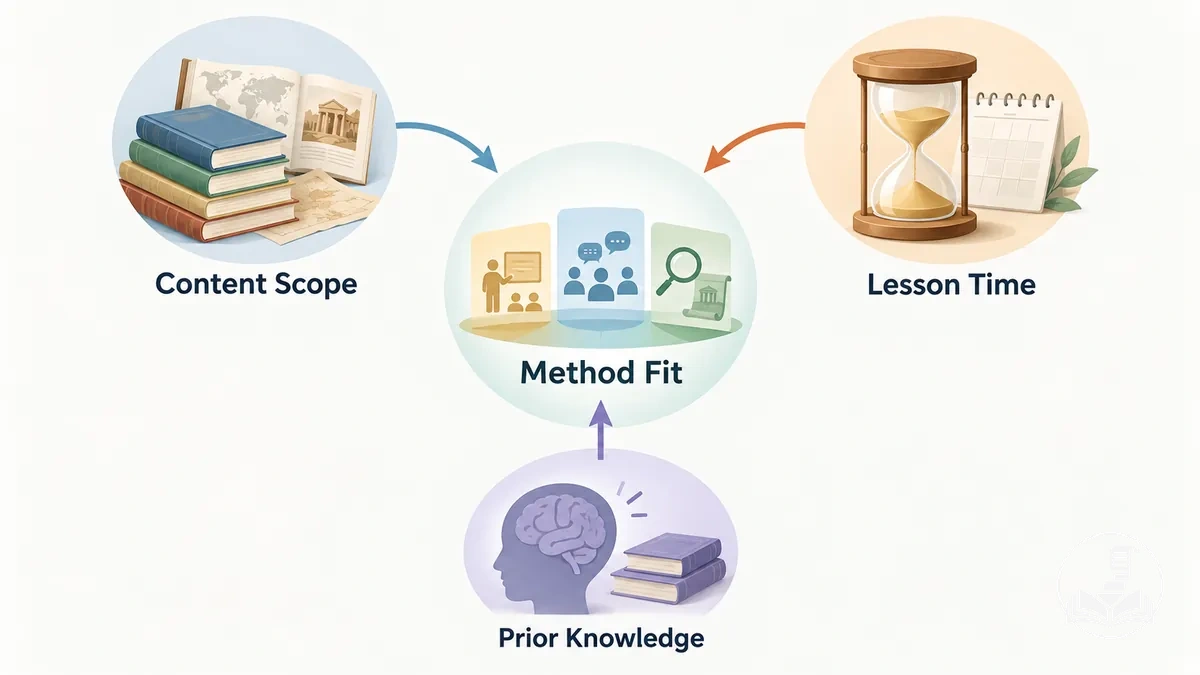
Each condition changes method suitability through a different constraint, so its instructional implication should be considered separately before judging their interaction.
- Content scope: broader or more complex coverage can increase the need for explicit framing and selective explanation before independent investigation.
- Lesson time: limited available time constrains the depth of investigation or discussion that can be developed within the lesson.
- Prior knowledge: greater topic familiarity may support more independent investigation, while unfamiliar content can increase the need for scaffolding and contextual explanation.
For example, a new and broad topic may require more explicit framing before students investigate evidence independently.
With a familiar topic and sufficient lesson time, the same class may support greater independence, although complexity and the lesson goal still condition method choice.
Student Participation and Level of Teacher Guidance
High student participation does not necessarily mean low teacher guidance; the two dimensions can coexist and vary independently.
Method suitability depends on the participation and guidance a lesson condition requires, rather than treating either dimension as a quality measure.
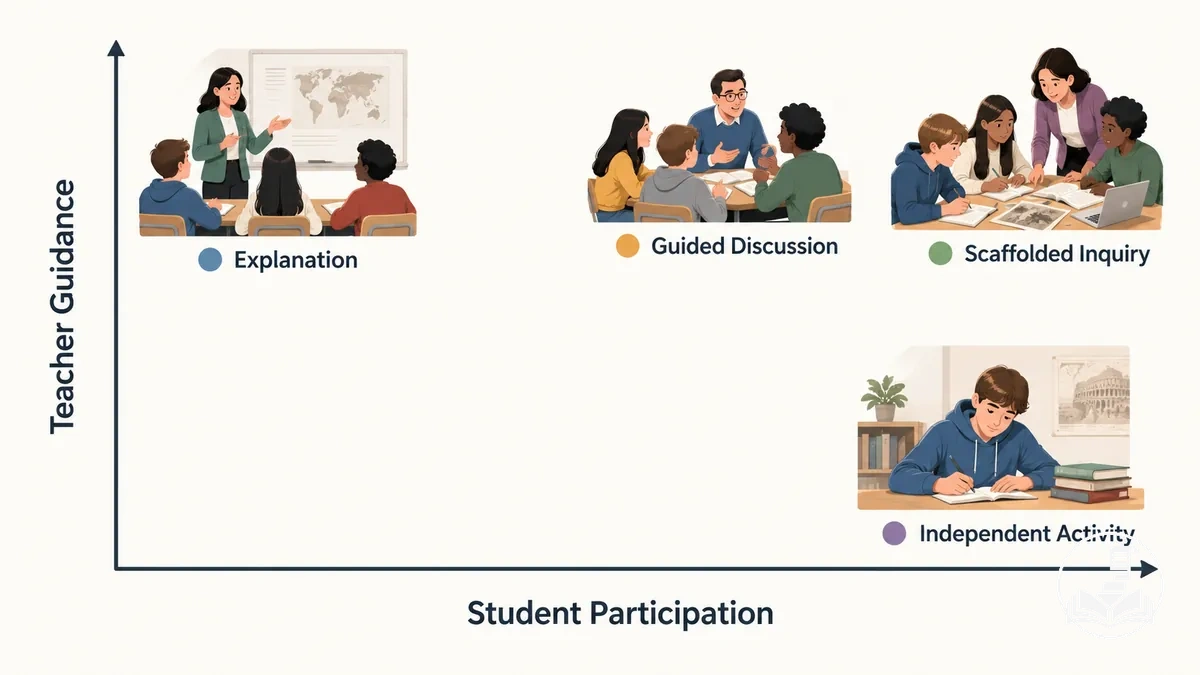
Forms of student participation differ from forms of teacher guidance, although both can operate within the same learning activity.
Discussion and collaborative activity increase student involvement, while independent inquiry gives students greater responsibility for investigating historical questions.
Teacher explanation and modelling provide explicit instructional guidance, while questioning and facilitation can structure student reasoning without replacing participation.
Scaffolding can therefore remain substantial even when students discuss, investigate, or collaborate actively.
- Discussion: students contribute interpretations, questions, or evidence within a shared exchange.
- Independent inquiry: students take greater responsibility for investigating a historical question within the task conditions.
- Collaborative activity: students work with others to examine information, develop reasoning, or complete a shared historical task.
- Explanation and modelling: teacher guidance makes relevant knowledge, reasoning, or task processes explicit.
- Questioning: teacher support can direct attention and prompt reasoning while students remain active contributors.
- Facilitation: guidance can structure discussion or collaborative activity without determining every student contribution.
- Scaffolding: temporary structure can support demanding inquiry while preserving meaningful student participation.
For example, students evaluating historical evidence collaboratively may participate extensively while the teacher supplies source context, modelling, and scaffolded questioning.
High participation can therefore coexist with strong teacher guidance, confirming that participation level and guidance level are independent method-selection criteria.
How Common History Teaching Approaches Differ
History teaching approaches differ in teacher role, student role, learning activity, evidence use, and the lesson conditions they can support.
Direct instruction, inquiry-based teaching, discussion-based teaching, and active learning describe instructional interaction, while chronological organisation and thematic organisation structure historical content.
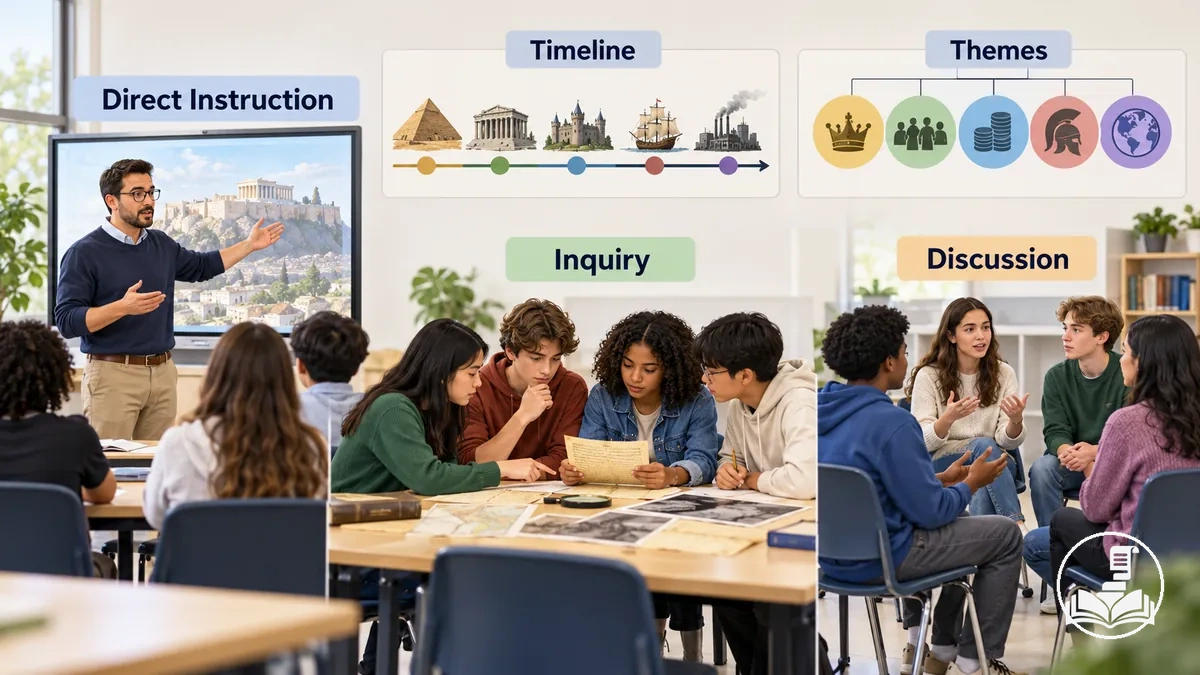
Using the same dimensions makes their functional differences comparable without ranking one approach above another.
The comparison distinguishes how each approach positions teachers and students, organises learning activity, uses evidence, and fits particular lesson conditions.
| Approach | Teacher role | Student role | Dominant learning activity | Evidence use | Suitable lesson conditions |
|---|---|---|---|---|---|
| Direct instruction | Explains and models content or reasoning explicitly | Follows explanation and applies modelled knowledge or processes | Teacher explanation, modelling, and guided practice | Evidence may illustrate content or support modelled analysis | When explicit framing, background knowledge, or modelling is required |
| Inquiry-based teaching | Frames questions, guides investigation, and provides scaffolding | Investigates questions and develops reasoning from evidence | Investigation, evidence analysis, and interpretation | Evidence functions as material for investigation and reasoning | When students can investigate a focused question with appropriate guidance |
| Discussion-based teaching | Questions, facilitates, and structures exchanges | Contributes, examines, and responds to interpretations | Structured discussion and collective reasoning | Evidence can support or challenge contributions and interpretations | When the lesson requires students to articulate and examine historical reasoning |
| Active learning | Designs tasks, guides participation, and provides support | Participates directly in purposeful learning tasks | Application, collaboration, analysis, or problem-focused activity | Evidence use depends on the task and learning objective | When the objective requires students to apply, examine, or work with historical content |
| Chronological organisation | Sequences historical content through time | Connects events and developments across temporal sequence | Following change, continuity, sequence, and context over time | Evidence can be positioned within its chronological context | When temporal sequence is important for understanding developments and relationships |
| Thematic organisation | Groups historical content around a recurring theme or issue | Examines connections across periods, cases, or contexts | Comparing and tracing a theme across historical contexts | Evidence can be grouped and compared around the selected theme | When the lesson requires connections across periods or historical cases |
Chronological organisation and thematic organisation differ categorically from the four instructional methods: they organise content rather than prescribe classroom interaction.
Either content organisation can be combined with different instructional methods according to the lesson's intended learning activity and evidence use.
Direct Instruction and Inquiry-Based Teaching
Direct instruction and inquiry-based teaching differ mainly in how they distribute explanation, guidance, questioning, investigation, and student reasoning.
Direct instruction emphasizes explicit teaching and modelling, while inquiry-based teaching emphasizes guided investigation supported by teacher guidance.
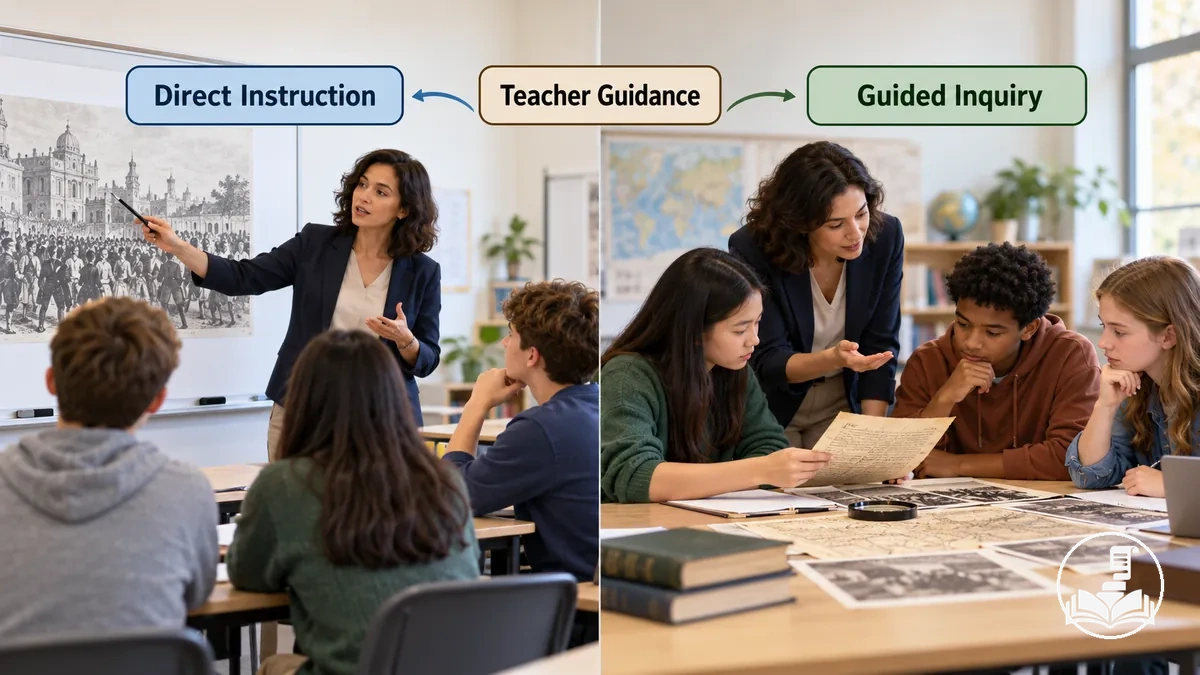
- Explanation and modelling: direct instruction makes relevant knowledge, concepts, or reasoning processes explicit through teacher explanation and modelling.
- Student investigation: investigation may follow explicit teaching after students have sufficient prior knowledge to work with the task.
- Evidence use: historical evidence can support modelled analysis before students apply similar reasoning with greater independence.
- Guidance: scaffolding can remain substantial when conceptual complexity or unfamiliar content requires structured support.
- Explanation and questioning: inquiry-based teaching uses questions and targeted explanation to frame a guided investigation rather than withholding guidance.
- Student investigation: students investigate historical questions and develop interpretations through evidence use and student reasoning.
- Evidence use: evidence becomes material students examine, compare, and use when constructing responses to an inquiry question.
- Guidance: scaffolding can support investigation when prior knowledge, conceptual complexity, or the learning objective makes greater independence unrealistic.
Prior knowledge and conceptual complexity influence how much explanation and scaffolding students may need before or during investigation.
Direct instruction can establish knowledge or model reasoning explicitly, while inquiry-based teaching can provide guided opportunities to question, investigate evidence, and construct interpretations.
Their relative fit therefore depends on the learning objective, evidence demands, and the degree of independence the task can support.
Inquiry-based teaching is not equivalent to unguided discovery, and explicit teaching can support later inquiry within the same lesson.
Detailed planning and implementation of inquiry-based history teaching belongs to the dedicated topic rather than this comparison.
Discussion-Based and Active Learning Approaches
Discussion-based teaching
A participatory approach centred on questioning, structured exchange, and peer reasoning about historical issues and interpretations.
Active learning
A broader category that can include discussion, collaborative analysis, and other purposeful tasks in which students actively work with historical knowledge or evidence.
Quality boundary: discussion volume or activity level alone does not demonstrate learning quality; value depends on evidence-based reasoning, preparation, task structure, and purposeful teacher facilitation.
Productive participation depends on how the task connects student preparation, historical interpretation, evidence-based claims, and teacher facilitation.
Questioning can focus attention on a historical issue, while peer reasoning allows students to examine competing interpretations and respond to evidence.
Collaborative activity can support shared analysis when the task has sufficient structure for students to contribute relevant reasoning.
For example, a structured discussion about competing interpretations of a historical event can require students to support each claim with evidence and respond to alternative interpretations.
The learning value then rests on evidence-based reasoning, student preparation, and purposeful teacher facilitation rather than participation alone.
Chronological and Thematic Organisation of Historical Content
Chronological organisation structures historical content through time sequence, foregrounding sequence and temporal context.
Thematic organisation groups material around a historical theme, foregrounding patterns and cross-period comparison rather than continuous chronology.
The two approaches can make different relationships within the same material more salient according to the lesson goal.
Chronological organisation can support examination of causation and continuity and change by keeping developments within temporal context.
Thematic organisation can support cross-period comparison by grouping related cases, although sufficient chronological framing remains important for context retention.
Their main organizing strengths and constraints therefore concern what each approach foregrounds and what it can obscure.
- Sequence and temporal context: chronological organisation keeps events and developments in temporal order, supporting context retention across the lesson.
- Causation: chronological organisation can clarify preceding conditions and subsequent developments when causal relationships depend on sequence.
- Cross-period patterns: a continuous chronology may make relationships between widely separated periods less immediately visible.
- Thematic grouping: thematic organisation connects historical material through a shared theme rather than continuous time sequence.
- Cross-period comparison: thematic organisation can foreground recurring patterns, contrasts, and continuity and change across different periods.
- Temporal context: separating cases from surrounding chronology may weaken context retention unless each case receives sufficient temporal framing.
For example, a lesson on migration could organize selected movements by time sequence to examine changing causes and consequences.
The same material grouped by a historical theme such as work or displacement could instead foreground cross-period comparison while retaining each case's temporal context.
Advantages, Limitations, and Trade-Offs of History Teaching Methods
An advantage or limitation of a history teaching method is meaningful only relative to the lesson goal and its constraints.
Trade-offs among history teaching methods therefore reflect method fit rather than a universal hierarchy of effectiveness.
Consistent comparison requires attention to content coverage, depth of reasoning, student participation, teacher guidance, evidence use, preparation demand, lesson time, and historical interpretation.
The same feature can be an advantage under one condition and a limitation when the lesson requires a different balance.
| Method or approach | Potential advantage | Corresponding limitation | Condition that changes the trade-off |
|---|---|---|---|
| Direct instruction | Can offer efficient content coverage and explicit teacher guidance. | May limit student participation or independent historical interpretation when explanation occupies most of the learning activity. | Becomes advantageous when lesson time is constrained or students need explicit framing before more independent reasoning. |
| Inquiry-based teaching | Can support evidence use, autonomy, and greater depth of reasoning through investigation. | Creates a trade-off when preparation demand, conceptual complexity, or limited lesson time restricts a sufficiently scaffolded investigation. | Its advantage increases when students have adequate prior knowledge, appropriate evidence, and teacher guidance for the inquiry task. |
| Discussion-based teaching | Can support student participation, peer reasoning, and evidence-based historical interpretation. | May limit reasoning depth when preparation is insufficient or discussion lacks structure and evidential focus. | Becomes advantageous when students are prepared to examine a focused issue and justify interpretations with evidence. |
| Active learning | Can offer opportunities to apply historical knowledge through purposeful participation and collaborative activity. | Activity may consume lesson time without supporting the intended reasoning or evidence use when the task is weakly aligned. | The trade-off changes when the learning activity directly supports the lesson objective and receives appropriate teacher guidance. |
| Chronological organisation | Can support content coverage through coherent sequence and preserve temporal context for historical interpretation. | May make cross-period comparison less prominent when the lesson remains closely tied to continuous chronology. | Becomes advantageous when sequence, causation, continuity, or change across time is central to the lesson goal. |
| Thematic organisation | Can support cross-period comparison and interpretation around a recurring historical theme. | May weaken temporal context when cases are separated from their surrounding chronology without sufficient framing. | Becomes advantageous when comparison across periods is central and the lesson preserves enough chronological context for each case. |
Faster content coverage creates a trade-off when the lesson also requires extended evidence analysis or independent reasoning.
Greater autonomy can deepen investigation when students have sufficient preparation and scaffolding, but it may create unnecessary difficulty when those conditions are absent.
Similarly, deeper discussion can support historical interpretation when claims remain evidence-based, while unstructured participation does not provide the same instructional function.
Student participation or visible engagement should therefore not be treated as proof of broader method effectiveness.
Strategies for improving student engagement in history belong to the dedicated topic; here, engagement remains one condition within a wider trade-off involving lesson goals, evidence, guidance, preparation, and time.
Matching a Teaching Method to the Lesson Goal and Context
Teaching method selection starts with the lesson goal, then filters method choice through the conditions that shape the instructional need.
Prior knowledge, content complexity, evidence demand, student participation, lesson time, and teacher guidance determine which method characteristics are suitable.
Limited prior knowledge or greater content complexity can increase the need for scaffolding, explanation, and modelling.
Stronger evidence demand can increase the need for investigation, while participation goals may require structured discussion or collaborative activity.
Lesson time constrains how extensively these activities can develop, and teacher guidance should reflect the support students need.
These conditions can support a method combination when different lesson functions require different forms of instruction.
A compact decision sequence keeps teaching method selection tied to the lesson context rather than prescribing one approach for every situation.
For the same historical topic, an introductory lesson may require more explicit framing, while a later evidence-focused lesson may support guided investigation.
- Define the learning goal: identify what students should know, explain, interpret, investigate, or reason about so the instructional need is explicit.
- Check prior knowledge and content complexity: determine whether students need greater explanation, modelling, contextual framing, or scaffolding before working more independently.
- Identify evidence and participation demands: establish whether the goal requires evidence analysis, investigation, discussion, collaborative activity, or another form of student participation.
- Account for lesson time and teacher guidance: consider how much investigation or discussion the available time can support and how much guidance the task requires.
- Select or combine method characteristics: choose a suitable method characteristic for the identified instructional need, using a method combination when different lesson functions require different approaches.
The sequence supports method selection rather than the complete process of structuring objectives, activities, transitions, and assessment across a lesson.
Detailed guidance on planning a history lesson belongs to the dedicated topic, while method choice remains conditional on the lesson goal and context.
Introducing New Historical Knowledge
New historical knowledge often requires enough explicit framing and scaffolding to make essential historical background, chronology, concepts, and vocabulary accessible.
The amount of support should reflect content novelty and students' prior knowledge while preparing them for later reasoning and participation.
Establish orientation
When novelty or conceptual load is high, use enough explicit explanation, modelling, or narrative framing to establish the essential chronology, concepts, vocabulary, and historical context. Available lesson time limits how much background can be developed before interpretive work begins.
Scaffold unfamiliar material
When prior knowledge is limited, connect unfamiliar concepts and vocabulary to the context students need for later reasoning. Guided questioning can check how students are making those connections while they are still receiving support.
Transition toward interpretation
A short explicit introduction can establish key chronology and concepts before students examine contrasting sources. Guided questioning can then shift the lesson toward interpretation while teacher scaffolding remains available where needed.
Investigating Evidence and Historical Interpretations
Evidence investigation requires method choices that make evaluation of historical evidence and the reasoning behind claims visible.
The required guidance varies with source complexity, prior knowledge, and the level of student independence the evidence task can support.
The main criteria connect evidence-task demands and learner readiness to appropriate modelling, scaffolding, questioning, corroboration, and discussion.
These conditions help determine how much teacher guidance supports historical interpretation without assuming that inquiry requires minimal instruction.
- Source complexity: unfamiliar context, language, perspective, or evidential relationships may require more scaffolding before students can interpret sources independently.
- Prior knowledge: limited background knowledge may require contextual support so students can connect historical evidence to the question being investigated.
- Modelling and questioning: modelling can make evidence-based reasoning visible, while questioning can direct attention to source features and competing interpretations.
- Corroboration: when claims require comparison across sources, the method should support students in examining agreements, differences, and evidential relationships.
- Discussion: structured discussion can support comparison of historical interpretations when students justify claims through relevant evidence and reasoning.
- Student independence: greater independence becomes suitable when students are prepared to evaluate evidence and construct supported interpretations with less scaffolding.
For the same evidence task, novices may require more modelling and guided questioning, while prepared students may undertake more independent interpretation and corroboration.
Detailed implementation of teaching history with primary sources belongs to the dedicated topic; here, the focus remains on matching guidance to evidence-task complexity and learner readiness.
Discussing, Applying, and Consolidating Learning
Consolidating historical understanding requires matching each activity to its learning function rather than to participation alone.
Structured discussion can help articulate reasoning, application can test understanding in a new task, and consolidation can reinforce connections between evidence and a historical claim.
Different participatory activities support these functions in distinct ways.
Their suitability depends on whether the teacher needs to surface competing interpretations, strengthen retrieval, apply learning, or guide students toward a coherent synthesis.
- Structured discussion: helps articulate reasoning and surfaces competing interpretations when students connect contributions to relevant evidence and historical claims.
- Peer explanation: allows students to express understanding in their own reasoning and explain connections between evidence, interpretation, and a historical claim.
- Retrieval and application: retrieval supports recall of relevant knowledge, while an application task requires students to use that knowledge in another historical question or context.
- Guided synthesis: supports consolidation by bringing evidence, interpretations, and prior reasoning together around the historical claim the lesson has developed.
An exploratory discussion may invite students to compare competing interpretations before reaching a developed position.
A consolidating discussion instead revisits an already developed interpretation so students can connect its historical claim to relevant evidence and reasoning; lively participation alone does not demonstrate consolidation.
Combining Methods Within One Lesson
Combining teaching methods is useful when each method serves a distinct instructional function while preserving one central lesson objective.
A method combination should therefore reflect different learning needs, not variety for its own sake.
One illustrative method sequence can assign explicit framing to essential background knowledge, guided inquiry to evidence analysis, discussion to interpretation, and consolidation to synthesis.
The example shows functional complementarity rather than a fixed sequence, and the order or combination can change with the lesson goal and conditions.
- Explicit framing: establish essential background knowledge or modelling needed to prepare students for the central lesson objective.
- Guided evidence investigation: use guided inquiry and questioning to support investigation and evidence analysis connected to that objective.
- Structured discussion or interpretation: use discussion to examine interpretations and connect evidence-based reasoning to the developing historical claim.
- Consolidation or synthesis: bring the preceding reasoning together so students can connect evidence, interpretation, and the lesson objective coherently.
Coherence depends on transitions that keep each instructional function connected to the same lesson objective rather than creating separate activities without a shared purpose.
A lesson may use fewer phases or a different sequence when its learning needs differ, so combining more methods does not itself improve the lesson.