
How to Differentiate a History Lesson Plan for Different Learning Needs
To differentiate a history lesson, identify the specific learning barrier and change the relevant access, support, task, response, time, grouping, or independence condition while keeping the shared learning goal, required evidence, and core historical reasoning intact. Verify the adaptation from the student’s response: it should improve access or participation without supplying the interpretation or removing an assessed skill.
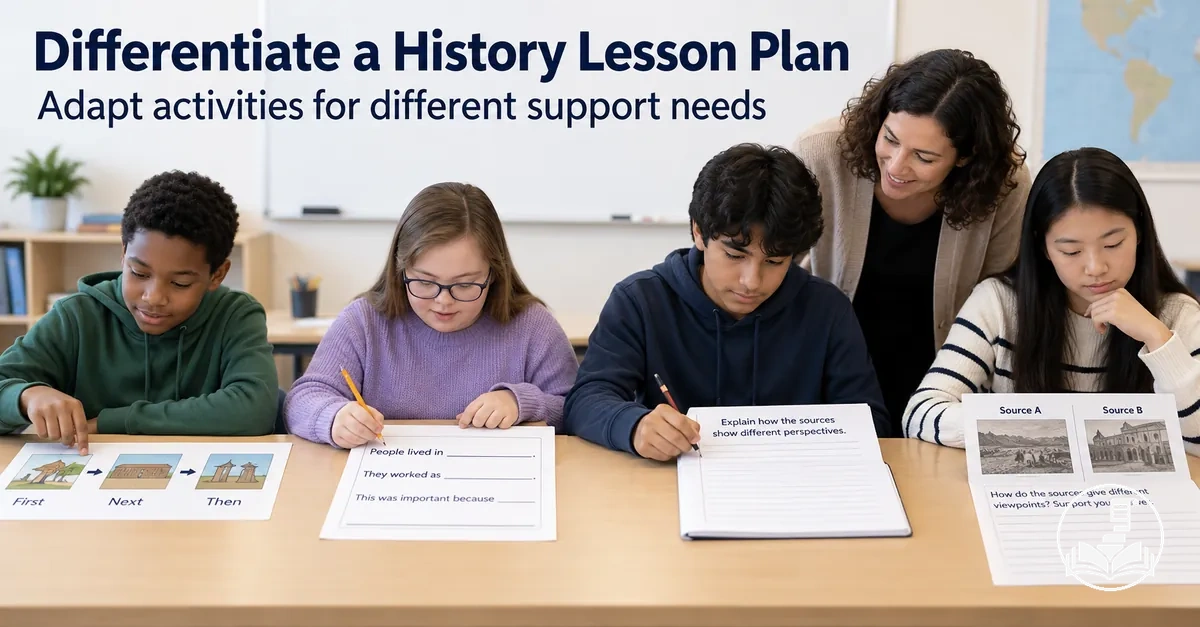
Differentiate the condition, not the historical goal
Use the learning barrier to decide what can change, then check that the student is still responsible for the historical knowledge, evidence use, or reasoning the lesson is designed to develop.
- 1Identify the barrier
Use recent work, assessment, documented support needs where available, and observation of the actual task. - 2Change the matching condition
Adjust only the feature that addresses the barrier: access, scaffold intensity, task staging, response mode, time, grouping, or independence. - 3Keep the essential learning fixed
Retain the shared learning goal, the evidence students must work with, and the historical reasoning or assessed skill. - 4Verify and adjust
Observe the resulting performance; change or fade support when the barrier remains, the support does too much, or greater independence is demonstrated.
Alignment rule: easier access is not the same as easier historical thinking. The adaptation is aligned when it removes an irrelevant barrier while the student still performs the essential disciplinary work.
For example, students can answer the same evidence-based history question while one uses the original source and another receives targeted vocabulary support or a guided prompt; the support differs, but the evidence requirement and historical reasoning can remain shared.
Table of Contents
Identify Student Learning Needs Before Differentiating the Lesson
Useful differentiation begins by identifying the specific learning barrier shown by evidence rather than assuming what a student needs from one behaviour or label.
Recent student work, a recent assessment, documented support needs where available, and observation of the planned history task can provide diagnostic signals; each signal should be checked against the demands of the task before an instructional decision is made.

For example, two students may both leave a written source-analysis task incomplete: one student's recent work may suggest difficulty interpreting evidence, while the other can explain the evidence orally but has difficulty accessing the written source.
The first signal calls for checking the historical reasoning skill, whereas the second calls for checking the language and reading demands before choosing an adaptation.
Individual learning needs should remain distinct from broader developmental differences addressed when adapting lessons by grade level.
Keep the History Learning Goal Constant While Adapting Access
An adaptation is aligned when the intended history learning goal remains the reference point while access conditions change.
The criterion is whether the student is still required to develop or demonstrate the same essential historical knowledge or historical reasoning, rather than whether every student completes identical work.

Features such as support level, text accessibility, task staging, response mode, time, and grouping can change when they reduce a barrier without removing what the learning goal requires.
A scaffold may change how a student accesses evidence, while a different response mode may change how the student demonstrates reasoning; either remains aligned only if the required historical knowledge and reasoning are still present.
The adaptation should therefore be evaluated against the learning goal, not simply by whether it makes the task easier to complete.
The practical criteria are to identify which feature can change without changing what students are expected to learn:
- Support level: add prompts, modelling, or scaffolds when they improve access without supplying the historical reasoning students are expected to perform.
- Text accessibility: adjust vocabulary support, formatting, or contextual guidance when the evidence needed for the learning goal remains available to the student.
- Task staging: divide a complex task into manageable stages when students must still complete the essential historical thinking required by the task.
- Response mode: change how a student communicates an answer when the new mode still requires evidence of the intended historical knowledge or reasoning.
- Time: adjust the time available when additional time changes access to the task rather than the learning goal being assessed or developed.
- Grouping: change whether students work independently, with peers, or with teacher support when the arrangement does not remove the reasoning each student is expected to develop or demonstrate.
For example, if the learning goal requires students to construct an interpretation from historical evidence, providing one student with vocabulary support is aligned when that student must still select and interpret the evidence; providing the interpretation itself would change what the student is required to reason through.
This fixed learning goal provides a useful reference point when planning history lessons because access conditions can be adjusted without treating identical task conditions as the measure of alignment.
The final check is whether the adaptation removes an irrelevant barrier while preserving the historical outcome the lesson is intended to develop.
Differentiate History Tasks by Complexity, Support, and Independence
A differentiated history task can vary three related but distinct levers: task complexity, support, and independence.
Adjusting any one of these changes the task demand or the conditions under which students work, while the shared learning goal and required historical reasoning remain the reference point.
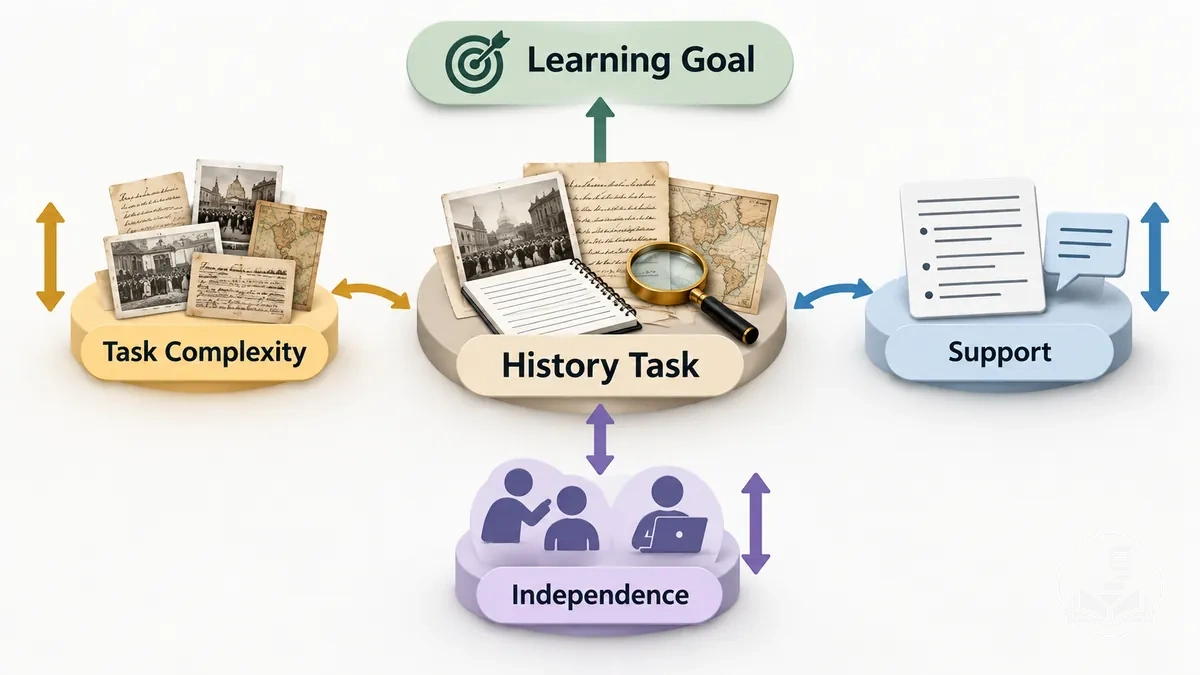
The three levers help separate what the task requires from how much assistance a student receives and how independently the student is expected to work.
A teacher can vary one lever without automatically changing the others, and the appropriate adjustment depends on the learner barrier and the demands of the history task.
The practical distinction is:
- Task complexity: vary the amount or complexity of evidence, the number of reasoning demands, or the structure of the task while retaining the historical reasoning required by the shared learning goal; changing complexity alters what students must manage within the task.
- Support: vary modelling, a scaffold, guidance, or a prompt when assistance is needed to access or complete the task; greater guided support can reduce the demand for immediate independence without performing the required reasoning for the student.
- Independence: vary how much of the task students are expected to complete without prompts or guidance; greater independence increases the requirement for students to manage and apply the task process themselves, while support can be adjusted when independent performance is not yet the intended condition.
For example, in a class with varied support needs analysing the same historical evidence, some students might use a scaffold that organises the task, others might receive a brief prompt, and others might work without prompts.
These variations change support and expected independence without requiring separate historical content for each group.
The students still work toward the shared learning goal by applying the historical reasoning required by the lesson.
Adjust Historical Text and Source Complexity
Source complexity can be adjusted to improve access to a historical text or source only while the evidence students need to interpret remains available.
The adjustment should reduce an unnecessary reading or processing barrier without removing the evidentiary content required for the historical reasoning task.
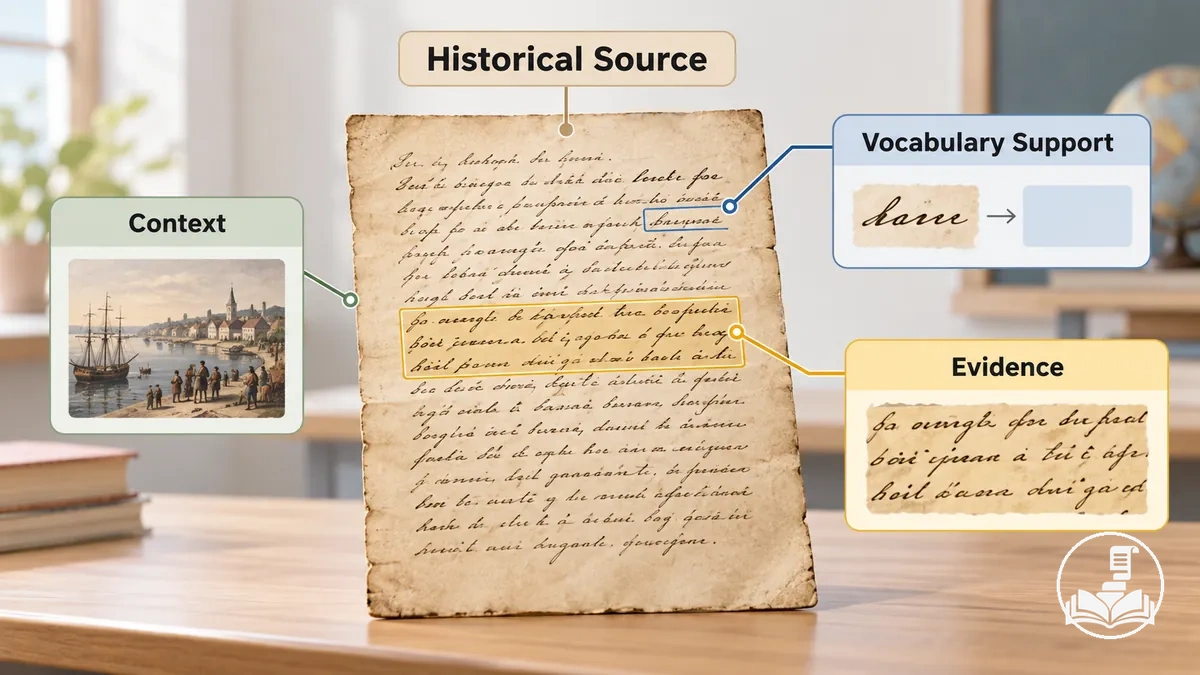
A historical source can create demand through language complexity, information density, required background knowledge, source length, visual legibility, and the amount of contextual support available.
These attributes can be adjusted separately because a source may be linguistically demanding without being long, or visually difficult to read even when its language is familiar.
The relevant comparison is therefore between the original demand, the possible accessibility adjustment, and the evidence that must remain available for interpretation.
| Source attribute | Original demand | Possible adjustment | Evidence that must remain |
|---|---|---|---|
| Language complexity | Unfamiliar vocabulary or dense sentence structures increase reading demand. | Add concise vocabulary support or clarify non-essential wording where the task does not depend on that wording. | Language, claims, or details students must interpret as evidence. |
| Information density | Many relevant and irrelevant details must be processed at once. | Use spacing, annotation, or focused contextual support to help students locate the material they need to examine. | The evidence and surrounding information needed to interpret it rather than merely identify it. |
| Background knowledge | The source assumes historical context that students may not yet know. | Provide brief contextual support needed to understand the setting or references. | Source features students must use to make the intended historical inference. |
| Source length | A long passage increases the amount of text students must process. | Use an excerpt when the selected passage still contains the evidence and context required by the task. | The relevant evidence and enough context to interpret its meaning. |
| Visual legibility | Dense layout, handwriting, or unclear presentation can obstruct access to the content. | Provide a clearly presented transcription or more legible rendering when visual form is not itself evidence being analysed. | Any visual feature that forms part of the evidence when the task requires students to interpret it. |
| Contextual support | Students must infer unfamiliar people, events, terms, or circumstances before analysing the source. | Add concise annotations or background cues relevant to accessing the source. | The interpretive work and evidentiary relationships required by the historical question. |
For example, when a source contains the evidence needed to answer a question but its surrounding passage creates unnecessary reading burden, a teacher can use an excerpt and provide vocabulary support while retaining the relevant claim and enough context for students to interpret it.
The adaptation remains aligned only if students still have to examine the evidence and perform the historical reasoning required by the same question.
Scaffold Primary-Source Analysis and Historical Reasoning
A scaffold should help students carry out primary-source analysis without doing the historical reasoning for them.
Modelling, a prompt, or other guided support can direct attention to evidence, interpretation, and contextualisation, but the student must still use the primary source to form and explain the relevant claim.
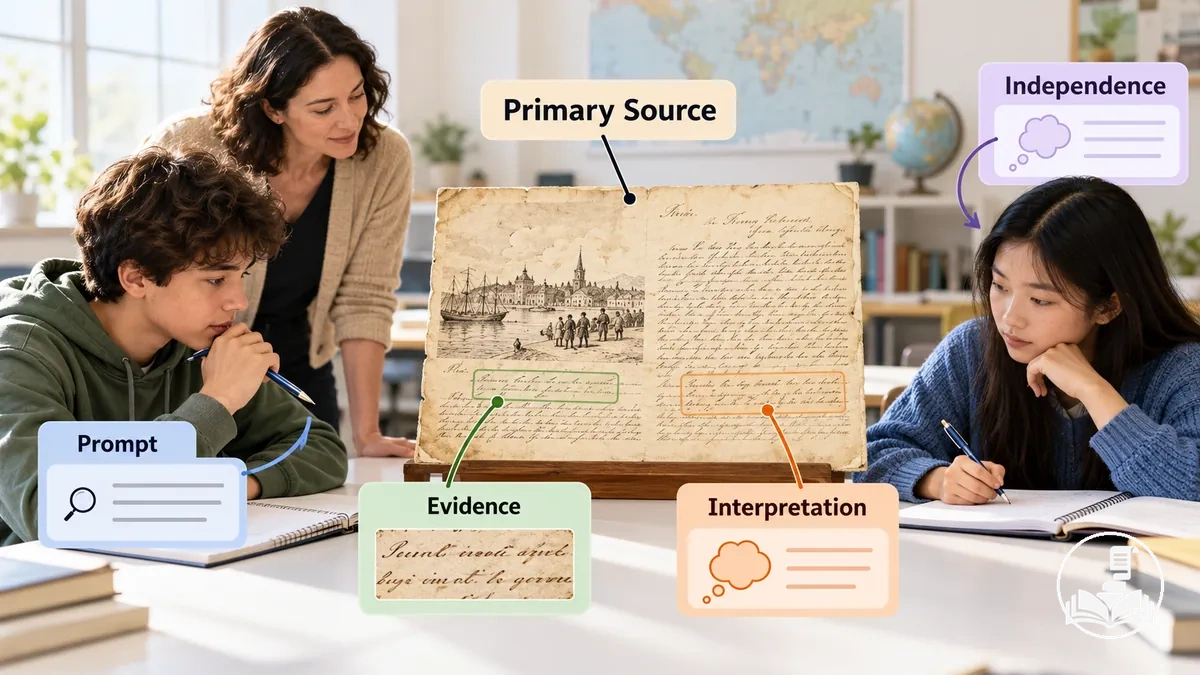
Scaffold intensity can change according to what students can currently do with the analysis task: modelling can make the reasoning process visible, prompts can guide attention to relevant evidence, and reduced prompting can require greater independence.
A scaffold that asks a student what evidence supports an interpretation leaves the reasoning with the student; a prompt that supplies the interpretation does not.
A practical temporary-support progression is:
- Model the process: demonstrate how to attend to relevant source information and explain the reasoning process, while students still interpret the evidence when they apply the process themselves.
- Guide with prompts: use cues that direct students to evidence, context, or a claim they need to examine, while students decide what the evidence means and explain their interpretation.
- Reduce prompts: withdraw cues that students no longer need so they take greater responsibility for contextualisation, interpretation, and explanation without changing the underlying source question.
- Verify independent analysis: ask students to apply the same reasoning process with less or no prompting and check whether they can select evidence, interpret it, contextualise the claim where required, and explain their reasoning independently.
For example, students analysing the same primary source might answer the same evidence question with different scaffold intensity: one student receives prompts to identify relevant evidence and explain what it suggests, while another receives only the question and source.
Both students remain responsible for the interpretation, and support can be reduced when observed performance shows that a prompt is no longer needed.
This differentiation of support intensity stays within the existing analysis task; broader instruction on scaffolding primary-source activities belongs to the wider primary-source teaching context.
Tier Questions and Activities by Required Support
A tiered activity varies support level, prompt demand, or expected independence while keeping students connected to the same shared learning goal.
Each task version should retain the evidence requirement needed for the intended historical reasoning, while the scaffold or differentiated prompt changes according to the support required.

Tiers are comparable when they use the same instructional reference point: a recognisably common shared learning goal and evidence requirement.
The tier condition can then vary the support level, prompt demand, and independence expected from students without assigning a different objective to each group.
The comparison shows what changes in the task version and what students must still do with the evidence:
| Tier condition | Support level | Expected student action | Retained evidence requirement |
|---|---|---|---|
| More guided prompt | A scaffold directs attention to relevant evidence and breaks the reasoning demand into prompts. | Select relevant evidence, respond to the prompts, and explain what the evidence supports. | Use the shared historical evidence to support the same learning goal. |
| Focused prompt | A brief cue identifies the reasoning focus without breaking it into separate prompts. | Select and interpret relevant evidence with limited guided support. | Use the shared historical evidence to support the same learning goal. |
| Open prompt | No additional scaffold is supplied beyond the task question and available evidence. | Identify, interpret, and explain relevant evidence with greater independence. | Use the shared historical evidence to support the same learning goal. |
For example, a tiered history task might ask every student to use the same evidence about a historical event to support an interpretation: one task version can provide prompts for selecting and explaining evidence, another can provide a single reasoning cue, and another can present the evidence question without an added scaffold.
The prompt demand and support level differ, but the shared learning goal and evidence requirement remain common across the tiered activity.
These tiers describe temporary task conditions rather than fixed levels of student ability, so students should not be assigned permanent labels from the version of the task they currently use.
Vary Response Formats Without Changing the Learning Goal
A response format may vary only when it still elicits the required evidence of the learning goal and preserves the assessed skill.
A written response, oral response, visual response, or structured response is therefore appropriate only when students must still demonstrate the intended history knowledge or historical reasoning rather than bypass it.
Start with the required evidence, then choose a response format capable of revealing it.
If the learning goal requires students to interpret historical evidence and explain a conclusion, a written response or oral response can both preserve alignment when each requires the student to identify relevant evidence, interpret it, and explain the reasoning.
A visual response can also be aligned when its labels, annotations, or accompanying explanation provide the required evidence of interpretation rather than merely displaying information.
A structured response can organise the demonstration with prompts or fields, provided the scaffold does not supply the historical reasoning students are expected to produce.
The boundary becomes clear when the response mode changes what the task actually assesses:
- Valid format change: if the learning goal is to construct and support a historical interpretation, allowing a student to give an oral response instead of a written response can preserve the assessed skill when the student must still make the interpretation, select evidence, and explain the connection between the evidence and the claim.
- Invalid format change: if the learning goal specifically requires students to construct a written historical argument, replacing the written response with an oral response removes the writing component from the assessed skill and therefore alters what is being assessed.
When a proposed response-format change alters the required evidence or removes part of the assessed skill, the decision moves beyond format differentiation and into assessment in differentiated history lessons.
Match Scaffolds and Accommodations to Specific Learning Needs
Select a scaffold or accommodation because it matches an identified learning barrier, not because it is a generic differentiation strategy.
A matched support should improve access or task participation under the relevant classroom condition while maintaining the challenge students still need to engage with; verification is necessary because the same support type may fit one barrier and fail to address another.
Scaffold or accommodation?
Scaffold
Instructional support—such as modelling, task chunking, or language support—that helps a student perform part of the learning process with guidance that can be adjusted as independence develops.
Accommodation or access support
A change to an access or participation condition—such as time, grouping, sensory access, or an appropriate response support—without functioning as instruction in the target skill.
Decision rule: use a scaffold when the barrier concerns how the student manages or performs the task process; use an accommodation or access support when the barrier concerns the conditions under which the student can access or participate in the task.
Use the matching process as a four-step decision flow, checking fit at each stage rather than assuming a support category will work:
- Identify the learning barrier: state what is limiting access or task participation in the specific history task, such as a language demand, difficulty managing a multi-part process, or an access condition.
- Select the support type: match the barrier to a relevant scaffold, accommodation, or other targeted support; for example, language support should address a language barrier, while modelling or chunking should address a task-process barrier that those supports can make more manageable.
- Check the classroom condition: consider how the support will operate with the actual task, available grouping, time, sensory or access conditions, and expected independence rather than treating the strategy as universally applicable.
- Verify access and maintained challenge: check whether the support improves access or task participation while the student still performs the intended historical thinking. If the barrier remains, or the support performs too much of the task for the student, adjust the match and verify again.
For example, extra time may not address a student whose barrier is understanding unfamiliar language in a historical source; targeted language support may be a closer match because it addresses the access problem directly.
Conversely, giving extensive modelling to a student whose barrier is a sensory access condition may add instructional guidance without resolving access to the material itself.
In either case, verification means checking the student's participation and maintained challenge, then changing the support when the observed result indicates that it does not fit the actual barrier.
Use Vocabulary, Sentence, and Graphic Supports for Demanding History Tasks
Vocabulary, sentence, and graphic supports should reduce a specific language demand or organisation barrier without supplying the substantive historical answer.
The support should enable students to access and organise historical evidence while preserving the interpretation and reasoning they are expected to perform.
Each support family addresses a different task demand: vocabulary support helps students access unfamiliar background knowledge or disciplinary language, sentence support cues how a claim, evidence, or explanation can be expressed, and graphic support makes relationships among information easier to organise.
The useful support is therefore the one that targets the barrier present in the task rather than adding prompts indiscriminately.
Students should still decide what the historical evidence means and how it supports their interpretation.
- Vocabulary support: use a targeted word bank, concise definitions, or contextual vocabulary cues when unfamiliar disciplinary language limits access to the source or task. The student still identifies relevant historical evidence and determines how the terms relate to the historical question.
- Sentence support: use a sentence starter or sentence frame when the language demand of expressing a claim, connecting evidence, or explaining reasoning is the barrier. The frame can cue the structure of an explanation, but the student must supply the claim, select the evidence, and explain the relationship between them.
- Graphic support: use a graphic organiser when organisation is the barrier, such as when students need to sort evidence, track relationships, or connect claims with supporting information. The organiser can provide places to record and relate information, but the student must decide where the evidence belongs and what interpretation follows from it.
For example, when a student must compare historical evidence before explaining why two sources present an event differently, a graphic organiser can provide separate spaces for evidence from each source and a place to record relationships between them.
The organiser reduces the organisation demand, but the student still selects the relevant evidence, interprets the differences, and constructs the historical explanation.
Chunk and Model Multi-Step History Tasks
Chunking and modelling can make a multi-step history task more manageable while preserving the purpose of the whole task.
The task stages should remain connected so students can move through the historical reasoning process rather than complete disconnected activities.
Each task stage should have a clear purpose within the sequence, with modelling focused on the process students need to learn rather than the historical answer they must produce.
Guided support can then cue the next action while leaving substantive decisions about evidence and interpretation to the student.
The amount of modelling and guidance can change according to the task demand and student need, but the sequence should lead toward an independent attempt and transfer of responsibility.
- Establish the whole task: make the final historical purpose explicit so students can see how each task stage contributes to the same outcome; students identify what they will ultimately need to do with the evidence and reasoning.
- Model the process: demonstrate a difficult process within one stage, such as how to examine evidence before forming an interpretation, without supplying the final historical claim; students attend to the reasoning process they will need to apply.
- Guide the connected attempt: use guided support or a prompt to help students move from one stage to the next, such as from evidence interpretation to identifying what the evidence could support; students make the substantive historical decisions while the support keeps the sequence visible.
- Move to an independent attempt: reduce the guidance and ask students to connect the stages themselves, using their interpretation of the evidence to construct and support a historical claim; verify whether they can complete the connected process without the earlier prompts.
For example, a staged task can first ask a student to identify relevant historical evidence, then interpret what that evidence suggests, and finally use the interpretation to construct a supported historical claim.
Modelling can demonstrate how to move from examining evidence to explaining its significance, while guided support can cue the connection to the claim without supplying the conclusion.
Transfer of responsibility occurs when the student can complete the same connected reasoning process in an independent attempt.
Adjust Time, Grouping, and Access Conditions
Time, grouping, or an access condition should change when that lesson condition is contributing to the barrier rather than when the historical learning goal itself is the difficulty.
The adjustment should improve task participation or the student's opportunity to demonstrate the intended learning while preserving the learning goal.
Time is relevant when time pressure or processing demand constrains completion of the intended task, so extra time can change the working condition without changing what the student must demonstrate.
Grouping is relevant when the grouping arrangement affects participation or appropriate peer support, provided the student still performs the reasoning or evidence work expected of them.
Physical access or information access is relevant when the format or availability of lesson material constrains access to the task, so an access adjustment should make the required information or activity usable without removing the historical demand.
The criteria are condition-specific, and each adjustment requires a check for its effect on access, independence, and the quality of evidence the student produces:
- Time: when time pressure limits task participation, extra time can allow the student more opportunity to process and complete the same historical task; check that the adjustment addresses the identified time-related barrier and that the student still demonstrates the required historical knowledge or reasoning.
- Grouping: when the grouping arrangement constrains participation, a different grouping arrangement or appropriate peer support can make participation more accessible; check that peer support does not perform the student's substantive reasoning and that the resulting work still shows what the student can do with appropriate independence.
- Access: when physical access or information access limits participation, adjust the relevant access condition or format so the student can engage with the necessary material; check that the adjusted format preserves the information and evidence required to demonstrate the learning goal.
For example, extra time can be a condition-based adjustment when time pressure is the barrier and the student still completes the same evidence-based history task, whereas removing the requirement to interpret historical evidence would change the academic goal rather than the time condition.
Similarly, peer support can help a student participate in a group task while leaving the student's historical decisions intact, and an accessible information format can change access to material while preserving the evidence that must be interpreted.
The final check is whether the adjustment changes only the relevant lesson condition while still allowing the intended learning to be demonstrated.
Fade Scaffolds as Students Become More Independent
Scaffold fading should reduce temporary support when observed performance shows that a student can perform more of the history task with greater independence.
Time alone is not a readiness signal; the support adjustment should follow evidence that the student can take over more of the reasoning or task process.
Readiness can be observed when the student performs the target process with the current prompt, modelling, or other guided support and then continues to perform the relevant part when some assistance is reduced.
Partial removal helps test transfer without assuming that independence means the absence of all support.
Reduce one support at a time when practical, then re-check observed performance so the effect of the adjustment can be interpreted.
If performance becomes less reliable after the change, the scaffold can be retained or restored while further observation continues.
- Observe current performance: identify what the student can complete with the current temporary support and which parts still depend on a prompt, modelling, or guided support.
- Reduce one support: withdraw or simplify one element that observed performance suggests the student may no longer need, while leaving the underlying historical task and reasoning demand intact.
- Monitor the independent attempt: observe whether the student can perform the targeted process with greater independence and whether the reasoning remains sufficiently evident to judge transfer.
- Adjust and re-check: retain the reduced support when performance remains sufficiently independent, reduce another support when further transfer is evident, or restore support when performance indicates that the previous adjustment was premature.
For example, if a student reliably uses a structured prompt to select evidence and explain how it supports a historical claim, the teacher can reduce the prompt to a shorter cue and observe the next independent attempt.
If the student continues to select and connect evidence without the removed guidance, the support adjustment can be maintained; if the reasoning breaks down, the prompt can be restored or revised.
Scaffold fading therefore follows re-observation of performance rather than a fixed timetable.
Check That Differentiation Preserves Historical Thinking and Productive Challenge
Differentiation remains aligned when students still engage with the intended historical knowledge, evidence required, and historical thinking while receiving the access or support they need.
Productive challenge therefore depends on preserving the relevant reasoning demand, not on making every student complete identical work or treating greater difficulty as greater rigour.
An alignment check should compare the learning goal with the evidence required from the student, the reasoning demand of the task, the scaffold intensity provided, the independence expected, and the demonstrated response.
Appropriate challenge can differ with the task and learner, so more support does not by itself indicate less challenge.
The key verification is whether support removes an irrelevant barrier while leaving the disciplinary thinking with the student; support that supplies the interpretation instead removes part of the historical reasoning that should be demonstrated.
- Learning goal: verify that the differentiated task still requires the intended historical knowledge or historical thinking; revise the task if the support changes the learning goal rather than access to it.
- Evidence required: check that students must still select, use, or explain the historical evidence required by the task; revise support that removes evidence students need to examine themselves.
- Reasoning demand: verify that students still perform the intended interpretation, comparison, evaluation, or other historical reasoning; revise a prompt or scaffold that supplies the reasoning instead of supporting access to it.
- Scaffold intensity: check whether the amount of guidance addresses the barrier without completing substantive parts of the historical thinking for the student; reduce or change the scaffold when it performs reasoning the student should demonstrate.
- Independence: verify that the expected independence is appropriate to the current task and support condition while leaving meaningful intellectual work with the student; adjust support when it either prevents access or substitutes for that work.
- Demonstrated response: examine the student's response for evidence of the intended knowledge and reasoning rather than judging alignment from task completion alone; revise the task when the response cannot reveal whether the intended historical thinking occurred.
- Need for revision: if any check shows that the learning goal, required evidence, or reasoning demand has been removed, revise the differentiated condition and verify the resulting student response again.
For example, two students can analyse the same historical evidence while one receives vocabulary support and the other uses a prompt that organises where to record evidence; both remain accountable for interpreting the evidence and explaining a historical conclusion.
If either support instead supplies that interpretation, the task no longer preserves comparable historical reasoning and should be revised.
Appropriate challenge may support participation, but broader improving history lesson engagement remains a neighbouring concern rather than evidence by itself that disciplinary challenge has been preserved.
Fix Common Differentiation Problems During the Lesson
A differentiation problem during a history lesson should be interpreted from an observable symptom and checked against plausible causes before the strategy is replaced.
The same symptom may reflect different problems with support intensity, barrier-support fit, task alignment, or independence, so one classroom signal does not establish a single likely cause.
Troubleshooting should distinguish whether the current support is too intensive, too limited or mismatched to the barrier, or has changed what the task requires students to demonstrate.
The check should compare the support condition with the student's response, the shared learning goal, the evidence required, and the historical reasoning demand.
Dependence on prompts may indicate excessive support but can also reflect an unresolved access barrier, while persistent difficulty may indicate insufficient support, a barrier-support mismatch, or another task condition that still needs checking.
A corrective direction should therefore follow the checked cause rather than the symptom alone.
| Symptom | Likely cause | Check | Corrective direction |
|---|---|---|---|
| The student repeatedly waits for prompts before continuing a task they can complete when guided. | Support intensity may be limiting opportunities to work with greater independence. | Reduce or withhold one prompt and observe whether the student can perform that part of the historical reasoning without the previous guidance. | If observed performance remains adequate, reduce that support; if performance breaks down, restore or revise it and check whether another barrier remains. |
| The student continues to have difficulty accessing or participating in the task despite receiving support. | The support may be insufficient or the barrier-support fit may be poor. | Check whether the chosen adaptation addresses the actual access or task barrier and whether the student can use the relevant evidence once that barrier is reduced. | Change the support type or intensity to address the checked barrier while preserving the intended learning goal and reasoning demand. |
| The student completes the differentiated task, but the output no longer demonstrates the intended historical reasoning. | Task alignment may have drifted because the adaptation removes required evidence or performs part of the reasoning for the student. | Compare the student's demonstrated response with the learning goal, evidence requirement, and reasoning demand of the original task. | Revise the task or scaffold so access improves while the student remains responsible for the required historical reasoning. |
For example, dependence on prompts is a troubleshooting signal rather than proof that support intensity is too high, because the student may still need support for a different barrier; persistent access difficulty similarly requires a check of barrier-support fit before more support is added.
Quick completion also requires checking the task output rather than assuming the work lacks challenge, because completion speed alone does not show whether task alignment or independence has changed.
Correction should target the checked mismatch in support fit, support intensity, or task alignment while preserving the shared learning goal.
Too Much Scaffolding Removes Productive Historical Thinking
Excessive scaffolding becomes a problem when scaffold intensity replaces too much of the historical reasoning the student is meant to perform.
A scaffold should enable student decision-making about evidence and interpretation; when a prompt supplies those decisions, the student has less of the intended reasoning left to practise.
- Reasoning is supplied: if a prompt tells the student what the evidence means or which interpretation to accept, reduce the part that supplies the conclusion and retain only the cue needed to direct attention to the evidence.
- Student decision-making is reduced: if the scaffold predetermines which evidence to select or how it must support the claim, remove that unnecessary layer and re-check whether the student can make the historical decision with reduced support.
- Dependence on prompts persists: if the student waits for a prompt before each reasoning step despite demonstrating that step when guidance is reduced, adjust scaffold intensity by withholding the unnecessary prompt and observe whether greater independence is maintained.
- Useful prompt versus over-scaffolded prompt: a prompt such as “Which evidence supports your interpretation, and why?” leaves the interpretation with the student, whereas “This evidence shows the policy failed; explain why” supplies the interpretation and should be revised so the student determines what the evidence supports.
Recognition depends on how much historical reasoning remains with the student, not simply on how many prompts are present.
A corrective adjustment should target the specific support that is replacing interpretation or another required decision, then re-check the student's performance with reduced support.
If the student still needs a prompt to access the task without having the reasoning supplied, that support can remain.
The correction is therefore to remove only the unnecessary support rather than treating independence as the absence of scaffolding.
Too Little or Mismatched Support Leaves the Learning Barrier in Place
Persistent difficulty after differentiation may indicate either insufficient support intensity or a mismatch between the chosen support and the actual learning barrier.
The distinction matters because increasing a poorly matched support may leave the original barrier unresolved rather than improve support fit.
- Cause: support intensity may be insufficient when the chosen support targets the correct learning barrier but does not provide enough assistance for the student to access or participate in the task. Check: examine the observed response for evidence that the support is relevant but still leaves part of that barrier unresolved. Action: adjust the intensity of the matched support and re-check the student's response while preserving the intended historical reasoning.
- Cause: mismatched support may be present when the chosen support addresses a different problem from the learning barrier affecting the task. Check: compare the original barrier with what the support type actually changes rather than treating persistent difficulty as evidence that more assistance is required. Action: replace or revise the support so its function matches the barrier, then observe whether access or task participation changes.
- Cause: an access condition may remain unresolved even when instructional assistance has been added. Check: determine whether the student can access the material or task condition before interpreting the difficulty as a need for more instructional support. Action: change the relevant access condition when that is the identified barrier rather than increasing an unrelated scaffold.
For example, if unfamiliar language in a historical source is the learning barrier, adding more prompts about the analysis process may increase support intensity without improving support fit because the prompts do not address access to the language.
A more relevant correction may be targeted vocabulary or contextual language support while the student remains responsible for interpreting the historical evidence.
After the adjustment, re-check the observed response to determine whether the revised support addresses the barrier without removing the intended reasoning demand.
Tiered Tasks Drift Into Different Learning Goals
Tier alignment has drifted when versions of a tiered task no longer develop or reveal the same core shared learning goal.
Task demand, support, and independence may vary across tiers, but the historical evidence or historical reasoning required for the intended outcome must remain recognisably shared.
For example, if the shared learning goal requires students to interpret historical evidence and use it to support a claim, acceptable variation can change how much guidance students receive without replacing that evidence requirement.
The contrast shows whether the adaptation changes access to the task or changes the essential historical outcome:
- Aligned tier: one task version provides prompts that help students locate and organise relevant historical evidence, while another requires greater independence in selecting it; both still require students to interpret the evidence and use their historical reasoning to support a claim.
- Drifted tier: one task version requires students to interpret historical evidence and justify a claim, while another asks only for factual recall about the topic; the task demand has changed the required reasoning and evidence, so the versions no longer align to the same core learning goal.
Correct goal drift by revising the tiered task until the adaptation changes support, task complexity, or independence without substituting a different essential learning outcome.
Alignment is preserved when each task version retains the common historical evidence or historical reasoning requirement needed to demonstrate the shared learning goal.