
Assessing Learning in a History Lesson Plan
Assess learning in a history lesson by matching the assessment task to the learning objective, collecting observable student evidence, and judging that evidence against explicit success criteria. Use formative evidence to adjust teaching while learning is underway, then use sufficient end-point evidence to decide whether the objective is met, partly demonstrated, or not yet demonstrated.
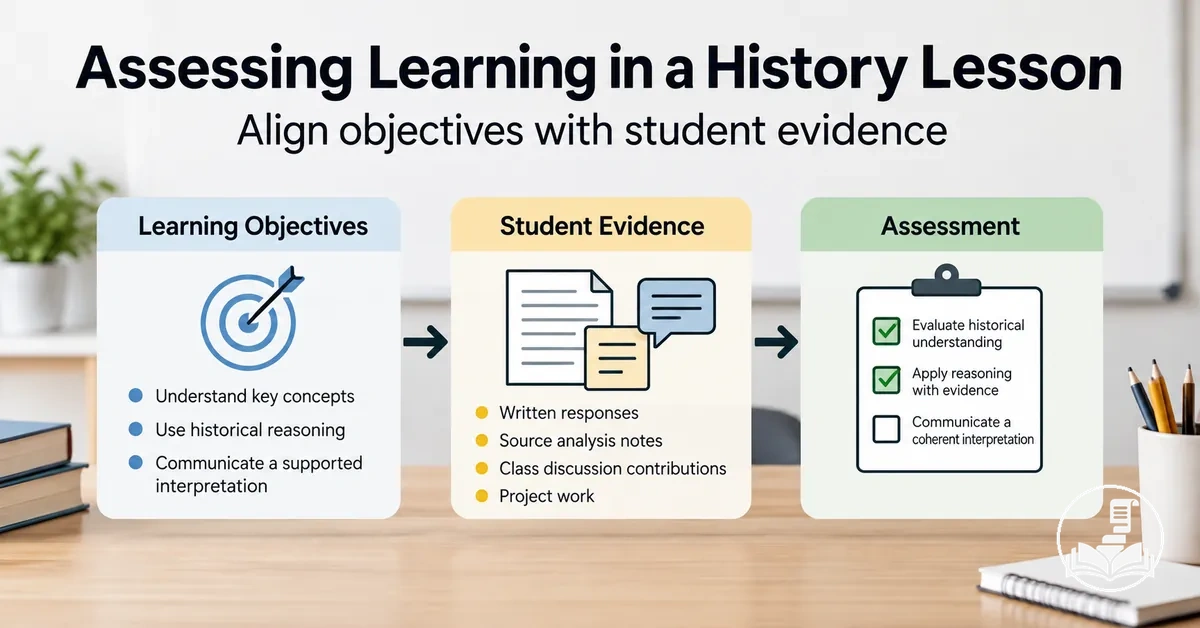
History assessment decision model
A defensible history assessment follows one connected chain from the intended learning to the judgement the available evidence can support.
-
Learning objectiveIdentify the knowledge or observable performance students must demonstrate.
-
Student evidenceChoose a task that makes that knowledge, reasoning, or source use observable.
-
Success criteriaDefine the observable qualities used to interpret the evidence before judging it.
-
Evidence-led decisionJudge only what the evidence covers and supports, then decide the next teaching or follow-up action.
- During learning
- Formative use: evidence informs feedback or instructional adjustment while there is still time to respond.
- End of a lesson or sequence
- Summative use: evidence supports an end-point judgement against the intended learning outcome.
- Method rule
- A format is not inherently formative or summative; its function depends on timing, purpose, and how the evidence is used.
- Judgement boundary
- Task completion is not proof of learning. Evidence must match the objective and be sufficient and consistent enough for the conclusion drawn.
Assessment is broader than grading: grading is one possible use of assessment evidence, while assessment also includes gathering, interpreting, and acting on evidence.
Table of Contents
Align the Assessment With the Learning Objective
Assessment alignment means the assessment task elicits the same knowledge or observable performance named in the learning objective.
The task must produce evidence that matches the intended learning and can be interpreted against the success criteria.
Topic match is necessary but not sufficient; the task must also match the objective’s required performance.
The learning objective’s action, historical content, and cognitive demand constrain what counts as appropriate assessment evidence and task demand.
Writing history lesson objectives is a separate planning task; for assessment alignment, use the existing objective to determine the required observable performance.
The following sequence checks alignment from the objective through the assessment task and evidence to the judgement that the evidence can support.
- Identify the required performance. Read the learning objective for its action and historical content, and determine what students must demonstrate, such as identify, explain, compare, or evaluate.
- Define observable evidence. Specify what a student response must show for the required performance to be visible and interpretable against the success criteria.
- Select a task with matching demand. Choose an assessment task that elicits the required evidence at the cognitive demand expressed by the objective rather than merely covering the same historical topic.
- Verify the alignment. Check whether the evidence produced by the task can support the intended judgement about the learning outcome. If the task measures a different skill or level of thinking, the assessment is weakly aligned even when the historical content matches.

For example, in a history lesson, an objective asking students to identify causes of an event can be assessed with a response that identifies those causes, while an objective asking students to evaluate historical evidence requires a task that elicits an evaluative judgement supported by that evidence.
A task requiring only identification would therefore provide insufficient evidence for the evaluation objective, although different suitably demanding tasks could validly elicit the required performance.
Define the Evidence That Will Demonstrate the Objective
Valid evidence is observable student work that demonstrates the performance named in the learning objective.
An observable response must reveal the relevant recall, explanation, comparison, argument, or source use at the cognitive demand required by the objective.
An assessment activity creates an opportunity for a response; the evidence is what the student response actually shows.
The type and quality of evidence therefore change with the objective’s cognitive demand rather than simply with its historical topic.
For example, if a history objective requires an explanation of why an event occurred, an observable response should show causal reasoning that connects relevant facts, not only recall those facts.
The criteria below map objective demands to observable evidence rather than listing assessment methods.
- Recall: a short response that accurately identifies or states the fact required by the objective shows evidence of recall.
- Explanation: a response that connects relevant facts through reasoning, such as describing a causal relation, shows evidence of explanation.
- Comparison: a response that identifies relevant similarities or differences between the specified historical subjects shows evidence of comparison.
- Argument: a response that states a claim and supports it with relevant reasoning or historical evidence shows evidence of an argument.
- Source use: a response that uses information from a historical source to support an interpretation or justification shows evidence of source use.
An annotated example can show how the required performance becomes visible in student work by linking a specific objective demand to the relevant parts of one observable response.

Set Success Criteria Before Students Complete the Task
Success criteria state the observable qualities used to judge whether student evidence is adequate for the learning objective.
Each criterion should specify an observable quality, such as factual accuracy, relevance, supporting evidence, or historical reasoning, rather than relying on labels such as “good understanding.” A criterion states what quality is judged, whereas a performance descriptor states how well that quality is demonstrated.
Only criteria relevant to the learning objective should be included because the objective determines which qualities matter to the judgement.
When one outcome is central to the objective, its criterion may carry greater importance than other qualities rather than treating all criteria as equal.
For an objective requiring students to explain a historical cause using evidence, the following criteria identify observable conditions in the student response.
- Factual accuracy: the response uses historical facts accurately enough to support the explanation rather than relying on inaccurate claims.
- Relevance: the response addresses the specified historical cause and keeps the explanation relevant to the question.
- Supporting evidence: the response uses relevant historical evidence to support the explanation rather than presenting an unsupported assertion.
- Historical reasoning: the response explains how the supporting evidence relates to the stated cause, making the reasoning observable for judgement.
The criteria can be made visible before scoring by showing the task beside its observable requirements and linking the priority criterion to the learning objective.
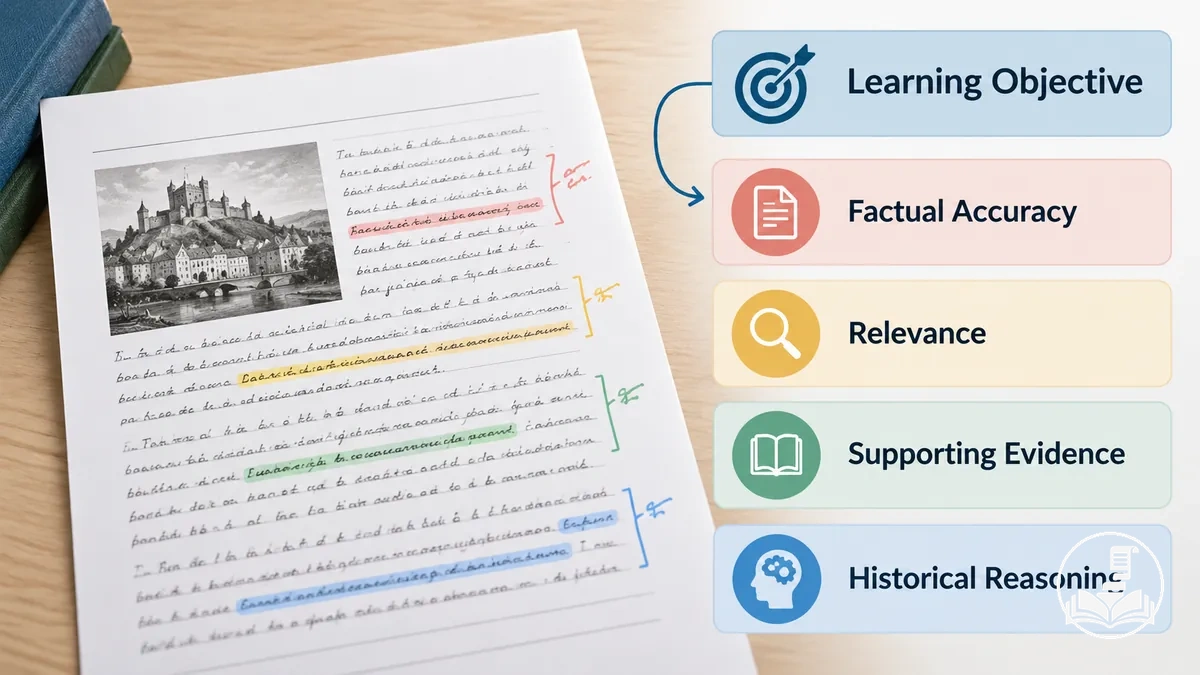
A vague criterion such as “shows good understanding” can instead be written as “explains the historical cause using relevant facts and supporting evidence.” The rewritten criterion identifies observable evidence that can support a judgement without defining performance levels or assigning a score.
Choose an Assessment Method for the Point in the Lesson
Assessment method selection should follow the purpose of the evidence, the timing within the lesson, the evidence type required by the learning objective, and the instructional decision the teacher needs to make.
A method is appropriate when it elicits evidence that can support that decision at the point it is needed.
Choose the method according to what evidence is needed and when it must inform a decision, rather than treating a format as inherently formative assessment or summative assessment.
Method characteristics affect the evidence a teacher can collect and use.
A quick check or discussion can elicit a brief indication of current understanding with a relatively low response burden, while a written response or source task can make reasoning and use of historical evidence more observable when the learning objective requires them.
An essay or project can support more extended evidence when the objective requires a developed response, but its greater response burden may make it less suitable when immediate feedback and adjustment are needed.
The following criteria select an assessment method according to its function and conditions rather than assigning a fixed assessment purpose to its format.
- Fit with the learning objective: select a method that elicits the knowledge, reasoning, source use, or other observable performance required by the objective.
- Timing: use a method whose evidence is available when the teacher needs to make the instructional decision, whether during the lesson or at an end point.
- Evidence type: match the method to the response needed, such as a brief indication of understanding, an explanation, source-based reasoning, or a developed written response.
- Response burden: consider how much student time and effort the method requires relative to the amount and depth of evidence needed.
- Feedback opportunity: when evidence needs to support adjustment during learning, use a method that allows the response to be interpreted and feedback to be provided while further learning can still occur.
A simple visual decision aid can show how lesson stage and evidence need narrow the suitable method category and determine how the resulting evidence can be used.

For example, a brief check for understanding may fit when the teacher needs immediate evidence to decide whether to clarify an idea before continuing, while a source task may fit when the objective requires students to make their historical reasoning visible through evidence.
A quiz can also support an end-point judgement when used after a defined period of learning, so the format alone does not determine whether its use functions as formative assessment or summative assessment.
Formative Checks for Understanding During Learning
Formative assessment gathers student evidence during learning so current understanding can inform the next teaching or learning move.
Its formative function comes from using that evidence for feedback or instructional adjustment while learning is still underway, not merely from a task being low stakes.
Checks for understanding therefore need to produce observable evidence that can guide a timely response.
A useful check reveals specific understanding or misunderstanding that can affect instruction, rather than only increasing participation or asking students to report confidence.
Each check should connect the student response to an interpretation and a possible next step; the examples below show that check → evidence → immediate response relationship.
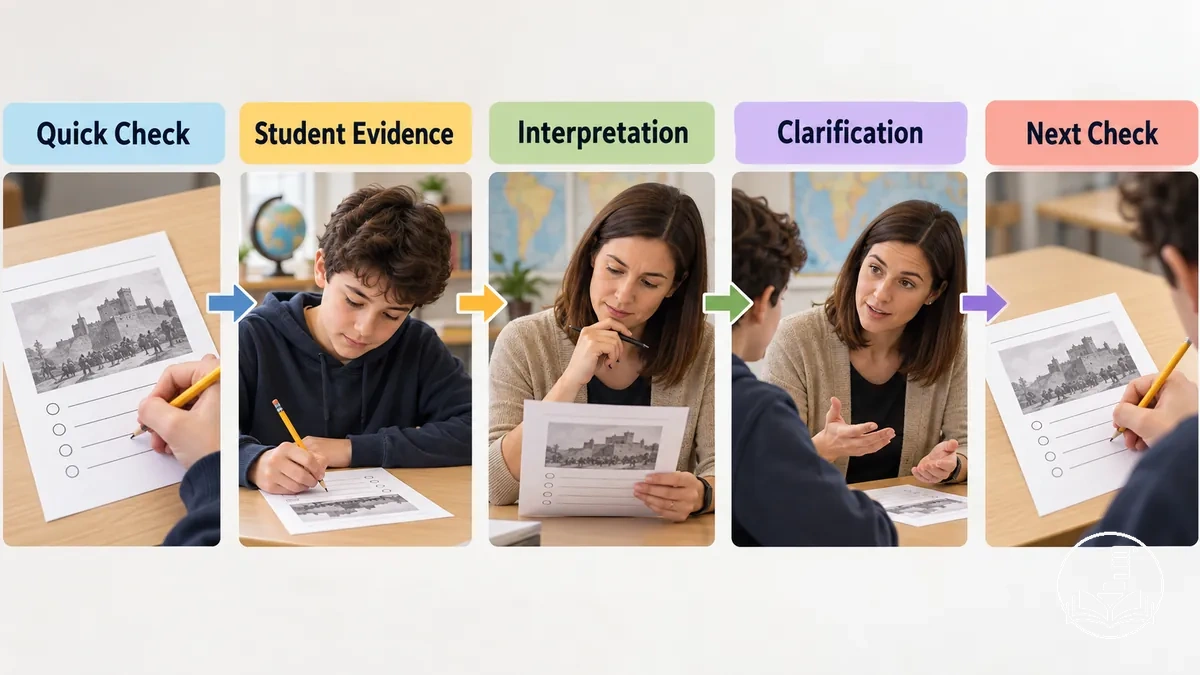
- Retrieval question: a brief retrieval question can reveal which previously taught facts or concepts students can accurately recall. Incorrect or incomplete responses may prompt clarification or focused review before those ideas are used in further historical reasoning.
- Exit ticket: an exit ticket asking students to explain one historical relationship can provide evidence of their current understanding near the end of a lesson. Responses may inform feedback or an instructional adjustment at the start of the next lesson.
- Timeline completion: completing or correcting part of a timeline can reveal whether students understand the sequence and relative placement of events. Misordered events may indicate that chronology needs clarification before students interpret relationships between those events.
- Short source prompt: a focused question about a historical source can reveal what evidence a student notices and how that evidence is being interpreted. If responses rely on unsupported assumptions rather than the source, the next move may be to model how to identify and use relevant source evidence.
- Brief explanation task: asking students to explain why a historical event occurred can reveal whether they connect relevant facts through causal reasoning rather than simply list them. For example, if several responses treat an event immediately preceding a conflict as its only cause, the teacher may clarify the distinction between a trigger and contributing causes before asking students to revise or extend their explanations.
Summative Evidence at the End of the Lesson or Sequence
Summative assessment uses end-point evidence to support a judgement about a learning outcome after an instructional segment or sequence.
The assessment task should produce evidence that can be interpreted against the intended outcome, whether that evidence concerns factual knowledge, historical reasoning, or both.
Task format is secondary to this end-point function.
The same task format can be formative or summative depending on its timing, purpose, and how the evidence is used.
A larger assessment task is not inherently more valid because validity still depends on alignment between the objective, the evidence produced, and the judgement being made.
The examples below concern the evidence different culminating tasks can capture when aligned with the objective, not a hierarchy of task quality.

- Mixed assessment: a combination of focused questions and a short evidence-based explanation can capture factual knowledge alongside historical reasoning when both are part of the intended learning outcome.
- Evidence-based written response: a response to a historical question can provide evidence of whether students select relevant information, construct an explanation or argument, and support it with historical evidence when those performances match the objective.
- Essay: an essay can provide end-point evidence of a sustained historical argument, organisation of relevant knowledge, and use of supporting evidence when the learning outcome requires an extended written judgement.
- Project: a project can capture several forms of student evidence when its required performance is explicitly aligned with the objective, but its size alone does not make the resulting evidence more valid.
- Source analysis: a source analysis can provide evidence of historical reasoning through the interpretation and use of source material. For example, an end-of-sequence task can pair focused factual questions with source analysis so the final judgement considers both factual knowledge and students' reasoning from historical evidence.
Define Criteria for Historical Understanding
Criteria for historical understanding should reflect the learning objective and may include accurate factual knowledge together with disciplinary use of chronology, historical reasoning, and evidence.
The relevant assessment criteria depend on what students are expected to know or demonstrate in the task.
Observable evidence should therefore match the particular dimensions of historical understanding named or implied by that objective.
Factual knowledge provides the historical content that students may need to identify, sequence, explain, or use, while chronology makes temporal order and relationships between events observable when those relationships matter to the objective.
Historical reasoning concerns how students connect facts, develop claims, explain relationships, or interpret the past, while evidence use concerns how they select and use historical material to support those interpretations.
These dimensions can support one another, but accurate content knowledge does not by itself demonstrate disciplinary reasoning, and reasoning unsupported by relevant historical content does not provide the same evidence as an evidence-based historical judgement.
The grouping below is selective rather than a universal checklist: each learning dimension should be assessed only when it is relevant to the learning objective and task demand.
Each criterion links an observable attribute to the evidence that can support the intended judgement.
- Factual knowledge: accurate identification or use of relevant people, events, concepts, or historical details provides observable evidence of content knowledge and supports a judgement about whether the required historical information is understood accurately.
- Chronology: accurate sequencing, dating, or explanation of temporal relationships provides observable evidence of chronological understanding when the learning objective requires students to locate events in time or relate developments across a sequence.
- Historical reasoning: a response that connects relevant facts through explanation, comparison, causal reasoning, or a supported claim provides evidence of disciplinary thinking when that form of reasoning is required by the objective.
- Evidence use: selection and use of relevant historical evidence to support a claim or interpretation provides observable evidence that the student can connect historical material to the judgement or explanation required by the task.
Not every assessment task needs to assess every dimension of historical understanding.
The learning objective determines which dimensions are relevant, so a focused task can provide valid evidence for its intended outcome without claiming to demonstrate historical understanding beyond the dimensions assessed.
Criteria for Factual Knowledge and Chronological Understanding
Factual and chronological evidence should show factual accuracy, coherent chronology, and appropriate historical context only to the extent required by the objective.
A historical claim should accurately represent relevant people, events, or developments and place them in the sequence, period, or date relationship needed for the task.
Exact dates are necessary only when the objective or the historical meaning depends on them; a small factual error should affect the judgement according to whether it changes the intended meaning.
- Factual accuracy: relevant names, events, developments, and details are accurate enough to support the historical claim; an error has greater assessment significance when it changes the claim or explanation rather than leaving its intended meaning intact.
- Sequence: events or developments are ordered correctly when their temporal order matters, so the response does not imply a historical relationship that depends on an incorrect chronology.
- Period or date relationship: the response places events within the relevant period and represents a date relationship accurately when that relationship is required by the objective; exact dates are not required when broader temporal placement provides the necessary evidence.
- Contextual placement: people, events, or developments are situated in the appropriate historical context so their placement supports, rather than distorts, the meaning of the response.
For example, if a student explains one development as contributing to a later event, correct sequence supports the explanation because reversing the temporal order would change the claimed relationship.
A minor date slip that leaves that sequence and historical meaning intact may have a different judgement implication from an error that places the supposed contributing development after the event it is used to explain.
Criteria for Historical Reasoning and Use of Evidence
Historical reasoning should be assessed through observable reasoning moves and the quality of evidence used to support a claim.
Depending on the learning objective, relevant reasoning may include sourcing, contextualisation, corroboration, comparison, or causal explanation.
A quotation or source reference alone does not demonstrate reasoning unless the student uses it to justify, qualify, or interpret the claim.
The table maps selected reasoning attributes to observable student actions, evidence of quality, and their implication for assessment judgement.
It is not a universal historical-thinking checklist; only reasoning attributes required by the learning objective should be assessed.
| Reasoning attribute | Observable student action | Evidence of quality | Assessment implication |
|---|---|---|---|
| Sourcing | Identifies relevant features of a source, such as its creator, purpose, or circumstances, and uses them when interpreting the source. | The interpretation explains how relevant source characteristics affect what the source can support. | Supports a judgement that the student evaluates source information rather than treating a citation as sufficient analysis. |
| Contextualisation | Situates a claim or source within relevant conditions or circumstances of the historical period. | The context is relevant to the interpretation and is used to explain the historical meaning of the evidence. | Supports a judgement that the student contextualises evidence when the objective requires contextual reasoning. |
| Corroboration | Compares relevant sources or evidence and identifies meaningful agreement or difference. | The comparison is used to strengthen, qualify, or challenge a claim rather than merely noting that sources differ. | Supports a judgement that the student corroborates an interpretation by using relationships between sources as justification. |
| Comparison or causal explanation | Compares relevant historical subjects or connects evidence to a stated cause, consequence, or relationship. | The selected evidence is relevant to the comparison or causal claim, and the reasoning explains how that evidence supports the conclusion. | Supports a judgement that the claim is justified through an observable reasoning process rather than asserted without explanation. |
For example, weaker evidence use may quote a source after a claim without explaining its relevance, while stronger evidence use selects a relevant part of the source and explains how it supports or qualifies the claim.
These criteria assess the reasoning visible in student work rather than teaching the full set of historical thinking skills.
The assessment judgement should therefore remain limited to the reasoning attributes required by the objective and demonstrated in the response.
Criteria for Assessing Primary-Source Analysis
Primary-source analysis should show that a student interprets a primary source as historical evidence rather than merely extracting or describing its content.
Description
States, quotes, or extracts what the source says.
Analysis
Connects relevant source attributes to what the source can support, qualify, or leave uncertain as historical evidence.
- Creator or origin: the student identifies a relevant creator or origin and explains how that provenance affects the interpretation or evidential use of the source, showing analysis rather than identification alone.
- Historical context: the student contextualises the source within relevant circumstances of its period and uses that context to interpret its content or significance, showing how temporal and situational conditions affect what the source can support.
- Audience or purpose: the student identifies the intended audience or purpose when relevant and explains how it shapes the source's content, emphasis, or usefulness as historical evidence.
- Perspective: the student interprets the perspective expressed or represented in the source and considers its implications or limitations without assuming that perspective or bias automatically makes the source unreliable.
- Corroboration: the student compares the source with other relevant evidence when the task requires corroboration and uses meaningful agreement or difference to support, qualify, or challenge an interpretation.
- Use as historical evidence: the student uses relevant information from the source to support a claim and explains why that evidence is pertinent, showing evidential reasoning rather than treating quotation or citation alone as analysis.
These criteria should be selected according to the task rather than applied mechanically, because a task may require attention to creator, origin, historical context, audience, purpose, perspective, corroboration, or evidential use in different combinations.
For example, a response that states what a source says remains descriptive, whereas a response that relates its creator and purpose to what its claim can support demonstrates observable analysis of evidential value.
Teaching these processes through primary-source learning activities is a separate instructional context; here, the assessment judgement concerns what the student's response actually demonstrates.
Use Rubric Criteria to Judge Student Performance Consistently
A rubric can support consistency in judging student performance by pairing each criterion with a performance descriptor that identifies observable differences in the evidence students produce.
The resulting judgement is more consistently grounded when descriptors are criterion-specific, clearly distinguish relevant differences in performance, and can be matched to the student response.
The criterion states what is judged; the performance descriptor states how the observable evidence differs in quality or completeness.
Descriptors must be rewritten for the actual learning objective rather than treated as fixed thresholds, because their relevance depends on the performance the task is intended to elicit.
The illustrative progression below uses one historical-reasoning criterion to show how an evidence match can support judgement without creating a universal rubric.
| Criterion | Less complete evidence | Adequate evidence for the objective | More complete evidence |
|---|---|---|---|
| Historical reasoning: use evidence to justify a causal claim | The student states a causal claim and includes relevant historical evidence but does not explain how the evidence supports the claimed relationship. | The student states a causal claim, selects relevant historical evidence, and explains how that evidence supports the claimed relationship. | The student states a causal claim, integrates relevant historical evidence into the explanation, and uses the evidence to justify and qualify the claimed relationship where appropriate. |
Build Assessment Into the Lesson Sequence
Assessment should be placed within the lesson sequence at points where evidence can inform instruction during learning and later verify the learning objective.
Each checkpoint should have a clear evidence purpose and an instructional consequence rather than existing simply to add another assessment activity.
The exact placement can vary with the objective, lesson design, activity length, and type of evidence needed.
The sequence below moves from planned evidence to formative checks, instructional adjustment, and end-point verification.
Its purpose is to connect each lesson stage with the evidence needed at that point, the assessment action used to gather it, and the decision that follows without turning every activity into a graded event.
- Plan the evidence from the learning objective: identify what student response or performance would demonstrate the intended learning and what success criteria will be used to interpret it. This establishes what evidence must eventually be verified and prevents later checkpoints from collecting unrelated information.
- Place an initial formative check where prior understanding matters: gather brief evidence before students depend on prerequisite knowledge or concepts. If the checkpoint reveals a relevant gap or misconception, use feedback, clarification, or another instructional adjustment before moving into work that assumes that understanding.
- Use an in-lesson checkpoint at a decision point: gather evidence after students have had an opportunity to develop the target understanding but while there is still time to respond. Interpret the evidence to decide whether to continue, clarify, model, provide further practice, or gather another focused response.
- Respond to the evidence: connect feedback or instructional adjustment to the specific issue revealed by the checkpoint rather than repeating instruction indiscriminately. The purpose of the assessment action is to influence the next teaching or learning move while improvement is still possible.
- Complete end-point verification: gather evidence at the end of the lesson or sequence that is sufficient to judge the intended learning against the success criteria. Use that end-point evidence to determine what has been demonstrated and what, if anything, requires follow-up beyond the current sequence.
For example, if the learning objective requires students to explain why a historical event occurred, an early formative check might ask them to identify relevant causes with a low evidence burden, while an in-lesson checkpoint might require a brief causal explanation that reveals whether they can connect those causes through reasoning.
End-point verification can then require a more developed explanation using the same objective and success criteria, so evidence is gathered at several useful moments without grading every stage of the lesson.
Gather Evidence at Planned Checkpoints
An assessment checkpoint should correspond to a meaningful change in what the teacher needs to know about progress toward the learning objective.
Each checkpoint should collect evidence that can inform a specific interpretation or action, with the evidence burden proportionate to that decision.
A checkpoint is therefore useful when its expected evidence can influence a judgement or instructional response rather than simply adding another test.
Prior knowledge evidence can indicate whether students have the baseline knowledge needed for the objective, while developing understanding can reveal whether their reasoning is progressing or requires adjustment.
Application evidence can indicate whether students can use that developing understanding in a relevant task, while end-of-lesson evidence can support a judgement against the objective and its criteria.
The sequence below treats these as meaningful evidence points rather than a fixed universal template, with each observation method selected according to what the checkpoint is intended to reveal.
- Check prior knowledge: identify the baseline knowledge or misconception that matters for the objective, then use a brief observation method such as a focused response to collect only the evidence needed. Interpret the response to decide whether students are ready to proceed or whether clarification is needed before the target learning develops further.
- Check developing understanding: collect evidence after students have begun working with the target idea, using an observation method that makes their current reasoning visible. Interpret the response for specific gaps or emerging understanding that can inform feedback or instructional adjustment rather than treating the checkpoint as proof of mastery.
- Check application: ask students to apply the target knowledge or reasoning in a task that requires deeper evidence than the earlier checkpoint. For example, if the objective is to explain why a historical event occurred, an earlier checkpoint might ask students to identify relevant causes, while this checkpoint asks them to explain how those causes contributed to the event; the interpretation therefore examines the same objective at greater depth rather than repeating the same question.
- Gather end-of-lesson evidence: use an observation method that elicits enough evidence to judge the intended learning against the relevant criteria. Interpret the resulting response as end-of-lesson evidence for the objective and use any remaining gap to determine whether follow-up is required.
Respond When Assessment Evidence Shows Misunderstanding
Assessment evidence showing misunderstanding is a signal that requires interpretation before the teacher chooses an instructional response.
One incorrect or incomplete response may indicate a knowledge gap, task misunderstanding, weak evidence use, or an isolated error, so the observed error is not yet a confirmed learning need.
A verification check should therefore test the most plausible interpretation before the teacher selects a corrective direction.
A knowledge gap is more plausible when a confirming check shows that relevant facts or concepts are missing, while a task misunderstanding may be suggested when the student can demonstrate the intended knowledge after the instruction or question is clarified.
Weak evidence use may be indicated when the student can state a claim but cannot select or connect relevant source evidence to support it.
An isolated error becomes more plausible when new student evidence demonstrates the expected understanding and the original error is not repeated under a comparable demand.
- Identify the signal: locate the incomplete, inaccurate, or inconsistent part of the student evidence and state what is observable without assigning a cause.
- Form a possible interpretation: consider whether the signal suggests a knowledge gap, task misunderstanding, weak evidence use, or isolated error, while keeping alternative interpretations open where the evidence is ambiguous.
- Use a verification check: gather a focused response that distinguishes the plausible interpretations, such as checking the missing knowledge, clarifying the task instruction, or asking the student to connect a claim to relevant source evidence.
- Choose the corrective direction: if the verification check supports the interpretation, respond proportionately by clarifying the task, reteaching missing knowledge, providing another example or corrective prompt, or collecting new evidence when the issue remains uncertain.
For example, if a student gives an inaccurate causal explanation, the teacher can first check whether the relevant historical facts are known; if the facts are accurate but the relationship remains unclear, another example or focused reasoning prompt may be more appropriate than reteaching the factual content.
More persistent or multi-part issues can be addressed through troubleshooting assessment and alignment problems after this local verification-and-response process has identified what requires further investigation.
Determine Whether the Learning Objective Was Met
A judgement that the learning objective was met requires an evidence set that matches the relevant success criteria, covers the intended learning, and is sufficiently consistent to support that interpretation.
Evidence quality concerns how well individual responses demonstrate the required knowledge or performance, while evidence sufficiency concerns whether the available evidence provides enough objective coverage for the judgement.
A strong response on one fragment of the objective may therefore be high-quality evidence for that fragment but insufficient evidence that the full objective was met.
Mixed evidence requires a qualified judgement rather than a binary conclusion from one ambiguous response.
When some relevant criteria are supported but objective coverage is incomplete or the evidence is inconsistent, the learning objective may be partly demonstrated; when the evidence set does not yet support the required criteria or is too limited for a defensible interpretation, the outcome may be not yet demonstrated.
Task completion alone does not establish learning because the judgement depends on what the student evidence demonstrates against the success criteria.
The diagnostic sequence below moves from evidence coverage through criterion match and sufficiency and consistency to an evidence-led interpretation rather than a mechanical score.
- Check evidence coverage: identify which parts of the learning objective are represented in the evidence set and whether any required knowledge or performance is missing from the available evidence.
- Compare the evidence with the success criteria: determine which criteria the student evidence supports and where the criterion match is partial, ambiguous, or absent.
- Evaluate sufficiency and consistency: consider whether the evidence is sufficient to judge the full objective and whether responses are consistent enough to support the interpretation. Strong evidence for only one fragment should not be treated as sufficient objective coverage.
- Make a qualified judgement: interpret the evidence as supporting that the objective was met, partly demonstrated, or not yet demonstrated only to the extent warranted by its coverage, criterion match, sufficiency, and consistency.
If the evidence is incomplete or inconsistent, the next decision is whether further evidence is needed to resolve the ambiguity or whether the existing evidence already identifies a specific learning need.
Any follow-up should address that informational gap rather than force a predetermined judgement from evidence that is not yet sufficient.
Compare Student Evidence With the Success Criteria
Each success criterion should be compared with the observed evidence in the student's response before an overall judgement is formed.
The comparison should identify the degree of match or gap for each criterion and give priority to criteria that directly represent the learning objective.
The table makes this judgement logic visible by linking each criterion to the evidence, match, and interpretation rather than relying on a mechanical average.
A critical gap can matter more than an average score when the missing criterion represents an essential part of the learning objective, and qualitative evidence can make that gap visible without implying that numerical scoring is inherently more valid.
For example, a response may be factually accurate but only partly match a reasoning or evidence-use criterion when it states relevant facts without explaining how they support the historical claim.
| Criterion | Observed evidence | Degree of match | Interpretation |
|---|---|---|---|
| Factual accuracy | The response states relevant historical facts accurately. | Matches | The observed evidence supports the factual-accuracy criterion. |
| Evidence use | The response includes relevant historical evidence but does not explain how it supports the claim. | Partly matches | The evidence is relevant, but the response indicates a gap in connecting that evidence to the claim. |
| Historical reasoning | The response states a conclusion but does not explain the relationship between the relevant facts and that conclusion. | Does not yet show the criterion | The content accuracy does not compensate for the missing reasoning when reasoning is a priority criterion for the learning objective. |
Identify Learning That Requires Follow-Up
Follow-up should target the unresolved criterion or evidence pattern that remains unsupported after student work has been compared with the success criteria.
The likely learning need should be inferred only as far as the available evidence allows, and the next instructional decision should be proportionate to the strength and consistency of that pattern.
Follow-up evidence is useful when the original response is too limited or ambiguous to support a confident interpretation.
An isolated anomaly may require another check, whereas a repeated pattern across several responses more strongly supports targeted follow-up.
Consistent evidence across comparable tasks increases confidence that the observed pattern reflects insecure learning, while a single unusual response may instead reflect task misunderstanding, inattention, or another temporary factor.
The diagnosis should therefore remain qualified until the unresolved criterion and observed pattern are sufficiently consistent to guide the next decision.
- Missing knowledge: repeated factual omissions or inaccuracies against an unresolved criterion suggest that relevant knowledge may not yet be secure. Use focused follow-up evidence to check the missing fact or concept, then clarify or revisit that content if the pattern is confirmed.
- Chronological confusion: repeated errors in sequence, period, or temporal relationships may indicate that chronological understanding remains insecure. Check whether students can correctly order or relate the relevant events before deciding whether further clarification of sequence or historical context is needed.
- Unsupported claim: a recurring claim without relevant evidence suggests a learning need in connecting historical assertions to support. Ask for follow-up evidence that requires the student to select and explain relevant material, then decide whether further instruction in evidence use is warranted.
- Weak source interpretation: repeated description of what a source says without interpreting its creator, purpose, context, perspective, or evidential value may indicate that source analysis remains insecure. Collect a focused response that tests the unresolved source-analysis criterion before choosing a targeted instructional response.
- Inconsistent performance: successful performance on one response followed by a comparable response that does not meet the same criterion may indicate unstable understanding rather than a confirmed gap. Another comparable check can establish whether the variation is an isolated anomaly or a recurring pattern that supports targeted follow-up.