
Planning and Structuring a History Lesson
Plan a history lesson by defining a bounded historical focus and intended learning first, then build a sequence in which context, the core historical activity, and the closing check all serve that same purpose. Allocate usable lesson time according to what each stage needs; when the plan does not fit, reduce scope or activity complexity rather than compressing every stage by the same proportion.
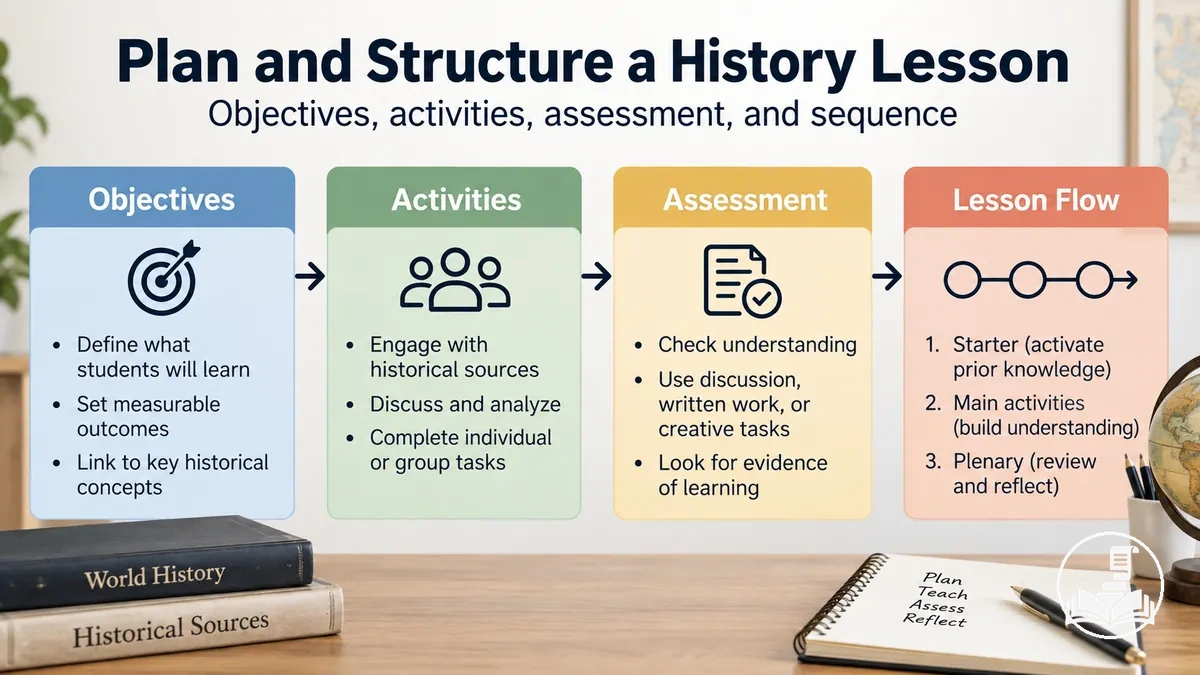
History lesson planning map
Use these decisions in order. Each one constrains the choices that follow, so the lesson stays aligned to one historical learning purpose.
- Frame the lessonSet the historical focus and intended learning. These define what belongs in the lesson and the depth students need to reach.
- Check practical capacityIdentify usable time, relevant prior knowledge, available resources, transitions, routines, and other constraints that limit feasible scope.
- Build the learning sequenceMove from necessary orientation to the core historical work and then to synthesis or a check of learning. Each stage should prepare for the next.
- Allocate time by functionGive each stage the time its purpose requires and protect the uninterrupted block needed for the core activity. If time is insufficient, reduce scope or complexity.
- Place content and activitiesPut facts, sources, explanations, and tasks where students need them; select activities for the student action and observable response they must produce.
- Verify coherenceCheck scope, sequence, timing, resources, transitions, activities, and the closing check against the same intended learning; prune anything without a clear function.
Planning rule: when a boundary changes, revise the downstream choices it affects instead of forcing the original sequence to fit.
The sections below move from lesson boundaries to sequence, timing, content placement, activity function, and the final pre-teaching check.
Table of Contents
Set the Planning Frame for the History Lesson
The planning frame establishes lesson boundaries before individual activities are selected.
Its historical focus and intended learning bound what the lesson needs to address, while available time, learner context, resources, and practical constraints shape what scope and sequence are feasible.
Establishing these planning conditions first keeps activity choices subordinate to the lesson's learning purpose rather than allowing individual tasks to define the plan.
The frame therefore connects the intended scope of historical learning with the conditions under which the history lesson will be taught.
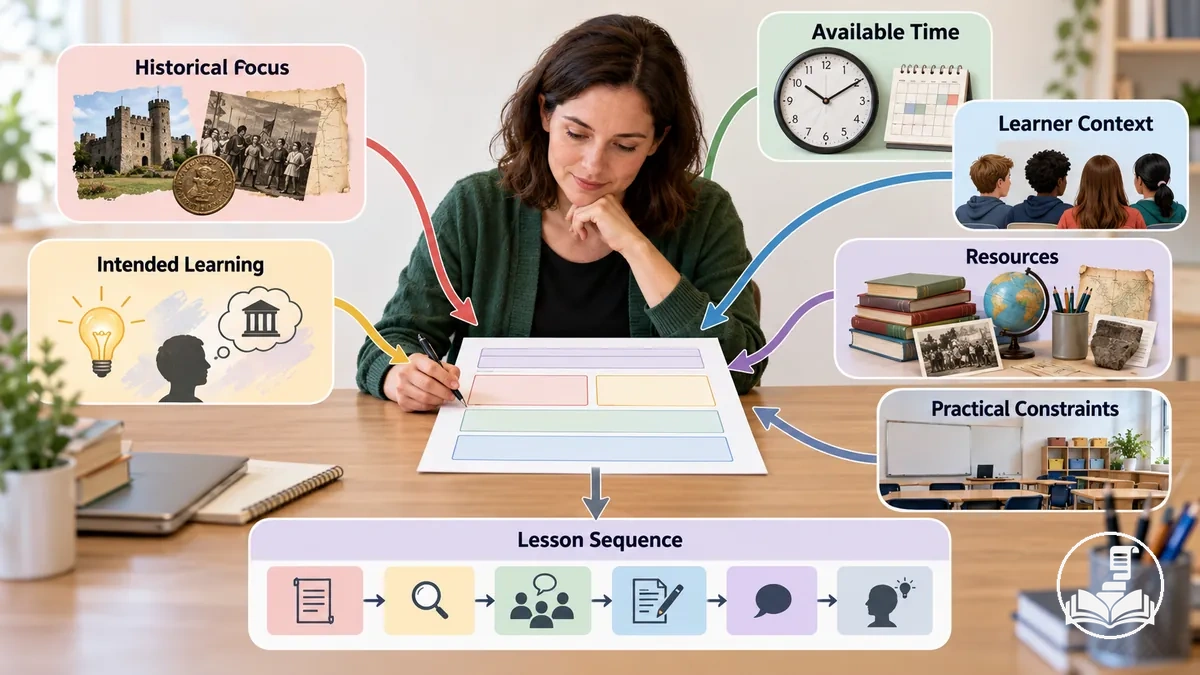
The historical focus and intended learning set the purpose-related boundaries for scope and depth.
Available time constrains how much of that scope can be developed within the lesson, while learner context, including relevant prior knowledge, shapes the sequence needed to make the historical work accessible.
Resources and practical constraints can permit or limit particular ways of working with the content, so a feasible sequence must reflect what is actually available in the classroom.
With these boundaries established, the planning frame is ready to be refined around historical focus and intended learning and around available time and practical constraints.
Clarify the Historical Focus and Intended Learning
A teachable history lesson needs a bounded historical focus and specific intended learning that state what students should know, understand, or be able to do by the end.
The historical focus narrows the lesson scope to a manageable historical question or concept, while the intended learning specifies the learning outcome that the lesson is meant to support.
The appropriate scope depends on available time, topic complexity, and relevant prior knowledge, but it must be specific enough to guide content selection and activity selection.
For example, an entire historical era is an overbroad topic for one lesson, whereas a focused question about a particular event, development, cause, or consequence provides a lesson-sized focus.
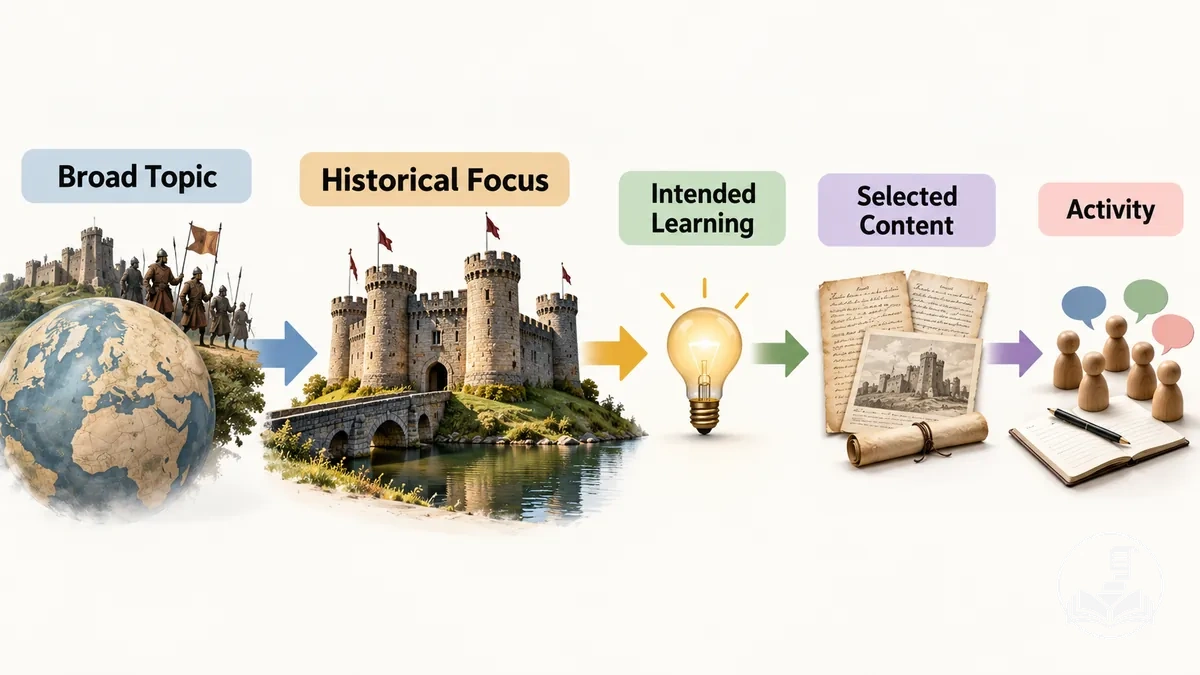
The historical question or concept should connect directly to the intended learning: once the learning outcome is clear, content selection can prioritise material needed to develop that understanding, and activity selection can support students in working with it.
Prior knowledge also affects lesson scope because unfamiliar background may need to be established before students can address the central historical question.
The deeper work of setting clear learning objectives belongs to the objective-planning stage; here, intended learning only needs enough specificity to guide the lesson.
Together, the historical focus and intended learning constrain what belongs in the lesson and what can be left outside its scope.
Define the Available Time and Practical Constraints
Available lesson time means the usable time for planned learning, not simply the nominal lesson length.
Setup, transitions, and classroom routines can consume part of the scheduled period, while resource availability and learner readiness may reshape what can be completed within the remaining time.
The amount of usable time therefore varies with the conditions of the particular lesson rather than following a universal percentage or fixed allocation.
The distinction matters because the feasible scope, activity length, and sequence need to fit the capacity that remains.
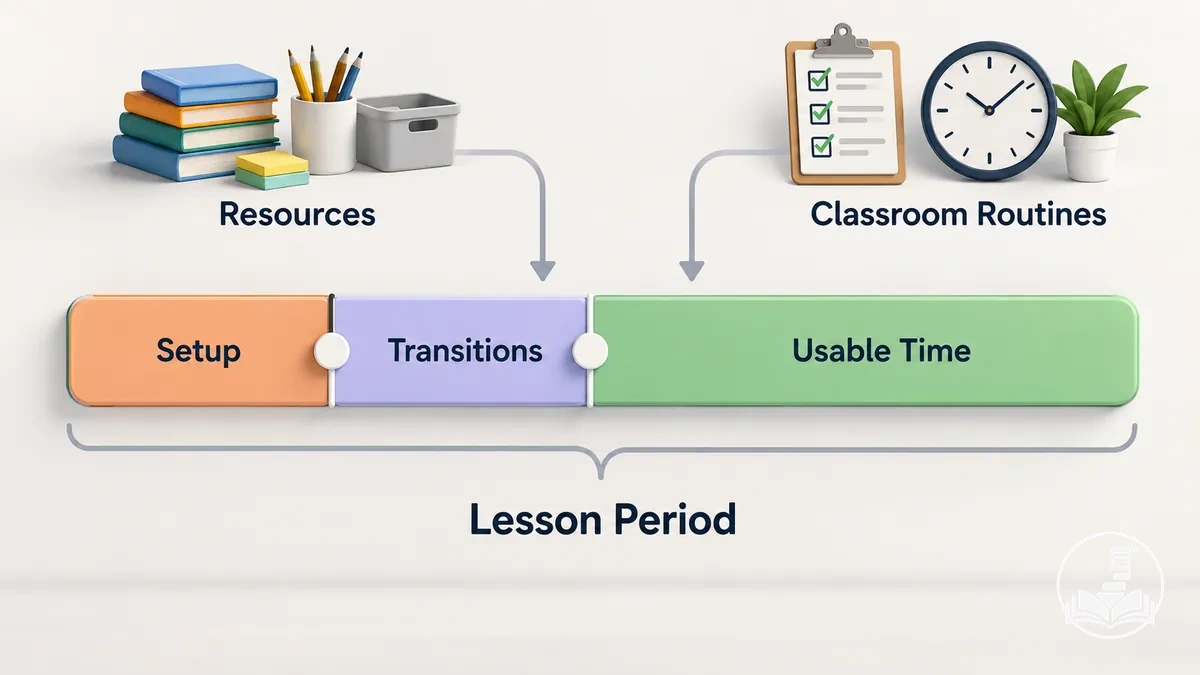
The relevant constraints should be identified before individual minutes are allocated.
Each criterion shows either what can reduce usable time or what can reshape the lesson's practical capacity:
- Setup and transitions: time needed to distribute materials, change tasks, organise resources, or move between lesson stages reduces the portion of the lesson length available for planned historical work.
- Classroom routines: required opening, closing, administrative, or procedural routines consume scheduled time and may require a shorter activity sequence.
- Resource availability: limited access to documents, devices, books, or other materials may constrain activity selection or require a simpler sequence.
- Learner readiness: when relevant prior knowledge needs to be established, part of the available teaching time may need to support that preparation, reducing the scope feasible for subsequent historical work.
- Required content: content that must remain in the lesson limits how much optional material or activity complexity can be accommodated within the usable time.
- Scheduling constraints: non-negotiable start, finish, interruption, or timetable conditions set practical boundaries for the sequence and its length.
These constraints do not prescribe one fixed timing pattern; they define the capacity within which the lesson must be planned.
As an illustrative scenario, a 45-minute lesson may accommodate greater content depth or activity complexity than a shorter lesson with the same historical focus, but the actual difference depends on setup, transitions, classroom routines, resources, learner readiness, and required content.
Available lesson time and practical constraints therefore bound the scope and sequence before detailed time allocation begins.
Build the History Lesson in a Logical Sequence
A logical lesson sequence makes each stage prepare students for the next rather than treating activities as disconnected tasks.
The progression usually moves from orientation into core historical work and then to synthesis or a check of learning, while the exact number and form of stages vary with the lesson's purpose and context.
Each stage therefore needs an instructional purpose that supports movement through the lesson sequence.
The ordered stages below represent a dependency between parts of one lesson rather than a universal formula.
At each stage, the instructional purpose should guide the student action, and the resulting evidence should indicate whether the lesson is ready to progress.
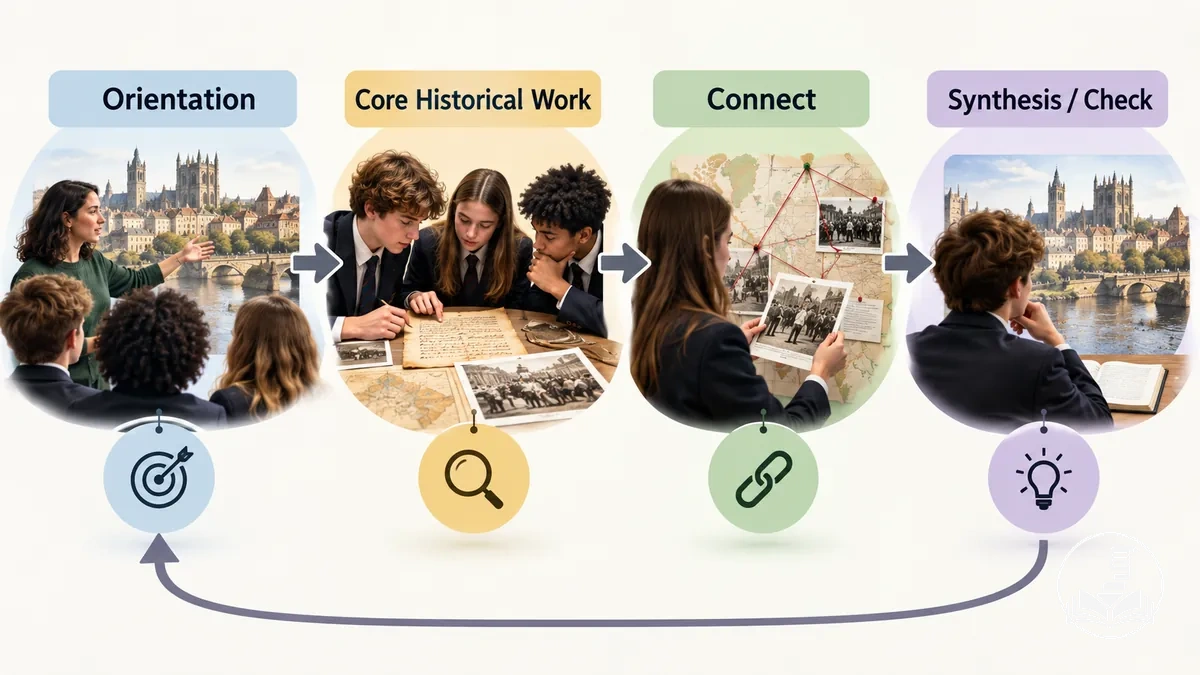
- Orient students to the historical focus. Establish the prior context or historical question needed for the lesson; students identify the focus and connect relevant prior knowledge, providing evidence that they have enough orientation to begin the core historical work.
- Develop the core historical work. Engage students with the selected historical content, sources, question, or task so they can examine and develop the intended learning; their responses or work provide evidence of whether the central historical idea is being addressed.
- Connect and consolidate the learning. Have students relate findings, explanations, or evidence from the core activity to the lesson's historical focus; the connections they make show whether the lesson can progress from exploration toward synthesis.
- Synthesise or check the learning. Return to the historical focus and ask students to express, apply, or check what the preceding stages developed; the resulting response provides a final check of learning tied to the lesson's instructional purpose.
Establish Context and Orient Students to the Historical Focus
Historical context at the lesson opening should provide only the background students need to interpret the core activity.
Orientation can activate relevant prior knowledge and frame the historical focus before students begin deeper work.
How much context is necessary depends on what students already know and on the complexity of the planned task.
Necessary context prepares students to interpret that task; excess background can turn the opening into a separate lecture.
The minimum background context should identify the time and place, key people or historical concepts, essential vocabulary, and the central historical question when each is needed for the planned task.
These cues connect prior knowledge to the historical focus and clarify what students will examine in the core activity.
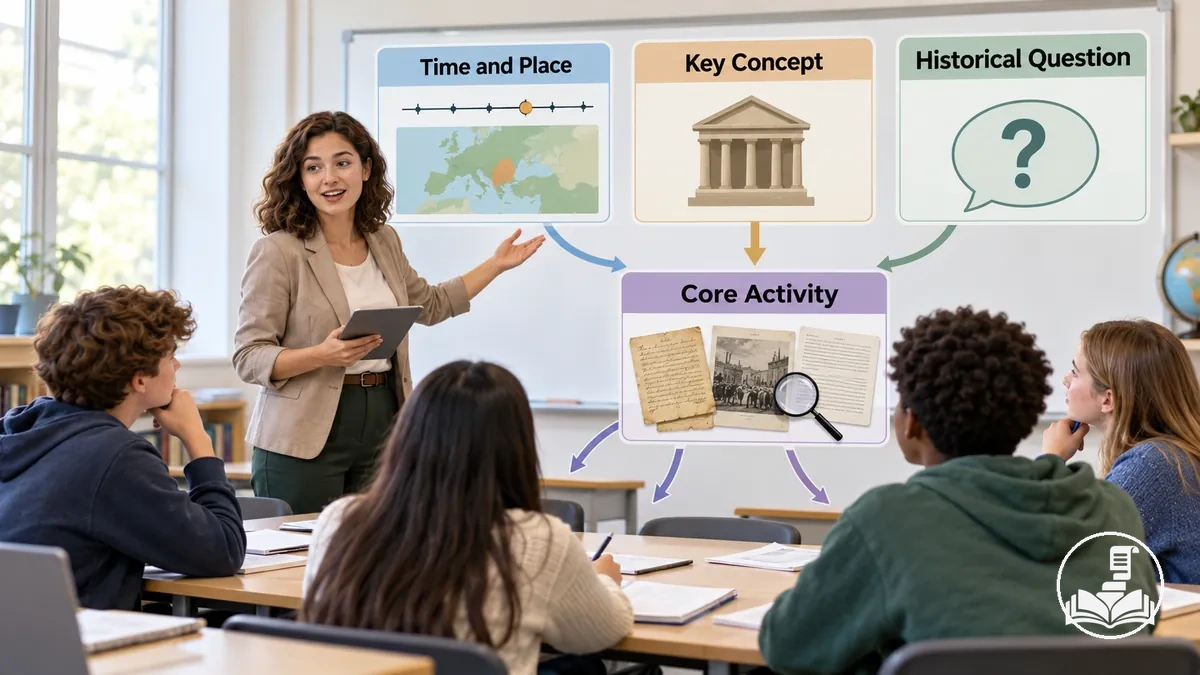
- Prior knowledge: activate background students need to connect the new historical focus with relevant knowledge they already hold.
- Time and place: locate the event, development, source, or question in the historical setting needed for interpretation.
- Key people or historical concepts: identify only the actors or concepts students need to make sense of the core task.
- Essential vocabulary: introduce terms whose meaning students need in order to interpret the material or instructions accurately.
- Historical question: frame the question that gives the core activity a clear historical purpose and directs attention to the evidence or content students will examine.
Develop the Core Historical Learning Activity
The core historical learning activity should carry the main historical thinking or knowledge work required by the intended learning.
Its learning function determines what historical content or evidence students work with, what student action the task requires, and what response should result.
Activity choice should therefore follow the learning purpose rather than novelty, entertainment value, or the availability of a resource.
The suitable activity type varies with the historical content, learner context, available time, and desired learning output.
Activity-purpose alignment can be tested as a chain from historical content or evidence to student action, cognitive demand, and an observable learning output.
What students work with identifies the content, evidence, or source material available for the task; what students must do with it identifies the cognitive action required, such as selecting relevant evidence, interpreting information, comparing accounts, or constructing an explanation.
The expected response should then make that work observable in a form appropriate to the intended learning, such as an evidence selection, comparison, interpretation, or explanation.
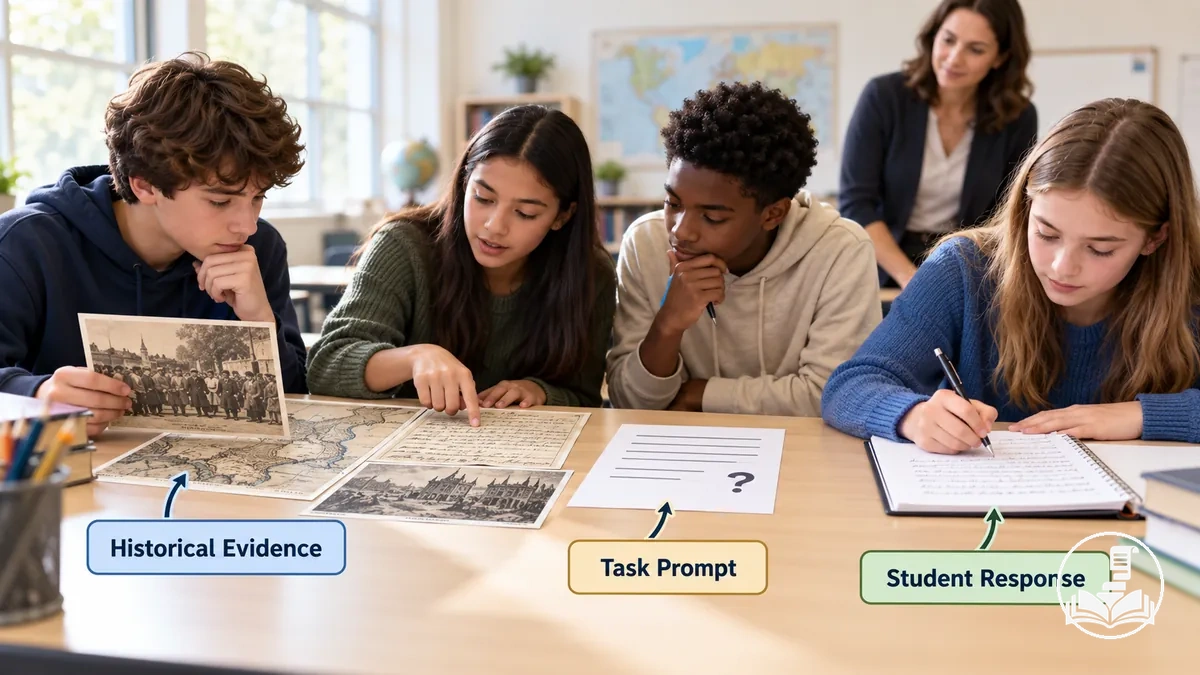
- Historical content or evidence: select material that gives students what they need to address the intended learning rather than choosing a resource simply because it is available.
- Student action: specify what students must do with that material, so the activity requires more than receiving or reproducing information when the intended learning calls for interpretation or explanation.
- Cognitive demand: align the thinking required by the task with the intended learning, such as identifying, comparing, interpreting, evaluating, or explaining.
- Learning output: require an observable response that reflects the intended student action and provides evidence of the historical work completed.
For example, asking students to annotate a historical source can be well aligned when the intended learning requires identifying evidence and explaining its significance, but the same activity is poorly aligned if students merely highlight unfamiliar words when the intended learning requires comparing competing historical explanations.
The activity type has not changed; its suitability changes with the required student action, cognitive demand, and learning output.
Activity choice should therefore follow learning function, not novelty.
End With Synthesis and a Check of Learning
The lesson close should consolidate the central historical idea and produce observable evidence connected to the intended learning. The routine can vary; an exit ticket or recap is only one possible form.
- Ask a focused synthesis prompt.Ask students to state, explain, connect, or demonstrate what the lesson developed. A prompt such as “Which factor most influenced this historical development, and what evidence supports your explanation?” directs attention to a specific relationship more clearly than a generic “What did you learn?”
- Observe the historical response.The output should make the intended historical connection visible in what students can express at that point in the lesson.
- Use the response to guide follow-up.A relevant, sufficiently clear response can support concluding the lesson; an incomplete or unclear response identifies a point to revisit.
Boundary: one brief closing check is evidence of current performance, not proof of complete understanding and not a full assessment framework.
Allocate Time Across the Lesson Sequence
Time allocation should distribute usable time across each lesson stage according to its instructional function rather than a fixed percentage or universal ratio.
The core activity should receive enough uninterrupted time to perform its intended historical learning function, while other stages should receive the time their purposes require.
The allocation therefore depends on lesson length, topic complexity, classroom routines, learner needs, and the work required at each stage.
A fixed-ratio allocation applies the same proportions regardless of those conditions, whereas condition-based allocation adjusts estimated minutes when the lesson requirements change.
Usable time is the part of the lesson length available after necessary setup, transition, and routine costs are considered.
For each lesson stage, estimate the duration needed for its instructional purpose and identify an adjustment condition that would justify shortening or extending it.
Where no evidence supports a universal duration, the estimate should remain specific to the actual class period, task complexity, and learner needs.
The table therefore treats estimated time as a planning decision rather than a standard timing rule.
| Lesson stage | Instructional purpose | Estimated time | Adjustment condition |
|---|---|---|---|
| Orientation | Establish the historical focus and necessary context | Teacher-set estimate within the usable time, kept only as long as needed to establish required context | Shorten when students already have the required context; extend when essential background must be established |
| Core activity | Complete the main historical thinking or knowledge work | Reserve the largest uninterrupted block required by the planned task within the available usable time | Extend when the task requires more source processing or explanation; reduce scope or activity complexity when usable time is limited |
| Connection and consolidation | Relate findings or evidence to the historical focus | Teacher-set estimate sufficient for students to connect the core work to the historical focus | Extend when students need more time to connect evidence to the central historical idea |
| Synthesis or closing check | Express or demonstrate the intended learning | Teacher-set estimate sufficient for the planned student output or closing response | Shorten or extend according to the form and complexity of the required student output |
If a shorter period does not provide enough usable time for the planned core activity, reduce the scope of historical content or simplify the activity rather than compressing every lesson stage by the same proportion.
The resulting timing plan should reflect the actual lesson length and conditions rather than an assumed fixed ratio.
Initial time allocation establishes a workable plan before teaching; repeated overruns, unfinished stages, or persistent pacing failures are a separate issue addressed through troubleshooting lesson flow and timing.
Organise Historical Content and Activities Around the Lesson Sequence
Historical content and activities should be placed according to what each lesson stage needs to accomplish for the same learning purpose. Relevance depends not only on what belongs in the lesson, but also on where it functions within the sequence.
For example, a historical source may be relevant to the lesson but misplaced if students encounter it before they have the prerequisite context needed to interpret its significance; placing the same source after that context can give it a clearer function in the activity.
Complete history lesson plan examples can show how content chunks, activity placement, and student output relate across a sequence in practice.
Every item should ultimately earn its place through a clear contribution to the lesson stage and learning purpose.
Choose a Coherent Order for Historical Content
Content order should follow the historical relationship students need to understand for the lesson’s learning purpose. The choice concerns content inside the current lesson, not the sequence of an entire history course.
Choose the ordering logic from the relationship
- Chronology
- Use when event sequence is necessary for interpreting what led to what.
- Cause and consequence
- Use when the lesson needs to foreground relationships between conditions, actions, and outcomes.
- Change over time
- Use when students need to examine what changed, persisted, or developed across a period.
- Comparison
- Use when the learning purpose depends on relating cases, accounts, or perspectives to each other.
- Concept development
- Use when students need to build a historical concept before they can interpret later material.
Judge the order by whether it makes the intended historical relationship more explicit and supports student understanding. Chronology can clarify causation when sequence matters, while thematic or conceptual grouping can be clearer when the purpose is to compare the same concept across different cases.
Match Each Activity to Its Function in the Lesson
Each activity should be selected for the learning function it performs at a particular lesson stage rather than for novelty or entertainment value.
The required function determines the activity type, the student action it should elicit, and the expected response that makes the work observable.
Retrieval, explanation, source analysis, discussion, writing, and synthesis can each fit different purposes, depending on the intended learning and learner context.
Activity choice should therefore change when the required learning function changes.
Activity-purpose matching begins with the lesson stage and the learning function required at that point, then identifies an activity type that requires an appropriate student action.
The expected response should correspond to that action, such as recalled information for retrieval, an evidence-based interpretation for source analysis, or a concise explanation for synthesis.
This stage-to-function-to-activity-to-response relationship keeps activity selection tied to the lesson purpose without requiring one activity type to serve every context.
The following matches are generic examples rather than fixed prescriptions.
| Lesson function | Possible activity type | Student action | Expected response |
|---|---|---|---|
| Retrieval | Brief recall prompt | Recall relevant prior knowledge | Relevant facts, terms, or ideas needed for the lesson |
| Explanation | Focused explanation task | Connect historical information or ideas | A concise explanation of the specified relationship |
| Source analysis | Historical source task | Examine and interpret relevant evidence | An interpretation supported by information from the source |
| Discussion | Focused discussion prompt | State and examine historical claims or interpretations | A reasoned contribution connected to the lesson question |
| Writing | Short written response | Organise evidence or ideas into a written account | A response that expresses the historical relationship required by the task |
| Synthesis | Closing synthesis prompt | Connect the lesson's main findings to its historical focus | A concise statement or explanation of the learning developed |
An engaging activity can still be misaligned when its student action and expected response do not address the intended learning; for example, an elaborate recall game would not fit a lesson stage that requires students to interpret evidence from a historical source.
A simpler source-analysis prompt can be better aligned in that situation because it requires the student action and expected response that the learning function calls for.
The appropriate activity is therefore the one that fits the required function, not the one that appears most elaborate or entertaining.
Use a Final Planning Check Before Teaching the Lesson
Before teaching, verify that scope, sequence, timing, activities, resources, transitions, and the closing check all support the same intended learning. Keep conditions that are already satisfied and revise any that fail.
Pre-teaching coherence check
- Does the lesson scope fit the intended learning without including content that does not contribute to it?
- Does the sequence place historical context, content, and activities in an order that students can follow?
- Does the timing fit the usable lesson time, including necessary setup and closing time?
- Does every activity have a defined activity purpose that contributes to the intended learning?
- Are the required resources and historical materials ready and accessible for the planned activities?
- Are transitions between lesson stages realistic within the available time and classroom conditions?
- Does each major content chunk have a clear function within the lesson rather than merely adding topic coverage?
- Does the core activity provide enough opportunity for students to complete the historical work the lesson requires?
- Does the closing check elicit evidence that is relevant to the intended learning?
- Is the overall plan coherent enough that its scope, sequence, timing, activities, resources, transitions, and closing check support the same learning purpose?
- Would removing any activity or content chunk improve coherence without losing the intended learning?
A failed check reveals a condition that should be revised before teaching, but it does not by itself prove that a particular planning mistake has occurred.
A fuller review of recurring errors belongs with lesson planning mistakes to avoid; this final review is limited to pre-teaching readiness and coherence.
The final pruning test is whether any remaining content or activity can be removed without losing the intended learning.