
Writing Clear Learning Objectives for History Lessons
A clear history lesson objective names the historical learning students should demonstrate, uses an observable student action, and adds only the scope, quality, or evidence condition needed to judge success. Measurable does not mean numerical: the student response or product must provide interpretable evidence of the intended historical knowledge or historical thinking.
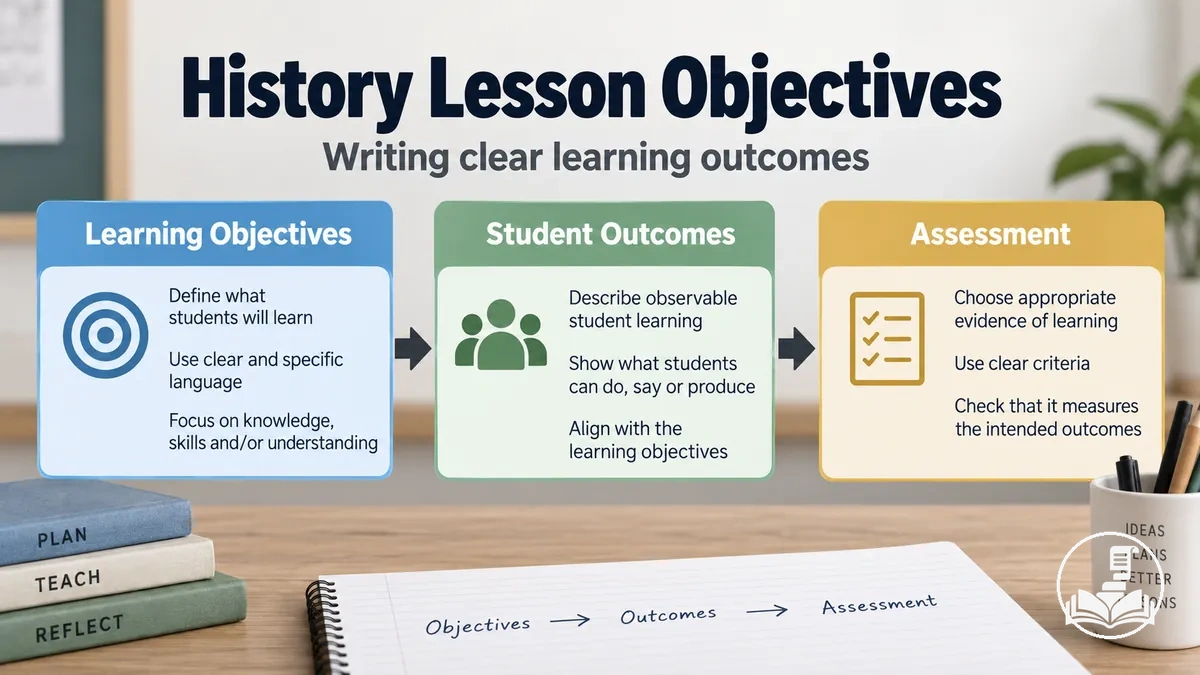
Write the outcome before the activity
Build a measurable history lesson objective
Use the same four relationships explained throughout this guide: historical focus, observable action, a relevant performance condition, and evidence. The last two are optional when the lesson context already makes them clear.
Draft objective: Add a historical focus and choose an observable action to generate a draft.
Use the output as a draft, not a formula. Confirm that the action can produce evidence of the intended learning and that any condition fits students' prior knowledge, lesson time, content, and assessment context.
A learning objective defines the outcome, not the classroom activity or the whole assessment design. Its wording should be specific enough to interpret the expected performance while remaining adaptable to the historical content, student level, available lesson time, and evidence the lesson can realistically produce.
Table of Contents
What Clear History Lesson Objectives Need to Specify
A clear history lesson objective specifies the intended learning, the observable performance through which a student can demonstrate that learning, an appropriate scope or quality, and usable evidence of the learning outcome.
These criteria make the expected learning interpretable without imposing identical wording on every objective.
The criteria work together rather than as a fixed formula: intended learning identifies the expected historical learning, while observable performance makes that learning visible through a student action or response.
Scope, quality, conditions, and evidence can be made more explicit when the lesson content, student level, available time, or intended evidence makes that detail necessary for interpretation.
The annotated example visually separates these parts so their relationship within one objective is easier to recognize.
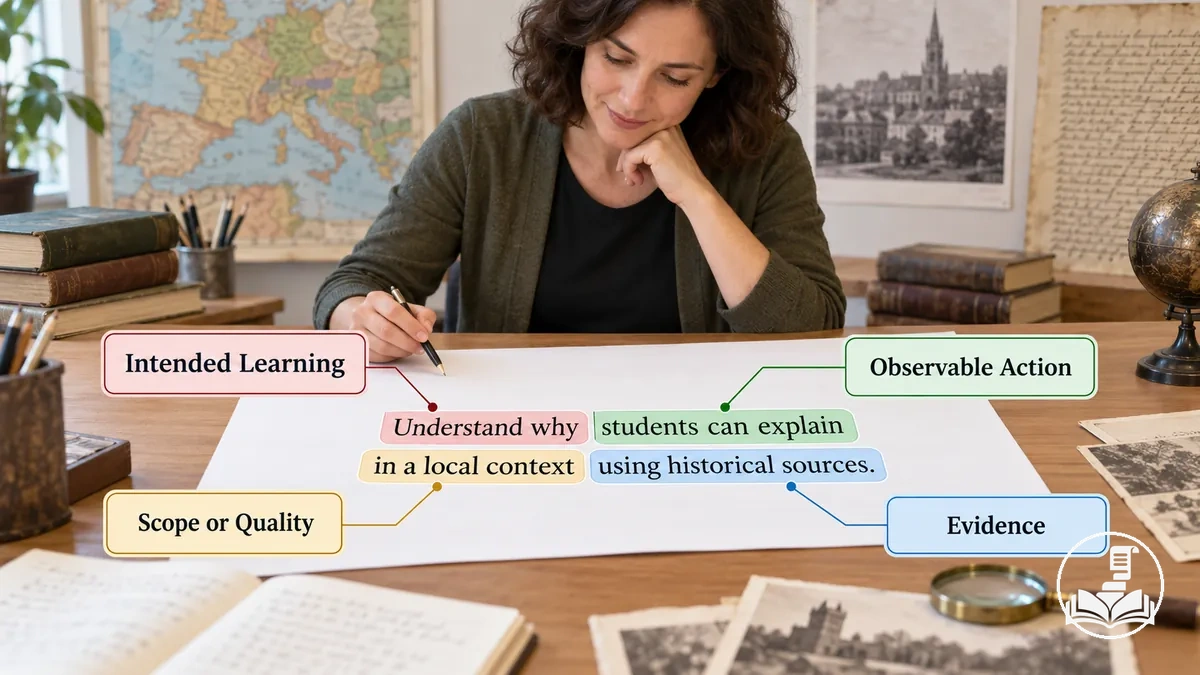
- Intended learning: specifies the historical learning the student is expected to develop or demonstrate.
- Observable performance: indicates an action, response, or other performance through which the intended learning can be observed.
- Scope: identifies the relevant breadth, depth, content boundary, or condition when the objective would otherwise be ambiguous.
- Quality: makes an expected characteristic of performance explicit when that distinction is necessary for interpreting the objective.
- Evidence: indicates what student response or work could provide usable evidence of the intended learning outcome.
Intended learning and interpretable student performance are essential, while the necessary precision for scope, quality, conditions, and evidence depends on the lesson context.
Decisions about activities, sequencing, resources, and the wider lesson belong to history lesson planning rather than to the objective criteria themselves.
Historical Knowledge and Historical Thinking Skills as Learning Outcomes
Historical knowledge and historical thinking skills represent different learning emphases within a history lesson objective, rather than competing levels of value.
Historical knowledge focuses on what students know about facts, concepts, chronology, and historical contexts, while historical thinking focuses on what students do with that knowledge and with evidence through reasoning about causation, perspective, significance, or interpretation.
The comparison below uses the same basis for both learning outcomes so the distinction remains clear without treating them as mutually exclusive.
| Learning focus | What students demonstrate | Typical evidence |
|---|---|---|
| Historical knowledge | Knowledge of relevant facts, concepts, events, people, and chronology | An accurate explanation, description, identification, or chronological account |
| Historical thinking skills | Application of historical knowledge and reasoning to evidence, causation, perspective, significance, or interpretation | Analysis of a source, comparison of perspectives, explanation of causation or significance, or an evidence-based interpretation |
The image contrasts knowledge-focused and thinking-focused learning outcomes while showing their possible overlap within the same learning objective.
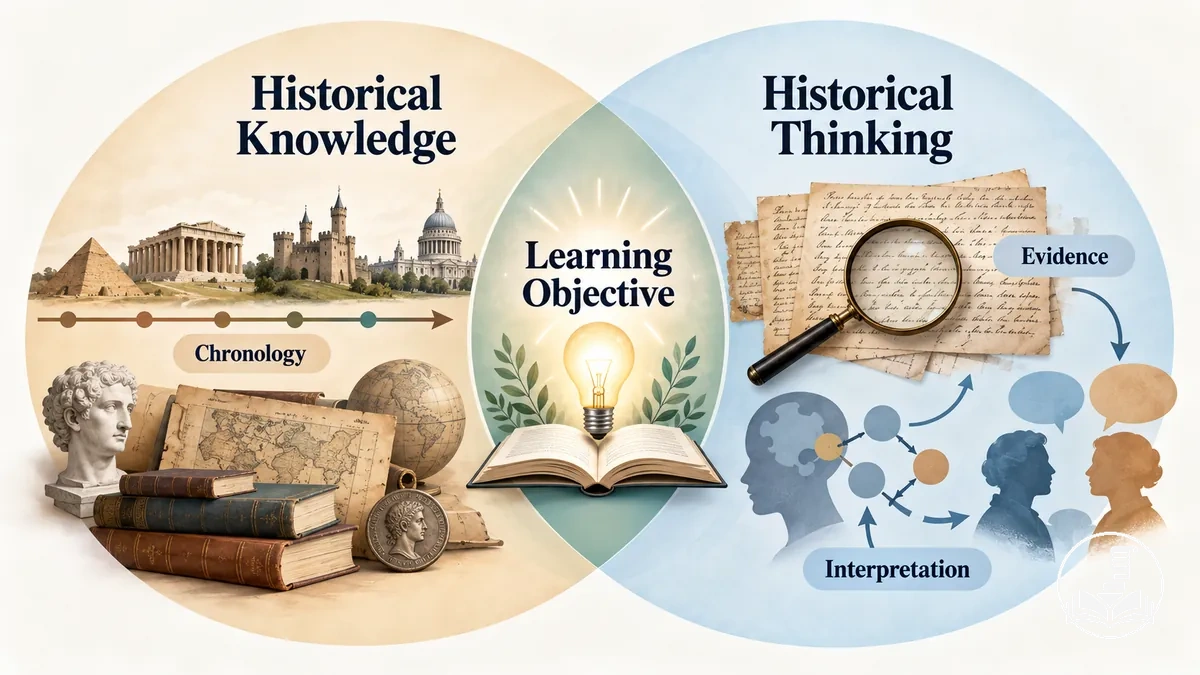
For example, a knowledge-focused objective might ask students to explain the chronology of a historical event, while a related historical thinking objective might ask them to interpret evidence about why the event occurred.
The second learning outcome applies historical knowledge through disciplinary thinking rather than replacing it.
Many objectives legitimately combine both, with the intended learning and available evidence determining the emphasis.
Observable Evidence of Learning
Observable evidence of learning is an action, response, or product from which the learning stated in an objective can reasonably be inferred.
The evidence must connect student performance to the intended learning; completing an activity alone does not demonstrate that the student has shown the knowledge or historical reasoning the objective describes.
Different forms of historical learning can produce different observable demonstrations, and observability does not require reducing complex reasoning to something that is merely countable.
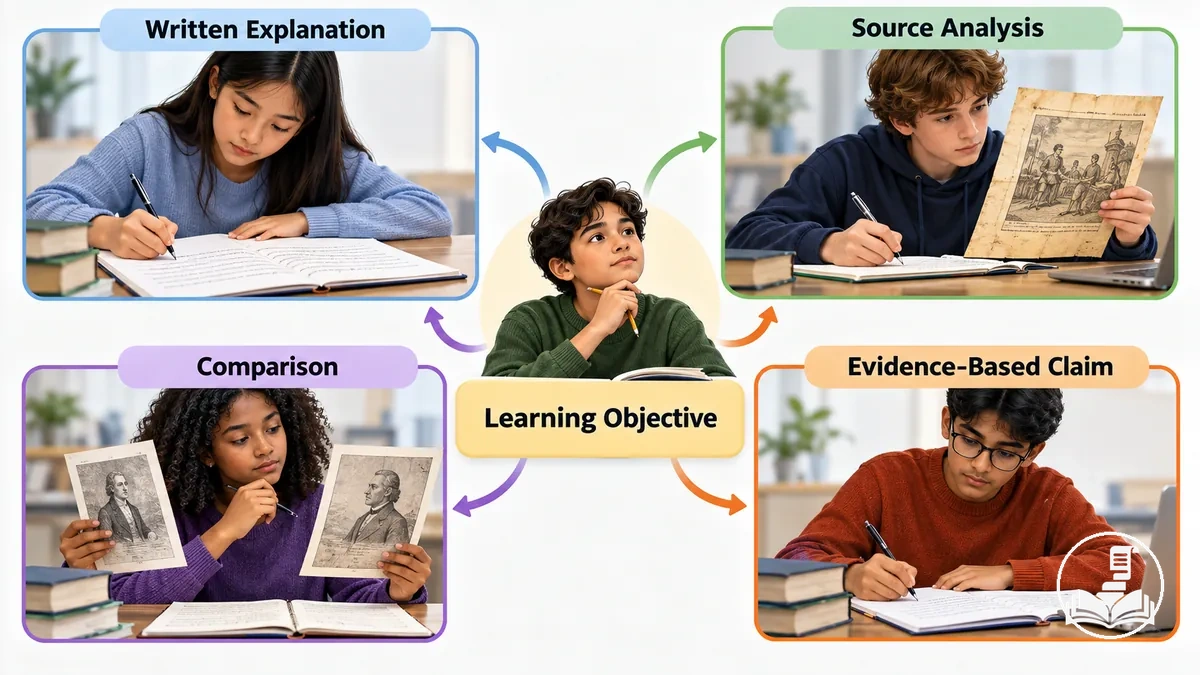
A written explanation can reveal reasoning about causation, a comparison can show how a student distinguishes interpretations, a source-analysis response can provide evidence of how the student interprets a source, and support for a historical claim can reveal how evidence is used.
The image illustrates these different forms of student response while keeping the inference about learning tied to what each response actually demonstrates.
Scope and Level of Expected Performance
The expected level of performance can be bounded by relevant dimensions such as scope, depth, quality, accuracy, independence, or complexity when those dimensions affect what successful learning means in the lesson.
Explicit limits are useful when the objective would otherwise leave the expected breadth or standard of student performance unclear; dimensions that are already clear from the lesson context can remain implicit.
The image contrasts an under-specified objective with an appropriately bounded objective, showing how scope, depth, and evidence expectations can make the intended performance more interpretable without imposing arbitrary precision.
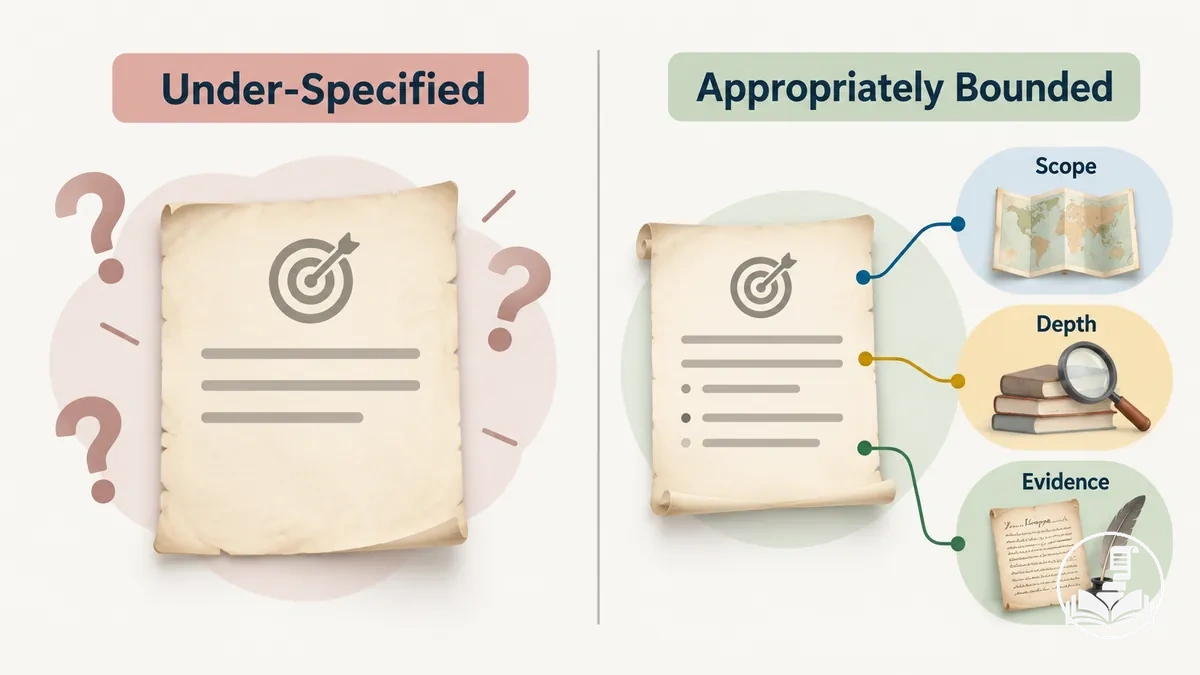
- Scope: specifies the breadth of content when students need a clear boundary on what part of a topic, event, or issue their performance should address.
- Depth: indicates how far an explanation or analysis should develop when a brief identification would not represent the intended learning.
- Evidence use: makes the expected use of historical evidence explicit when supporting or interpreting a claim is part of the objective.
- Accuracy: matters when successful performance depends on historically accurate content, chronology, concepts, or evidence use.
- Independence and complexity: can be specified when the objective depends on how independently students work or how demanding the reasoning is, rather than merely whether a task is completed.
- Quality: indicates the relevant characteristics of a successful response when the expected standard would otherwise remain ambiguous.
These dimensions do not require fixed thresholds or identical wording in every objective.
For example, an expectation to explain a historical cause may be appropriately bounded by the content covered and the evidence available, while an arbitrary numerical requirement may add false precision without clarifying the intended learning.
Appropriate expectations remain conditional on the lesson time, students' prior knowledge, their level of learning, and the instructional scope.
How to Write a Measurable History Lesson Objective
Write a measurable history lesson objective by defining the intended learning, choosing an observable action that demonstrates that learning, setting an appropriate performance condition, and checking what evidence could verify the expected outcome.
The historical content, student level, and intended evidence should determine how specifically each part is expressed rather than forcing every objective into the same sentence pattern.
The sequence turns a broad historical-learning goal into an assessable outcome by giving each part a distinct purpose and check.
Follow the steps in order, then revise any part that does not make the intended learning or expected performance sufficiently interpretable.
- Define the intended learning. Identify the historical knowledge, understanding, or reasoning students should develop, keeping the learning outcome distinct from the activity used to teach it.
- Choose an observable action. State what students will do to demonstrate the intended learning, such as explaining a cause, comparing interpretations, analysing evidence, or supporting a historical claim.
- Set the performance condition. Specify relevant scope, evidence use, level of explanation, or other expectations when the objective would otherwise leave the expected performance unclear.
- Check the evidence. Identify the student response or product that could provide evidence of the intended learning, and check that the observable action can actually produce that evidence.
- Verify and revise. Read the complete objective and verify that the intended learning, observable action, performance condition, and evidence align; revise any element that remains ambiguous or does not fit the historical content or student level.
The image summarizes how the parts of a measurable history lesson objective connect within the writing process, making the progression and possible revision easier to follow without replacing the ordered steps.
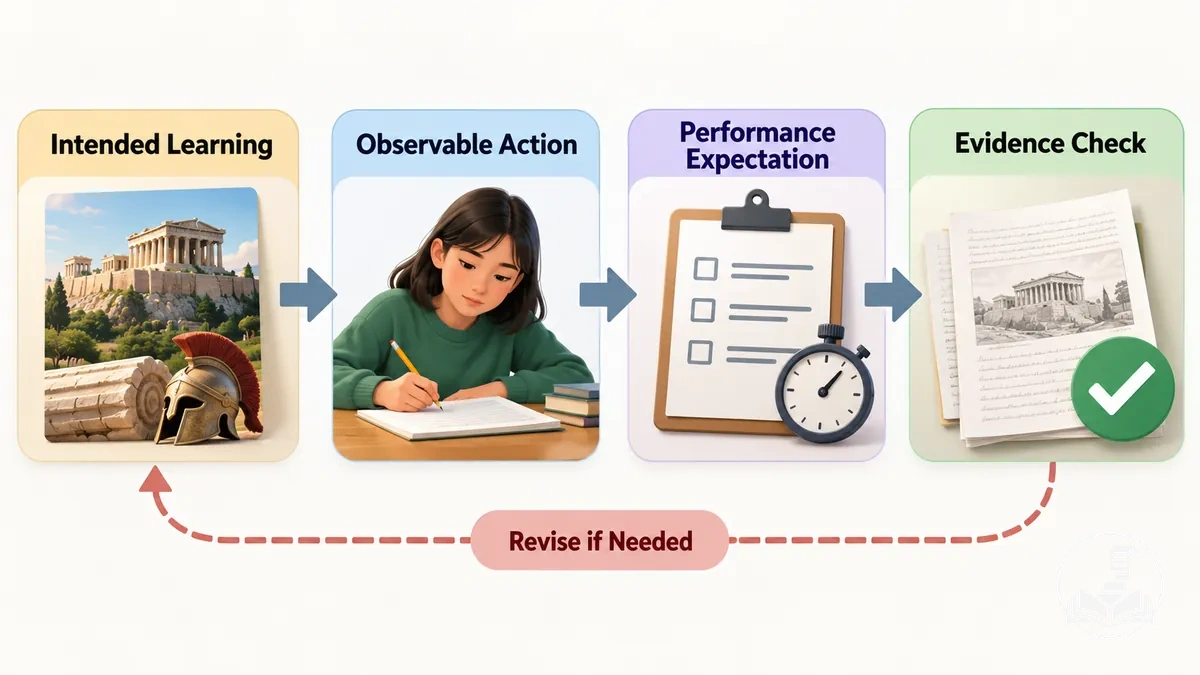
A measurable objective is verified by whether the expected student performance can provide suitable evidence of the intended learning, not by whether it follows one fixed formula.
Its wording can be adapted to the historical content, student level, scope, and intended evidence while keeping the learning outcome observable enough to assess.
Define the Intended Historical Learning
Identify the intended historical learning before selecting a classroom activity by naming the historical knowledge, concept, reasoning skill, or combination that students should gain.
Narrow the lesson focus into a specific learning target rather than treating what students will merely do during the lesson as the objective.
The image shows how a broad history topic can be narrowed through a selected learning focus and relevant constraint into achievable intended learning.
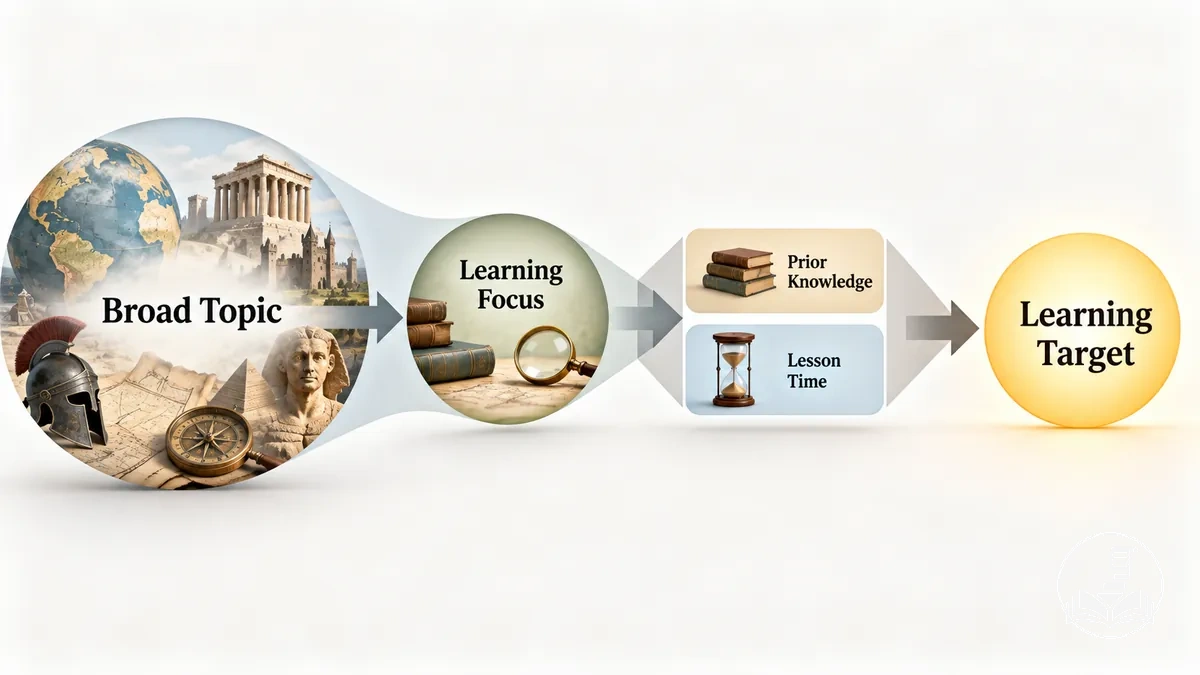
For example, instead of using a broad topic such as the causes of a historical event as the learning target, select the particular historical knowledge or reasoning skill students should demonstrate about those causes.
Prerequisite knowledge and student level determine what understanding can reasonably be assumed, while lesson time and the available historical content act as a constraint on the achievable scope.
The resulting objective focus should be narrow enough to express the intended learning without expanding into a complete lesson sequence.
Decisions about activities, resources, and sequencing belong to the broader process of planning a history lesson.
Choose an Observable Learning Action
Choose an observable action that makes the intended learning visible without changing what students are expected to learn.
The action should produce evidence that can be interpreted against the objective, so its suitability depends on the historical knowledge or reasoning the student must demonstrate rather than on choosing a supposedly more complex or impressive verb.
Match the action to the learning
- Identify
- Recognise or select relevant historical information.
- Explain
- Show a relationship, such as how a cause contributed to an outcome.
- Compare
- Distinguish relevant similarities and differences between accounts, events, or interpretations.
- Analyse
- Reason about a source, evidence, or relationship rather than merely locating information.
- Evaluate
- Make a judgement supported by relevant criteria or evidence.
- Construct an evidence-based interpretation
- State a historical claim and justify it with relevant evidence and reasoning.
For example, wording such as “understand the causes of an event” leaves the student action unclear, whereas “explain how selected causes contributed to the event” states an observable action that can produce interpretable evidence of the intended learning.
Set the Expected Level of Performance
Set the expected performance by adding only the condition needed to make successful student performance interpretable.
Choose the condition that changes how success should be interpreted; not every objective needs every performance dimension.
What each performance condition clarifies
- Quality
- A relevant characteristic of a successful response beyond simple completion.
- Depth
- The level of explanation or analysis expected beyond identification.
- Independence
- How much support or prompting is acceptable when independent performance matters.
- Accuracy
- Whether historically correct content, chronology, concepts, or evidence use are necessary to success.
- Completeness
- Whether the response must address the relevant parts of the defined scope.
Avoid arbitrary precision or a condition that cannot reasonably be observed within the lesson.
For example, “explain the causes of the event” names an action, whereas “explain the relevant causes and support the explanation with historical evidence” also states an interpretable performance expectation without inventing a fixed threshold.
Check the Objective Against Assessment Evidence
Check objective-assessment alignment by confirming that the assessment evidence reveals the same historical knowledge or historical skill named in the objective.
The student task should require an action that addresses that intended learning, because completing an activity alone is insufficient when the resulting evidence does not reveal the stated outcome.
Alignment exists when the objective, student task, evidence, and performance expectation address the same learning relationship.
The interpretive standard should support a judgement about the performance described by the objective rather than introduce a different learning demand.
- Objective to task: Check that the student task requires students to perform the historical knowledge or historical skill expressed in the objective.
- Task to evidence: Check that completing the task produces a student response or product that can serve as assessment evidence for the stated action.
- Evidence to learning: Check that the evidence reveals the intended historical learning rather than merely showing that the activity was completed.
- Evidence to performance expectation: Check that the evidence supports interpretation against the condition or standard specified for successful performance.
For example, if an objective asks students to compare two historical interpretations, a task that only asks them to identify each interpretation is mismatched because its evidence does not reveal the intended comparison; requiring students to compare the interpretations and support the comparison with relevant evidence aligns the task more closely with the objective.
This local alignment check establishes whether revision is needed, while the broader process of assessing history lesson outcomes addresses how lesson outcomes are evaluated beyond the wording of the objective.
Check for Common Objective-Writing Mistakes
Common objective-writing mistakes can weaken clarity, measurability, or alignment between the intended historical learning and the evidence students produce.
Check for vague wording, activity-focused phrasing, excessive scope, an unobservable outcome, an overloaded objective, or mismatched evidence only where each issue changes how the objective can be interpreted or verified.
Each mistake can be checked by identifying its consequence, looking for a recognition cue in the drafted objective, and making the smallest correction that preserves the intended historical learning.
The aim is to diagnose objective-specific wording problems rather than treat stylistic preferences as errors.
- Vague wording: creates ambiguity about what students should demonstrate. A recognition cue is wording that names a broad state of learning without indicating what students will observably do; correct it by expressing the intended learning through an observable action.
- Activity-focused wording: obscures the learning outcome when the objective states what students will complete rather than what they should learn or demonstrate. If removing the activity leaves the intended learning unclear, correct the objective by naming the historical knowledge or skill the activity is meant to develop.
- Excessive scope: makes the objective difficult to achieve or interpret within the lesson when it combines more historical content or reasoning than the lesson can reasonably address. Recognise it when the objective spans several substantial outcomes, then limit it to the learning that fits the lesson context.
- Unobservable outcome: prevents the wording from indicating how the intended learning could become visible in student performance. If the objective does not state an action capable of producing interpretable evidence, correct it by selecting an observable action that matches the intended historical learning.
- Overloaded objective: combines distinct learning demands in a way that makes the expected performance unclear. Recognise it when several actions or outcomes compete within one objective, then retain the related learning that needs to be demonstrated together or separate genuinely distinct outcomes where appropriate.
- Mismatched evidence: weakens alignment when the student response does not address the learning or performance described by the objective. Check whether the expected evidence can reveal the stated outcome, then revise the objective wording or task relationship without treating activity completion itself as evidence of learning.
For example, “complete a worksheet about the causes of the event” is activity-focused, whereas “explain how selected causes contributed to the event” preserves the historical focus while making the intended learning observable.
These objective-specific checks form one part of identifying common objective and planning mistakes without expanding the objective review into broader lesson-planning diagnosis.
History Lesson Objective Examples
An effective history lesson objective example makes the historical content, observable action, expected performance, and evidence inspectable within the wording or its immediate lesson context.
The examples below show different ways a measurable objective can connect what students are learning with what they will do and what evidence could demonstrate the intended outcome.
Read each example for the relationship among content focus, student action, performance expectation, and evidence rather than as model wording to reproduce unchanged.
The appropriate wording should be adapted to the lesson context, student level, historical content, and scope so that the expected performance remains realistic and interpretable.
Worked examples: inspect the relationship, not just the wording
Causation
Objective: Explain how two selected causes contributed to the outbreak of a studied historical conflict.
Why it works: The objective identifies a defined causal focus and uses the observable action “explain”; a student response that connects each selected cause to the outbreak can provide evidence of the intended causal reasoning.
Comparison
Objective: Compare two historical accounts of the same event by identifying a relevant similarity and difference in their interpretations.
Why it works: Comparison is the observable action, and the expected performance requires attention to both similarity and difference. The completed comparison can therefore reveal whether the student can distinguish the two interpretations.
Source analysis
Objective: Analyse a selected primary source to identify the author's perspective and support the interpretation with relevant evidence from the source.
Why it works: The objective requires a historical skill rather than simple source completion, and the expected performance connects interpretation with evidence use. The student's source analysis can show whether the stated perspective is supported by relevant evidence.
Significance
Objective: Construct an evidence-based interpretation of why a studied historical development was significant, using relevant historical content to support the judgement.
Why it works: The student must make and support a historical interpretation rather than merely identify the development. The resulting explanation provides evidence through the relationship among the significance judgement, selected historical content, and supporting reasoning.
Objectives for Historical Knowledge
A historical knowledge objective makes factual knowledge or conceptual understanding the primary learning outcome and states an observable demonstration through which students can show that knowledge.
The content and expected performance can vary with the lesson scope, so knowledge-focused objectives may require students to identify accurate historical information, describe relevant features, or explain a historical concept.
Factual knowledge is demonstrated when students accurately identify or describe specified historical content, while conceptual understanding requires them to show how relevant facts relate within a historical idea or concept.
The observable demonstration should therefore match the intended learning outcome: identification may suit a bounded factual target, whereas explanation is more appropriate when students need to demonstrate conceptual understanding.
Objective: Identify the main terms of a studied historical agreement and accurately describe what each term required.
This example focuses on factual knowledge within defined content and makes the expected performance observable through identification and accurate description.
Objective: Explain how the concept of continuity and change applies to a studied period by describing what changed and what remained consistent within the selected scope.
This knowledge-focused objective targets conceptual understanding; the explanation can provide evidence that students understand the concept in relation to the historical content rather than merely recognising its name.
Objective: Describe the roles of selected institutions within a studied historical system and explain how those roles relate to the system's operation.
This example combines content knowledge with an observable demonstration of conceptual relationships, allowing the learning outcome to be assessed through the accuracy of the description and the relevance of the explanation.
Objectives for Source Analysis and Evidence
A source-analysis objective requires students to interpret a historical source or use evidence in reasoning rather than merely locate information.
The objective should connect a relevant source feature to an analytical action and an observable response, with the depth of interpretation matched to the lesson scope and students' expected level of source analysis.
Key distinction: identifying evidence is not analysing it
Identify evidence
Locate or select information from a historical source that is relevant to a question or claim.
Analyse evidence
Explain how selected information contributes to an interpretation or claim through reasoning.
A student can identify relevant evidence without yet analysing its significance. When analysis is the learning outcome, the response should connect the evidence to the claim rather than present the selected information alone.
Objective: Identify evidence in a selected historical source that indicates the author's perspective on a studied event.
This introductory source-analysis objective makes identification observable while requiring students to select evidence connected to a specific source feature: the author's perspective.
Objective: Analyse how selected evidence from a historical source supports a claim about how people experienced a studied event.
This objective moves beyond identifying evidence by requiring students to connect the selected material to a historical claim through explicit reasoning.
The response can be evidenced by how clearly the student interprets the evidence and explains its relevance to the claim.
Objective: Interpret a historical source in its relevant context and use specific evidence from the source to support a conclusion about the perspective it represents.
This example requires students to connect context, source feature, evidence, and interpretation.
The expected performance is an observable response in which the conclusion is supported by relevant evidence and reasoning, without requiring a broader evaluation of source reliability unless that is part of the lesson objective.
Objectives for Historical Explanation and Reasoning
A historical explanation and reasoning objective makes a specific relationship, such as causation, consequence, change, continuity, significance, perspective, or interpretation, observable in student performance.
Rather than using vague wording such as “understand causation,” the objective states what students will explain or interpret and, where appropriate, how evidence should support the historical explanation.
What changes with the reasoning relationship
- Causation
- Connect relevant contributing factors to a historical outcome.
- Consequence
- Explain what followed and how or why it mattered.
- Change and continuity
- Account for what altered and what persisted within the defined period or scope.
- Significance
- Make a reasoned judgement about why a historical development matters.
- Perspective and interpretation
- Explain a viewpoint or historical claim in relation to relevant evidence.
The expected depth should match the lesson scope and available evidence rather than combining several distinct reasoning demands into one objective.
Naming a factor identifies relevant information; constructing a supported explanation requires reasoning that connects that information to the historical question.
Objective: Explain how selected causes contributed to a studied historical event, using relevant evidence to support the causal reasoning.
This causation example requires more than naming contributing factors: the observable response explains how the selected causes relate to the event and supports that historical explanation with relevant evidence without implying that one cause provides a complete explanation.
Objective: Explain a significant change and a continuity within a studied historical period, supporting each explanation with relevant evidence.
This example makes change and continuity observable by requiring students to account for what changed and what persisted within the defined period.
The evidence supports the reasoning attached to each relationship rather than functioning as a list of historical details.
Objective: Interpret a historical perspective on a studied issue and support the interpretation with relevant evidence.
This objective makes interpretation the primary reasoning demand.
The observable response connects the perspective, evidence, and resulting claim without requiring students to prove the interpretation or perform a broader evaluation beyond the lesson's intended scope.