
Teaching With Primary Sources in History Lessons
To teach with primary sources in history lessons, begin with a focused historical question, choose sources that contain usable evidence, give only the context students need to start, and guide them from observation and sourcing to an evidence-supported, qualified interpretation. Increase or reduce scaffolding according to whether students can access the source and perform those analytical moves independently.

Primary-source lesson workflow
Use the sequence as a planning model: each step is a decision about evidence and support, not a fixed amount of lesson time.
- Start with the historical questionDefine a question the source set can genuinely help students answer.
- Choose usable evidenceSelect a source that is relevant to the question and accessible with proportionate support.
- Give minimum sufficient contextSupply the time, place, circumstances and provenance needed to begin without giving away the interpretation.
- Move from observation to interpretationObserve first, then source and contextualise before forming a qualified inference.
- Require an evidence-based explanationConnect a bounded claim to specific source evidence, reasoning and any important limitation.
- Adjust support from performanceModel or prompt when analytical moves are not yet secure, then reduce support as students demonstrate them independently.
The sequence preserves the central boundary of primary-source teaching: context and sourcing should constrain interpretation, while the claim must stay within what the evidence can support.
Table of Contents
Choose Primary Sources That Fit the Lesson Purpose
Choose primary sources for the lesson purpose and the evidence students need to examine before considering novelty or format.
Primary-source selection should first test whether the source is relevant to the historical question and contains evidence that students can use to address it.
Accessibility matters as a condition of use: difficult language, poor legibility, or unfamiliar context can increase the support students need without automatically making an otherwise relevant source unsuitable.
The selection criteria connect the historical question to source suitability.
Relevance and evidence value are essential fit criteria because they determine whether the source can serve the intended inquiry, while accessibility and prior knowledge are support-sensitive criteria because they affect how readily students can engage in analysis.
An annotated source can make this relationship concrete by showing how relevance, accessibility, and evidence value are checked against the lesson question before classroom use.
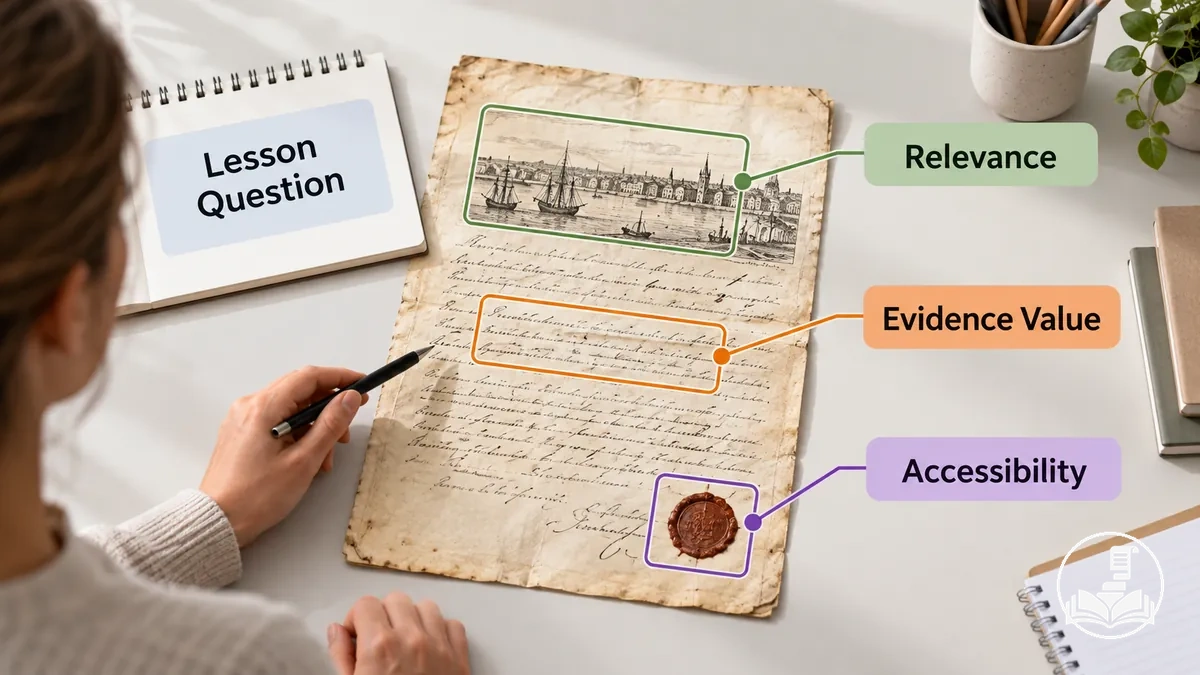
- Alignment with the historical question: if the source contains evidence directly relevant to the question students are investigating, it has a clear role in the lesson; if the connection is peripheral, its suitability decreases even when the source is historically interesting.
- Evidence and interpretive value: if the source gives students details, claims, perspectives, or other evidence from which they can develop and support an interpretation, it serves the evidence task; a source with little usable evidence for that task offers less interpretive value.
- Temporal relevance: if the source's date and circumstances connect to the period or development under investigation, students can use it as evidence for that historical question; a source from another period requires a clear evidentiary reason for inclusion.
- Accessibility: if students can read, view, hear, or otherwise examine the relevant evidence with appropriate support, the source remains usable; difficult language, length, legibility, or media quality can increase support needs when those barriers obstruct analysis.
- Students' background knowledge: if students have enough contextual knowledge to recognise the source's relevant people, events, circumstances, or concepts, they can focus more directly on interpretation; substantial knowledge gaps require additional context before meaningful analysis.
A well-matched source is both relevant to the historical question and accessible enough for students to examine its evidence with appropriate support.
A source may be highly relevant yet poorly matched for the immediate task if its language or required background knowledge prevents students from reaching the evidence the lesson asks them to analyse.
Match the Source to the Historical Question and Time Period
A source is useful when it can supply evidence for the specific historical question and has a meaningful relationship to the time period, event, or phenomenon being investigated.
Question fit should come before simple date or topic matching because the relevant issue is what claim the source can help students examine.
A source from the period may be relevant, but contemporaneity alone does not establish its evidentiary fit or reliability.
The visual compares one primary source against two historical questions to show how the same document can have stronger evidentiary fit for one question and weaker fit for another.
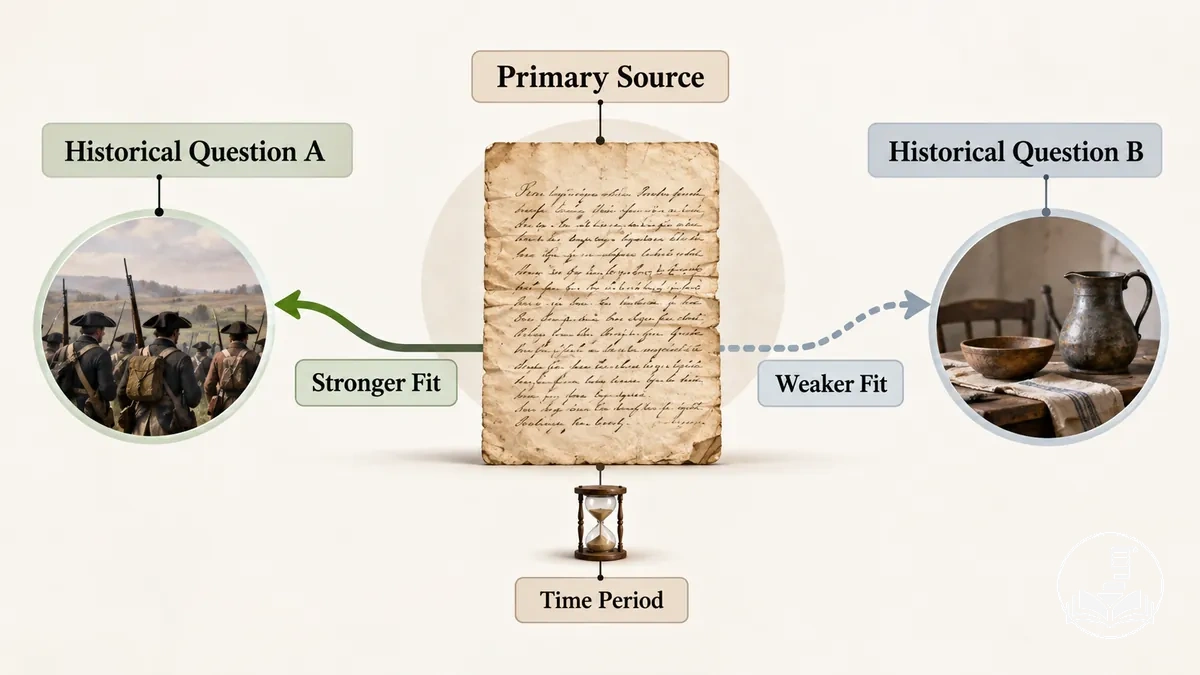
- Relevance to the historical question: the source should contain evidence that can help address the specific question or claim being investigated.
- Temporal relationship: the source's date should have a meaningful connection to the event, period, or later interpretation under study rather than being treated as sufficient evidence of usefulness by itself.
- Provenance: who created the source, when it was created, and the circumstances of its production should help clarify what kind of evidence the source can provide.
- Claim support: the source should be used only for claims its content and provenance can reasonably support; changing the historical question can therefore change the source's evidentiary role.
For example, a wartime recruitment poster can be highly relevant to a question about how authorities presented military service to a contemporary audience because its message, creator, intended audience, and provenance provide evidence for that claim.
The same poster would be weak evidence for a question about soldiers' private experiences unless the question specifically concerned how public messaging related to those experiences.
This contrast shows why source usefulness depends on the historical question, not on date matching alone.
Check the Source's Accessibility and Evidence Value for Students
Evaluate accessibility together with evidence value: students need to be able to reach and interpret the evidence, but the source does not need to be made maximally simple.
Language difficulty, length, legibility, background knowledge, and source complexity become access barriers when they prevent students from examining evidence required by the task.
Productive complexity can remain when limited support gives students meaningful access without removing the ambiguity or interpretation that makes the source useful for historical analysis.
The main criteria separate source difficulty that can be supported from difficulty that removes the possibility of meaningful analysis.
Each source attribute should therefore be checked for both its access condition and its effect on the evidence students need to interpret.
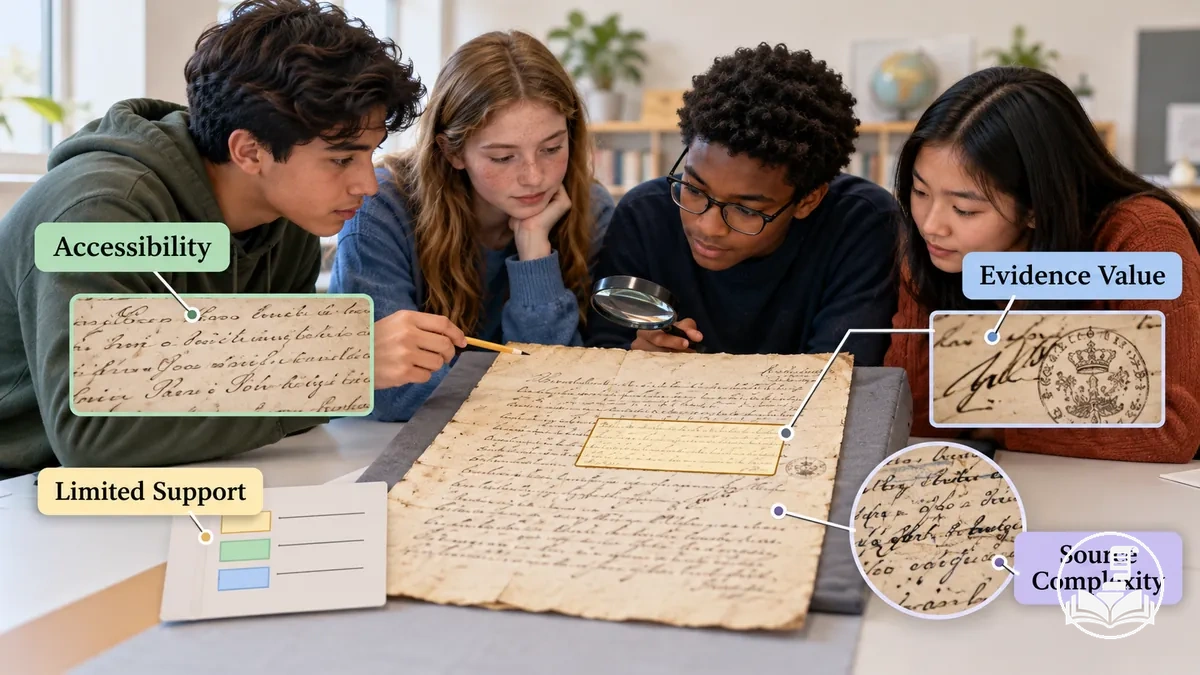
- Language difficulty: if unfamiliar vocabulary or syntax obscures otherwise useful evidence, limited vocabulary support can improve accessibility while leaving the source's substantive language available for analysis.
- Length: if the source is too long for students to locate and examine the evidence required by the task, a focused excerpt can reduce the length barrier while retaining the relevant passage and necessary context.
- Legibility or media quality: if handwriting, print quality, audio, or visual clarity prevents students from identifying relevant evidence, a clearer reproduction or transcript can improve access without changing the source's substantive content.
- Background knowledge and source form: if students cannot interpret the source because essential people, events, conventions, or features of its form are unfamiliar, limited contextual or form-specific support can supply prerequisite knowledge while preserving the analytical task.
- Interpretable evidence: if the source contains details, perspectives, claims, or ambiguity that students can examine and use in an interpretation, its evidence value remains meaningful; if the required evidence remains inaccessible even with proportionate support, another source or task may be more workable.
For example, a source with unfamiliar vocabulary can still provide productive challenge when brief vocabulary support allows students to interpret competing meanings or perspectives themselves.
If students still cannot identify the relevant evidence because the language, format, or required background knowledge remains inaccessible after limited support, the difficulty is obstructing analysis rather than contributing useful source complexity.
Broader learner-specific adaptation belongs within differentiating source-based history lessons.
Prepare Students With Enough Historical Context to Begin
Give students enough historical context to understand the source's basic time, place, circumstances, and stakes without giving them the interpretation they are expected to develop from the evidence.
The purpose of contextual preparation is to supply missing background knowledge that students need to begin analysis, not to explain what the source ultimately means.
The visual below shows only this essential grounding around a primary source so that preparation remains distinct from interpretation.
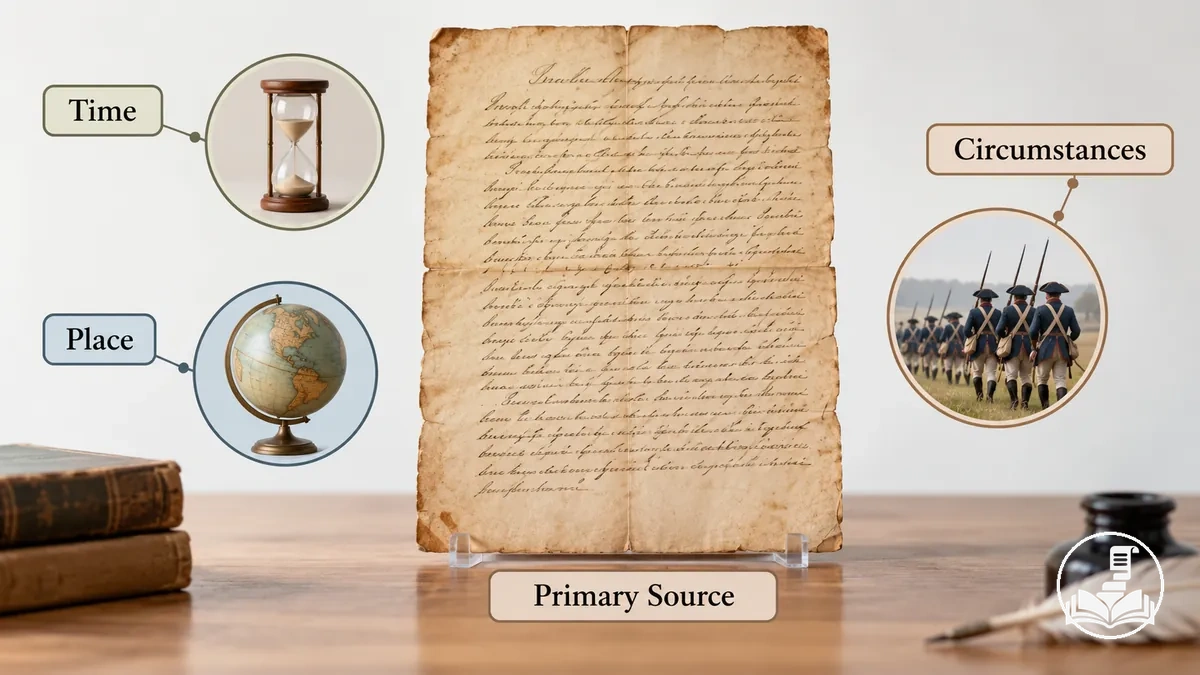
Before students encounter the evidence, select only background details that clarify features they could not reasonably understand from the source alone.
This preparation can be organised as a short sequence covering the historical setting, unfamiliar terms or actors, and relevant provenance while leaving interpretive conclusions open.
- Establish the time and place: identify the relevant period and location when they affect how students understand the source's historical setting.
- Supply essential background: introduce the event or circumstance needed to recognise what is happening around the source rather than presenting a complete overview of the period.
- Clarify unfamiliar terms and actors: explain vocabulary, people, institutions, or events that would otherwise prevent students from understanding what the source states or depicts.
- Identify relevant provenance: provide available information about who created the source, when and where it was created, and the circumstances of its production when those details are necessary for beginning analysis.
Insufficient context can produce misreading when students lack the background knowledge needed to recognise the historical setting, while excessive pre-explanation can remove the interpretive task by supplying conclusions before students examine the source.
The boundary is minimum sufficient context: establish the relevant time, place, circumstances, and provenance, then leave the source's interpretation for students to develop from the evidence.
Establish the Time, Place, and Circumstances Around the Source
Establish a source's historical setting by identifying only the time, place, and circumstances that materially affect how its evidence can be interpreted.
Relevant context can include the source's date or time period, location, event conditions, social or institutional setting, and circumstances of creation.
These cues locate the source historically without predetermining what it means.
The annotated example below labels these contextual features around one primary source while leaving interpretation open.
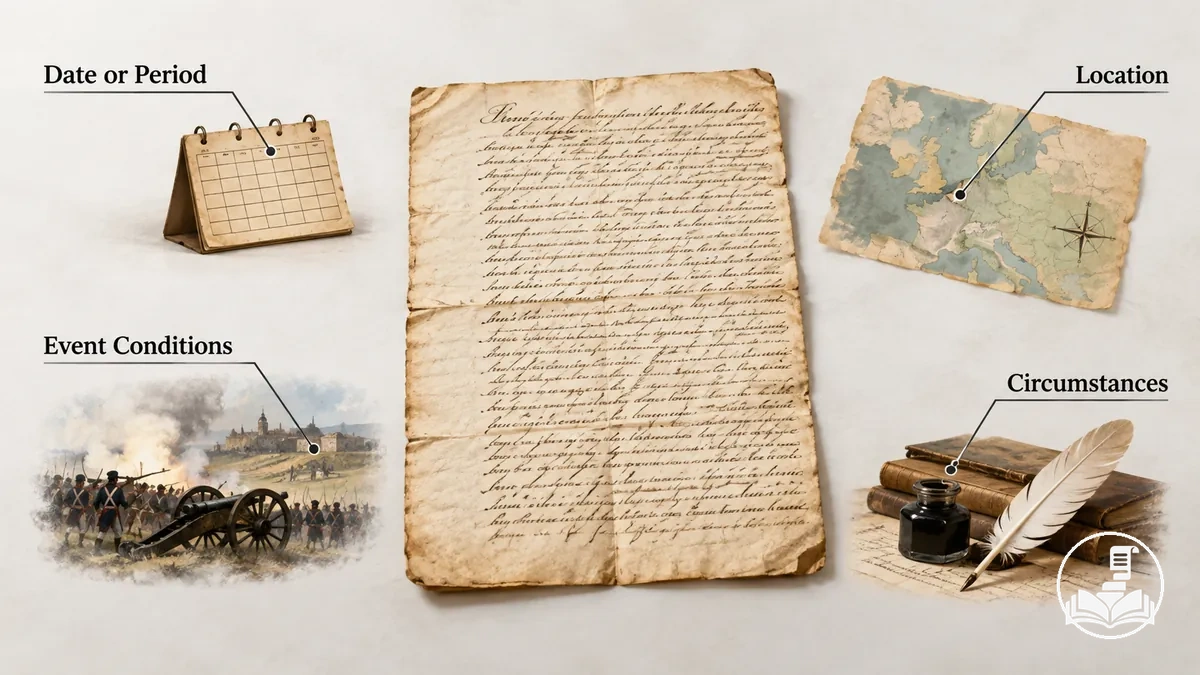
Use contextual facts when they change the range of plausible interpretations rather than because they belong to the wider period.
For example, if a public statement was created during an active political campaign, that circumstance can make persuasion a relevant possibility to investigate, but it does not by itself establish the creator's motive or determine the statement's meaning.
Context should therefore stop at the date, location, event conditions, setting, and circumstances of creation that materially affect how students can understand the evidence.
Clarify Primary and Secondary Sources When the Distinction Affects the Task
Primary and secondary sources are evidence roles distinguished by a source's relationship to the event or period being studied and by the historical question students are asking, not by a quality ranking.
A primary source provides first-hand evidence or other evidence directly connected to the subject under investigation, while a secondary source provides later analysis, interpretation, or synthesis of that subject.
The comparison below applies the same dimensions to both source roles so students can decide how each source functions in the task.
| Comparison dimension | Primary source | Secondary source |
|---|---|---|
| Creation relationship | Created by a participant, witness, or other source directly connected to the event, period, or subject being investigated. | Created later or at analytical distance from the event or subject, commonly using primary and other sources to examine it. |
| Evidentiary role | Provides first-hand evidence or direct evidence from the subject or historical setting being studied. | Provides analysis, interpretation, commentary, or synthesis about the subject being studied. |
| Typical analytical use | Students examine what the source itself can reveal about experiences, actions, language, perspectives, or conditions relevant to the historical question. | Students examine an author's interpretation or synthesis and how it explains or contextualises evidence about the historical question. |
| Question dependence | A source can function as primary evidence when its creation, perspective, or historical setting is itself part of what the historical question investigates. | The same source can function as secondary evidence when it provides a later interpretation of an earlier event or period being investigated. |
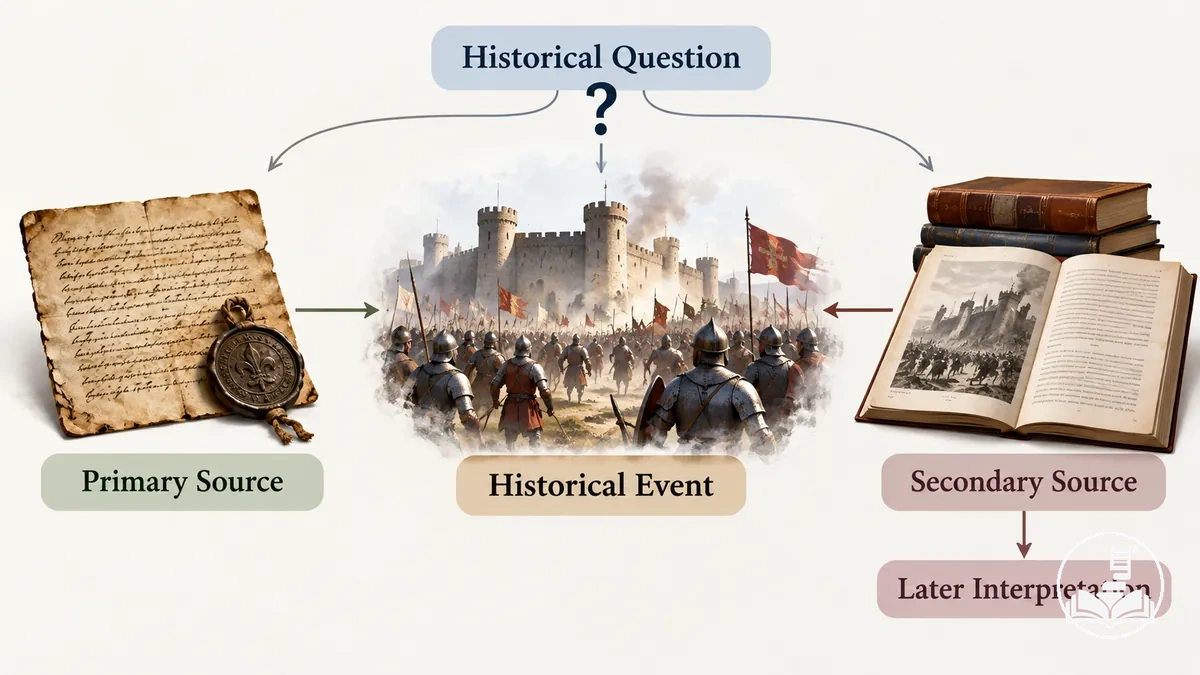
Source classification can therefore change when the historical question changes because the source role depends on the relationship being investigated rather than on format alone.
For example, a later account interpreting an earlier event is a secondary source for a historical question about that earlier event, but the same account may function as a primary source for a question about interpretations produced during the later period in which the account was created.
The distinction should guide how students use the evidence, not imply that a primary source is inherently more reliable or valuable than a secondary source.
Guide Students Through Primary Source Analysis
Guide primary-source analysis from concrete observation to sourcing and historical context, then to a qualified interpretation supported by evidence.
Observation should remain separate from inference so students have evidence to reason from before deciding what a source may mean.
- Observe the source: identify concrete details in the words, images, objects, layout, or other content without immediately assigning meaning to them. These observations establish the evidence that later questions and interpretations must address.
- Ask sourcing questions: identify the creator, intended audience, purpose, and perspective, then ask how those features may shape what the source communicates and what it leaves unstated.
- Contextualise the evidence: connect the source to the relevant time, place, events, and circumstances of creation. Historical context helps students judge which interpretations are plausible without determining the interpretation in advance.
- Interpret the source: combine observations, sourcing questions, and context to form a qualified inference about what the evidence may indicate. For example, if a poster repeatedly enlarges one slogan while giving other information less prominence, students can observe that visual emphasis, ask why the creator highlighted that message for its audience, and infer that the message was intended to receive particular attention.
- Support the inference with evidence: identify the specific source details and contextual information that justify the interpretation, while noting omissions or uncertainties that limit what can be claimed. The result should be an evidence-based inference whose scope matches what the source can reasonably support.
Observe What the Source Shows or States Before Interpreting It
Observation records what is directly present in a source; inference assigns possible meaning to those observable details.
Students should first notice relevant wording, dates, names, physical features and notable absences without treating those details as proof of motive, reliability or historical significance. Source type can guide what students inspect, but the detail remains an observation until it is connected to a question and interpretation.
Observation
“The same phrase appears in larger lettering than the surrounding wording.”
This records a visible feature of the source.
Inference
“The creator may have intended that phrase to attract particular attention.”
This proposes a meaning that still needs sourcing, context and supporting evidence.
Keeping the distinction explicit lets observations become evidence for later interpretation without silently turning the proposed meaning into an observed fact.
Identify the Creator, Audience, Purpose, and Perspective
Examine the creator, intended audience, purpose, and circumstances of a source because these provenance attributes can shape its perspective, what evidence it can reveal, and the limits of an interpretation.
The creator's role or background may affect which experiences or positions appear in the source, while the intended audience may affect its wording, detail, and presentation.
Purpose and circumstances can further clarify why particular information was included, emphasised, or omitted.
These attributes guide interpretation, but none establishes motive, falsehood, or reliability by itself.
These relationships are conditional: an audience, purpose, or circumstance can support a plausible interpretation of perspective without automatically establishing bias, motive, or inaccuracy.
For example, the same statement addressed privately to one recipient may provide evidence about communication within that relationship, while a version addressed to a public audience may also reflect the demands of communicating to that wider audience; the difference changes the evidentiary questions students can ask without establishing that either statement is false.
Examining sourcing and perspective in this way also connects the local source-analysis task to broader historical thinking skills.
The following sourcing questions organise the provenance attributes that shape interpretation and clarify what a source may reveal or leave uncertain.
- Creator: Who created the source, and what role, background, position, or relationship to the subject may be relevant to the evidence it provides?
- Audience: Who was the intended audience, and how might addressing that audience affect the source's wording, detail, or presentation?
- Purpose: What apparent purpose does the source serve, and what evidence in the source or its provenance supports that interpretation of purpose?
- Circumstances: Under what historical or immediate circumstances was the source created, and which of those conditions may affect how its content should be interpreted?
- Perspective: What point of view may emerge from the creator's position, audience, purpose, and circumstances, and what does that perspective allow the source to reveal or leave uncertain?
Interpret the Source in Its Historical Time and Place
Interpret a source within the historical context of the time, place and circumstances in which it was created. Relevant events, social conditions, institutions and constraints can change which readings of the evidence are plausible because the source was produced within those conditions rather than in isolation.
For example, a phrase that appears unusual today may carry a different implication when its historical usage, institutional setting or circumstances of creation are considered. That context can rule out an unsupported present-day reading while still leaving more than one interpretation possible.
Use only contextual information that materially changes how the source can be read, and keep the conclusion within what the source and relevant context can support rather than generalising from one source to an entire time, place or population.
Design the Primary-Source Activity Around a Historical Question and Evidence Use
Design the primary-source activity so that every stage serves a focused historical question and ends with students using specific source evidence in a bounded explanation.
The question determines which evidence matters; observation gives students details to work with; discussion tests possible interpretations; and the final response connects a claim to evidence and reasoning.
The source set and the question must have matching scope. If the question requires evidence the available sources cannot reasonably provide, narrow the question or change the source set rather than asking students to infer beyond the evidence.
Frame the Activity Around a Focused Historical Question
Frame the historical question so it is answerable with the available source evidence while remaining open enough to require interpretation.
Its scope should match what the source set can reasonably support, giving students a clear reason to inspect details and use them in a claim rather than simply retrieve a fact.
The question wording should define a focused task and require an evidence-based response.
A question that requires evidence beyond the available sources needs either a narrower scope or a different source set.
The criteria below test whether the historical question gives the source an analytical purpose and keeps the evidence task manageable.
For example, “What date appears on this poster?” is a fact-recall prompt because the response can be copied directly from the source, whereas “How does this poster present its message to its intended audience?” requires interpretation supported by source evidence.
The second question remains answerable only to the extent that the source set provides evidence for that interpretation.
Developing a wider sequence of student-generated questions and investigations belongs to the broader method of inquiry-based history teaching.
- Relevance to the source evidence: the historical question should direct students toward evidence that the available source set actually contains or can reasonably support.
- Manageable scope: the question should be narrow enough for the available sources to address; a broader claim requires a source set capable of supporting that broader scope.
- Openness to interpretation: the wording should require students to interpret evidence and develop a qualified claim rather than locate a single stated fact.
- Evidence-based response: the task should require students to support their interpretation with specific source evidence, making the connection between claim and evidence observable.
Sequence Source Observation, Discussion, and Evidence Use
Sequence source work so students begin with observation of the evidence, move into discussion that tests possible interpretations, and finish with evidence use in a historical claim or explanation.
Each stage builds on the previous one: individual noticing provides source details for shared reasoning, while discussion develops questions and interpretations that students can then support with evidence.
The duration and grouping can remain flexible rather than turning this sequence into a fixed classroom routine.
- Observation: students first inspect the source and record relevant details before developing an interpretation. For example, in a three-stage poster activity, each student might begin by noting a repeated phrase, prominent image, or other source detail that could become evidence.
- Discussion and questioning: students compare observations, raise questions, and test whether proposed interpretations are consistent with the source evidence. The purpose of discussion is to make reasoning explicit and consider alternatives, not to assume that agreement proves an interpretation is accurate.
- Evidence use: students use specific source details to support a historical claim or explanation whose scope matches the available evidence. In the poster example, students could finish by explaining one interpretation of its message and identifying the observed details that support that claim.
Timing and grouping may vary with source complexity and student readiness, while the instructional progression remains observation, discussion and questioning, then evidence use.
Have Students Use Source Evidence in a Historical Explanation
A historical explanation should connect a claim to specific source evidence and then explain, through reasoning, what that evidence can support. A quotation or reference is not enough unless the student makes the evidentiary connection explicit.
- ClaimState a conclusion whose scope matches the historical question and source set.
- EvidenceIdentify a specific, accurately represented detail from the source that bears on the claim.
- ReasoningExplain how that detail supports the claim instead of leaving the connection implicit.
- QualificationNote a source limitation or plausible alternative reading when it materially restricts the conclusion.
One source can support a bounded conclusion about what it records, depicts or communicates without establishing a broad conclusion about an entire event, period or population. Students should therefore distinguish what the evidence directly shows from the reasoning used to interpret its significance.
For example, “The poster uses a large central slogan, so it supports my claim” names a feature but leaves the connection unexplained. A stronger explanation identifies the enlarged slogan as evidence of visual emphasis and then states the limited historical claim that this feature can support.
This evidence-use process is distinct from the separate task of assessing source-based learning.
Scaffold Analysis From Guided Questions to Independent Work
Scaffolding primary-source analysis means providing temporary support and reducing it as students demonstrate control of the analytical task.
Early support can combine modelling with guided questions that show students how to notice evidence, form an interpretation, and explain their reasoning.
Supported practice then gives students opportunities to perform those analytical moves with less teacher direction.
The intended progression is toward independent analysis rather than permanent dependence on prompts or worksheets.
The appropriate support level depends on the task and demonstrated performance rather than a fixed schedule or broad student label.
Greater source complexity, limited prior knowledge, or unfamiliarity with a source type can justify more modelling and guided questions when those conditions make the analytical moves difficult to perform independently.
As students demonstrate that they can identify relevant evidence, interpret it in context, and support their reasoning, prompts can be reduced while productive difficulty remains.
The same students may therefore need different levels of support for different sources or analytical tasks.
The progression moves from explicit modelling to guided practice and then toward reduced support as students demonstrate the relevant analytical moves.
Scaffolding progression
- Modelling: demonstrate the analytical task with a source, making visible how an observation becomes a question, interpretation, and evidence-supported explanation.
- Guided practice: give students guided questions that direct attention to the required analytical moves while students perform more of the source analysis themselves.
- Supported independence: repeat the same type of analytical task with fewer prompts, retaining only the support students still need to identify evidence and explain their reasoning.
- Reduced support: once students demonstrate control of the relevant analytical moves, reduce unnecessary prompts so they conduct the source examination and evidence use more independently.
Model the Analysis Process Before Students Work Independently
Modelling should make one or two analytical moves visible before students work independently rather than complete the source for them. Show how an observation becomes a question and how evidence contributes to a tentative interpretation, including the uncertainty in that reasoning.
- Observation
- “One phrase is printed much larger than the surrounding wording.”
- Question
- “Why did the creator give that phrase greater visual emphasis?”
- Tentative interpretation
- “The creator may have wanted viewers to notice that message first.”
- Boundary
- The design feature supports an inference about emphasis, but does not by itself establish the creator’s motive.
Then leave the remaining analysis open. A comparable student prompt is: “Identify another observable detail, ask a question about it, and explain one tentative interpretation that the evidence could support.”
Use Questions That Move From Observation to Context and Interpretation
Primary-source analysis questions should progress from observation to questions about the creator, audience, purpose, and context, and then to interpretation supported by evidence.
Students first need prompts that direct attention to details they can examine before questions ask them to explain what those details may mean.
Sourcing and contextual questions then add information that can constrain or qualify an interpretation.
The sequence should remain selective, using only the questions that serve the source and historical task.
Later questions should depend on evidence gathered through earlier observation and sourcing rather than invite an unsupported judgment at the outset.
The grouped prompts below move from noticing evidence to examining its circumstances and finally to forming an inference whose support can be identified.
- Observation: What details do you notice in the source, and which words, images, dates, objects, or other features could become evidence for the historical question?
- Creator and audience: Who created the source, who was its intended audience, and what available evidence supports those identifications?
- Purpose and circumstances: What purpose might the source have served, and which features of the source or its circumstances support that tentative interpretation?
- Time, place, and context: When and where was the source created, and which relevant historical conditions change how its evidence can reasonably be interpreted?
- Missing information: If the task requires it, what relevant information is absent or uncertain, and what additional evidence would help address that gap?
- Evidence for an inference: Based on the observations, sourcing information, and context gathered so far, what interpretation can you make, and which specific evidence supports or limits that inference?
Reduce Support as Students Take More Responsibility for the Analysis
Reduce analytical support when students demonstrate that they can perform the relevant analysis moves with increasing independence, not simply because time has passed.
Readiness for independent analysis is shown through student performance: noticing relevant evidence, asking useful source questions, applying context, and supporting an interpretation with reasoning.
Prompts, modelling, and teacher cues can then become less directive for the demonstrated skill while remaining available where students still need them.
Independence therefore means greater student responsibility for the analysis rather than the removal of all guidance.
The readiness indicators below connect observable analytical behaviour to the corresponding adjustment in support.
A prompt can also become more open-ended while preserving the same historical task; for example, “What detail do you notice, and what might it suggest?” can become “What interpretation can you support with evidence from this source?” as students take greater responsibility for selecting and reasoning from evidence.
Support may still remain uneven across skills because readiness in observation does not by itself establish readiness in contextualisation or interpretation.
- Relevant observation: when students independently identify details that matter to the historical question, reduce prompts that direct them toward particular words, images, or features.
- Source questioning: when students independently ask relevant questions about the creator, audience, purpose, or circumstances, replace detailed sourcing prompts with broader cues to investigate the source.
- Use of context: when students can select and apply relevant historical context to constrain an interpretation, reduce cues that specify which contextual information they should use.
- Evidence-supported interpretation: when students independently connect an interpretation to specific source evidence and explain their reasoning, reduce prompts that prescribe the claim-evidence connection while retaining guidance where the reasoning remains unsupported or incomplete.
Troubleshoot Common Primary Source Analysis Problems
Weak primary-source analysis is a symptom, not a diagnosis. A vague or unsupported response can reflect missing context, an undeveloped analytical move, source-access difficulty, or more than one of these conditions.
- Identify the symptomDescribe what is observable in the student’s work or interaction with the source.
- Consider plausible causesAsk whether context, an analytical habit, source complexity or another barrier could explain the breakdown.
- Check the reasoningLook for evidence that distinguishes among those causes instead of assuming the first explanation.
- Choose the smallest useful correctionAdd the missing context, prompt the missing analytical move, or adapt the specific access barrier while preserving the evidence task.
The visible symptom alone does not establish its cause. Base the corrective direction on observable student work and reasoning, then return the student to the source for renewed analysis.
When Students Treat the Source as a Complete or Neutral Account
A diagnostic signal of uncritical reading appears when a student repeats a source's claims as though the account were complete or self-validating without examining its perspective.
The response may omit questions about the creator, intended audience, purpose, or circumstances that shaped what the source communicates.
It may also treat an omission as irrelevant rather than considering whether absent information limits what the evidence can support.
This response pattern indicates a need to check the student's interpretation process, not confirmation that the source itself is false or unreliable.
Check whether the student can identify the creator and audience, infer a purpose from available evidence, describe a relevant perspective, and notice information the source does not provide.
Then redirect the interpretation by asking how those attributes affect what the source can reasonably show and what remains uncertain, rather than replacing analysis with a reliability label.
Perspective and incompleteness can limit the claims supported by a source while also providing historically useful evidence about the creator's position, priorities, or communication to an audience.
Example: A recruitment poster may present military service from a clearly promotional perspective while omitting experiences that do not serve that purpose.
Those limitations restrict its use as evidence about the full range of military experience, but its message, emphasis, and intended audience can still provide evidence about how recruitment was presented to the people the poster sought to reach.
When Students Lack the Context Needed to Interpret the Source
A weak interpretation may reflect a specific context gap when students lack historical background needed to understand what a source refers to or why a detail matters.
The missing cue may concern the relevant time, place, event, institution, vocabulary, or social condition, but only when that knowledge changes how the evidence can reasonably be interpreted.
A student misunderstanding is therefore a diagnostic signal to check for missing background, not proof that historical context is the cause.
If the student can explain the relevant contextual cue but still cannot reason from the evidence, the analysis problem may lie elsewhere.
Identify the particular claim or source detail being misunderstood, then check which piece of contextual knowledge the student's reasoning requires.
Supply the minimum corrective information needed to close that context gap rather than replacing the analysis with a full account of the period or a predetermined interpretation.
The corrective information should clarify the relevant historical setting while leaving students responsible for deciding how the source evidence should be interpreted.
After the targeted context check, return students to the source for re-analysis.
Example: If a student reads an unfamiliar historical term as though it has its present-day meaning, the missing contextual cue is the vocabulary used in that time and place.
Clarifying the term's relevant historical meaning gives the student a basis for reconsidering the passage, but the student still has to determine how that contextual information changes the interpretation of the source.
When the Source Is Too Complex for Meaningful Analysis
Source complexity becomes an analysis barrier when students cannot reach or interpret the evidence required by the historical task, rather than when the source is simply challenging.
Productive challenge remains when students can examine relevant evidence and reason from it with limited support.
Length, vocabulary, legibility, unfamiliar genre, dense syntax, missing background knowledge, or media-access problems can each obstruct a different part of that process.
Diagnose the specific barrier before choosing an adaptation.
Check which feature is preventing students from working with the evidence and whether that feature can be reduced without changing what the source means.
Each item below pairs an access barrier with a limited adaptation intended to preserve the evidence students need for analysis.
- Length: if students cannot locate or sustain attention to the evidence required by the task because the source is too long, use a focused excerpt or chunk the source while retaining the passages and context needed for interpretation.
- Vocabulary or dense syntax: if unfamiliar words or sentence structures prevent students from understanding relevant evidence, gloss essential vocabulary or clarify a difficult construction without rewriting away language that matters to the source's meaning.
- Legibility or media access: if handwriting, print quality, audio quality, or another presentation barrier prevents students from identifying evidence, enlarge the reproduction, provide a clearer version, or transcribe the relevant content while preserving the substantive evidence.
- Unfamiliar genre: if students can access the content but do not understand how to read a feature of the source form, model that feature briefly and then return responsibility for the remaining analysis to students.
- Missing background knowledge: if a relevant time, place, event, institution, or social condition is necessary to understand the evidence, supply only that essential context before students re-examine the source.
For example, if students can interpret the historical question but cannot work through a long document containing the relevant evidence, a focused excerpt can reduce the length barrier while keeping the same evidence-based reasoning task.
If excerpting, glossing, transcription, modelling, or essential context would remove the evidence or meaning that the task requires students to analyse, the problem is no longer access alone and the source or task needs reconsideration rather than further simplification.