
Planning an Inquiry-Based History Lesson
Plan an inquiry-based history lesson by starting with one focused historical question, then selecting evidence and activities that help students investigate it, providing only the scaffolding needed to analyse the sources, and ending with a response that links claim, evidence and reasoning. Keep the scope achievable for the available lesson time and student readiness; when those constraints tighten, narrow the evidence set or increase temporary support rather than disconnecting the final response from the inquiry.
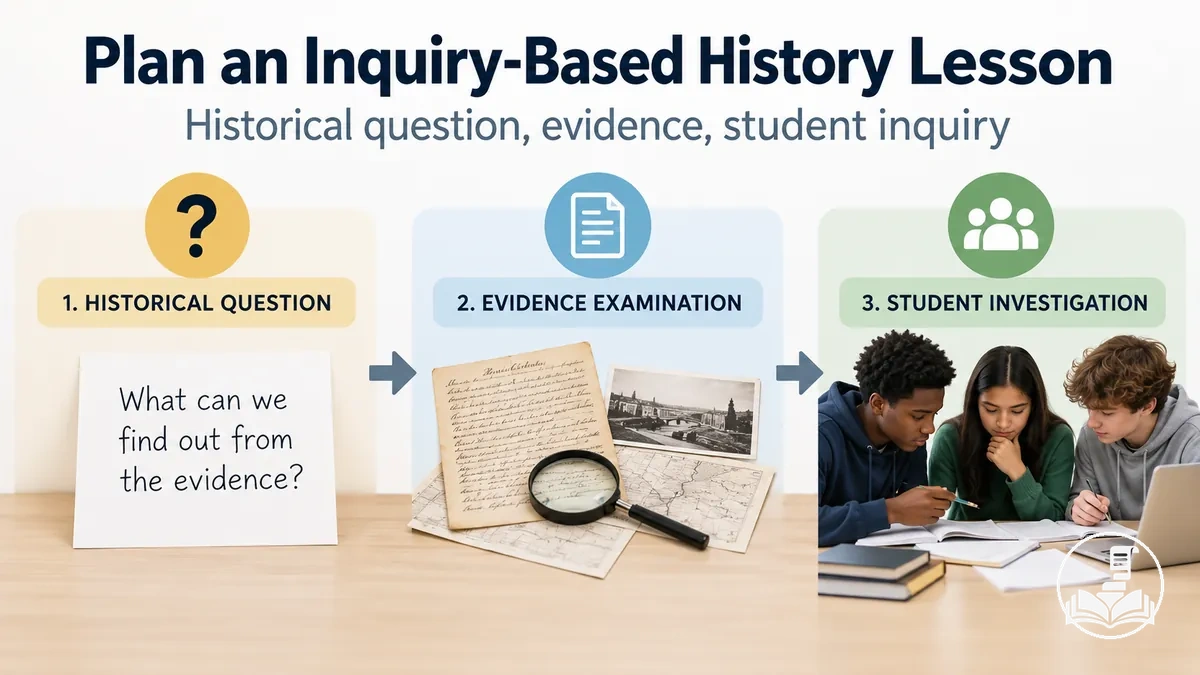
Inquiry lesson alignment planner
Plan in this order so every classroom decision remains traceable to the same historical inquiry.
-
Inquiry questionDefine a focused, evidence-answerable historical question that requires interpretation rather than recall alone.
-
Evidence setSelect sources that are relevant to the question, useful for comparison and manageable within the available time.
-
Student investigationUse activities that make students examine, compare and interpret evidence in order to answer the question.
-
ScaffoldingSupport difficult evidence-analysis moves without supplying the conclusion, then fade support as students demonstrate independence.
-
Final responseRequire a direct answer in which the claim is supported by relevant evidence, explicit reasoning and qualification where the record is limited.
Adjust the scope, not the alignment.
- Less time or greater source difficulty: narrow the evidence set and/or increase temporary support.
- Greater demonstrated independence: fade scaffolds; broaden evidence only when students can still investigate it meaningfully.
Alignment test: the final claim should be traceable through reasoning and evidence back to the original inquiry question.
The central planning rule is alignment: the inquiry question sets the evidence and reasoning demand, while lesson time, source complexity and student readiness determine how broad the investigation can be. Coherence matters more than maximising the number of sources or activities.
Table of Contents
What Makes a History Lesson Inquiry-Based
An inquiry-based history lesson is one in which students investigate a meaningful historical question through evidence and construct an interpretation rather than only receiving a predetermined conclusion.
The investigation requires students to examine evidence, reason about what it supports, and develop a reasoned response.
Primary and secondary sources can both contribute when they provide evidence relevant to the historical question.
The defining feature is how students use evidence to answer the question: they investigate sources, interpret their content and context, and compare perspectives or claims where relevant.
In history lesson plans, inquiry therefore functions as an evidence-based investigation rather than as a set of activities labelled as inquiry.
Practices such as sourcing, contextualizing, and corroborating can help students assess evidence and connect it to a claim or interpretation.
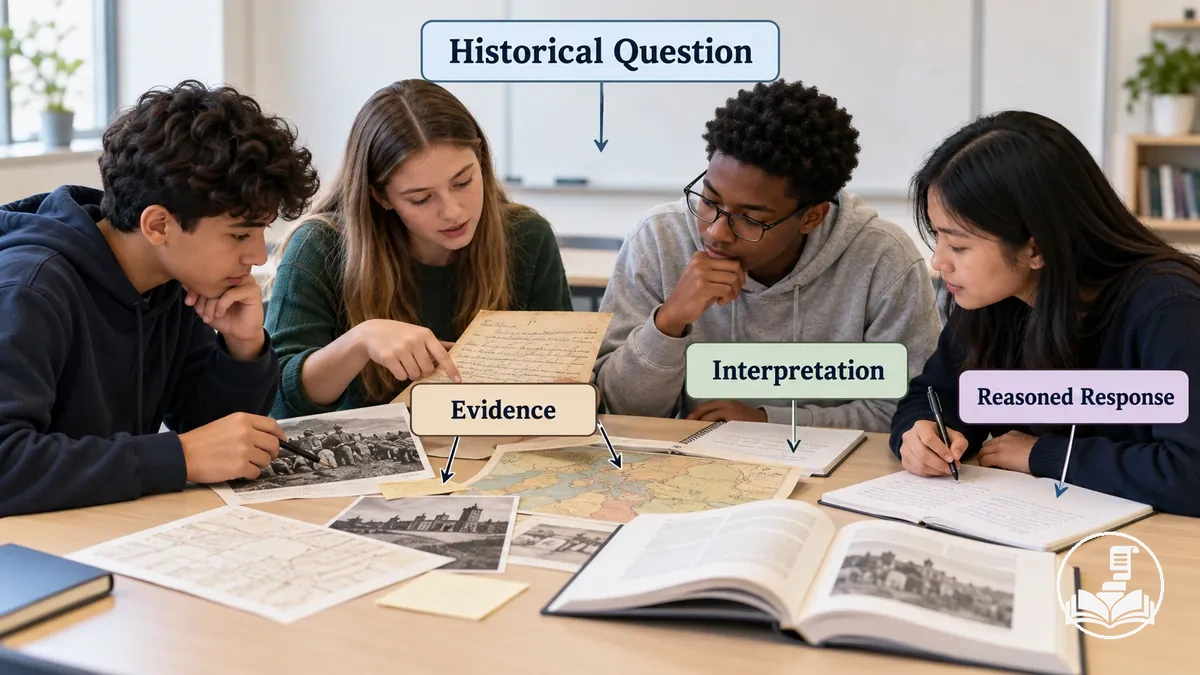
Inquiry is one of several history teaching approaches, and it differs from recall-led or conclusion-first instruction because a recall task can be completed without students interpreting evidence to answer a historical question.
The defining outcome of the inquiry is a reasoned response in which students construct an interpretation supported by the evidence they investigated.
Set the Historical Inquiry Before You Plan Activities
Historical inquiry planning should define the inquiry question and its evidentiary purpose before activity selection begins.
The historical topic provides the subject area, but the inquiry question sets the investigation focus and determines what students need to use evidence to explain or interpret.
Activities should then be selected because they advance that inquiry rather than because they work as isolated classroom tasks.
The inquiry question constrains which available evidence can support the investigation and which activities have a useful purpose.
The workable scope also depends on lesson time, student readiness, the demands of the evidence set, and the expected final response.
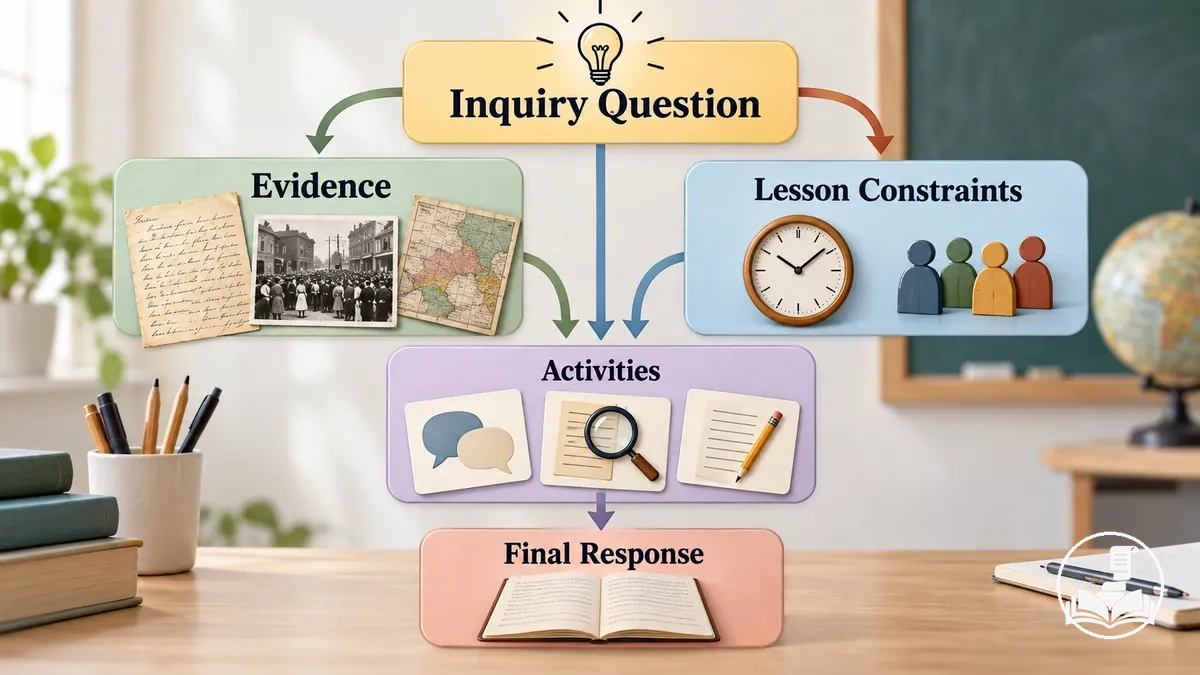 A broader inquiry may need to be narrowed when the available evidence, lesson time, or student readiness does not support the intended investigation, while the final response should remain achievable from the evidence students can examine.
Frame a Focused Historical Inquiry Question
A focused inquiry question has a clear historical focus, addresses historical significance, can be answered with available evidence, and requires interpretation rather than recall alone.
Its interpretive demand should require students to reason from evidence toward a supported claim or conclusion, while its scope should remain manageable within the available sources, lesson time, and student readiness.
Question design controls both the evidence an inquiry requires and the reasoning students must perform.
A question with a narrower historical focus limits the evidence field, while an overbroad question can create more periods, actors, causes, or sources than students can realistically investigate within the available conditions.
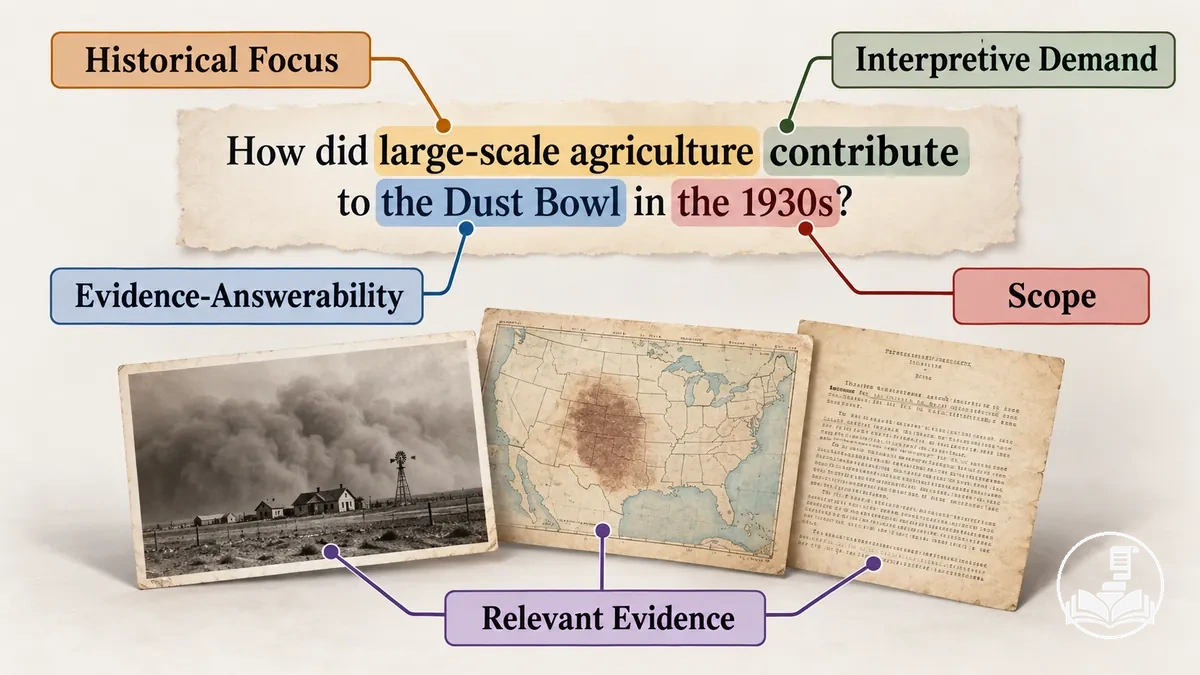
- Historical focus: The historical inquiry question focuses on a defined event, development, relationship, or problem with historical significance, giving evidence selection a clear subject and boundary.
- Interpretive demand: The historical inquiry question requires students to analyse evidence and reason toward a claim or conclusion; a question answerable by recalling one fact provides too little interpretive demand for the intended inquiry.
- Evidence-answerability: The historical inquiry question can be answered with evidence available to students and relevant to the reasoning the question requires.
- Manageable scope: The historical inquiry question narrows the investigation enough for the available sources and lesson time; what is manageable can also change with source complexity and student readiness.
- Openness to reasoned conclusions: The historical inquiry question supports conclusions that students can justify from evidence rather than embedding the intended interpretation in the question itself.
For example, “How did large-scale agriculture contribute to the Dust Bowl in the 1930s?” is a stronger focused inquiry question than “What caused environmental change in the United States?” because the first narrows the historical relationship, period, and evidence demand, while the second leaves the scope too broad for a bounded investigation.
A proposed question has practical answerability when its interpretive demand can be supported by the evidence students can realistically investigate.
Define the Evidence Scope and Final Student Response
Evidence scope and the final student response should be planned together because the evidence set determines what students can reasonably investigate, while the response form determines what they must demonstrate from that evidence.
The expected evidence-based answer should therefore be supportable by the sources students can examine within the available lesson time and with support appropriate to their readiness.
The evidence load changes with lesson time, student readiness, source quantity, source diversity, and source complexity.
A shorter lesson or a more demanding source set may require a narrower evidence scope, while a longer investigation can support broader evidence work when students have sufficient time and support to interpret it.
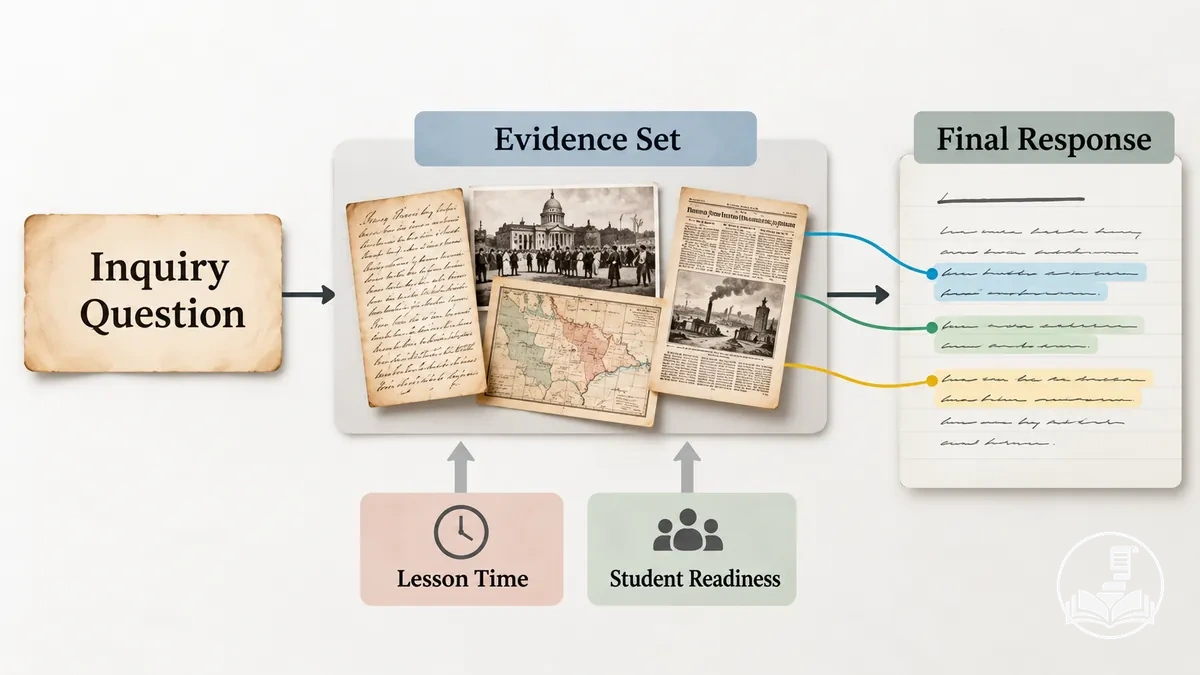
- Lesson time: Less available investigation time constrains the evidence set and may require a narrower response demand; more time can permit broader evidence work when it remains relevant to the inquiry.
- Source complexity: Sources with greater reading or interpretation demands increase the time and support required, so complexity can limit how much evidence students can examine meaningfully.
- Source diversity: Different source types or perspectives can broaden the evidence students must reconcile, so diversity should be included when it contributes to the reasoning required by the inquiry rather than simply increasing source quantity.
- Student readiness: When the evidence demands exceed what students can manage independently, the plan should narrow the evidence load or provide support that makes the required interpretation accessible.
- Response form: A brief evidence-based answer can align with a narrower investigation, while a response requiring students to develop and support a more substantial claim generally requires enough relevant evidence to sustain that reasoning.
- Support level: More demanding evidence or response expectations may require additional guidance, whereas familiar sources and a narrower response can require less instructional support.
The final response should require students to answer the inquiry with a claim or conclusion supported by the evidence they investigated, without turning the planning decision into a separate grading system.
For the same inquiry question, a short lesson may use a smaller, tightly bounded evidence set and a concise response, while a longer investigation may use a more diverse or complex evidence set and require a fuller evidence-based answer; the appropriate scope depends on available time, source demands, student readiness, and support.
Build the Lesson Around the Historical Inquiry Process
The historical inquiry process should preserve one historical question from the opening context through source investigation, evidence comparison, interpretation, and the evidence-based response.
Each stage should support the same inquiry rather than operate as an isolated classroom task.
The exact classroom routine and boundaries between stages can vary with the historical topic, available time, and learner needs.
The process progresses by establishing enough context for students to understand the historical question, then connecting that question to evidence work.
Source investigation supplies evidence for comparison, and the stages remain connected because each contributes to answering the same historical question.
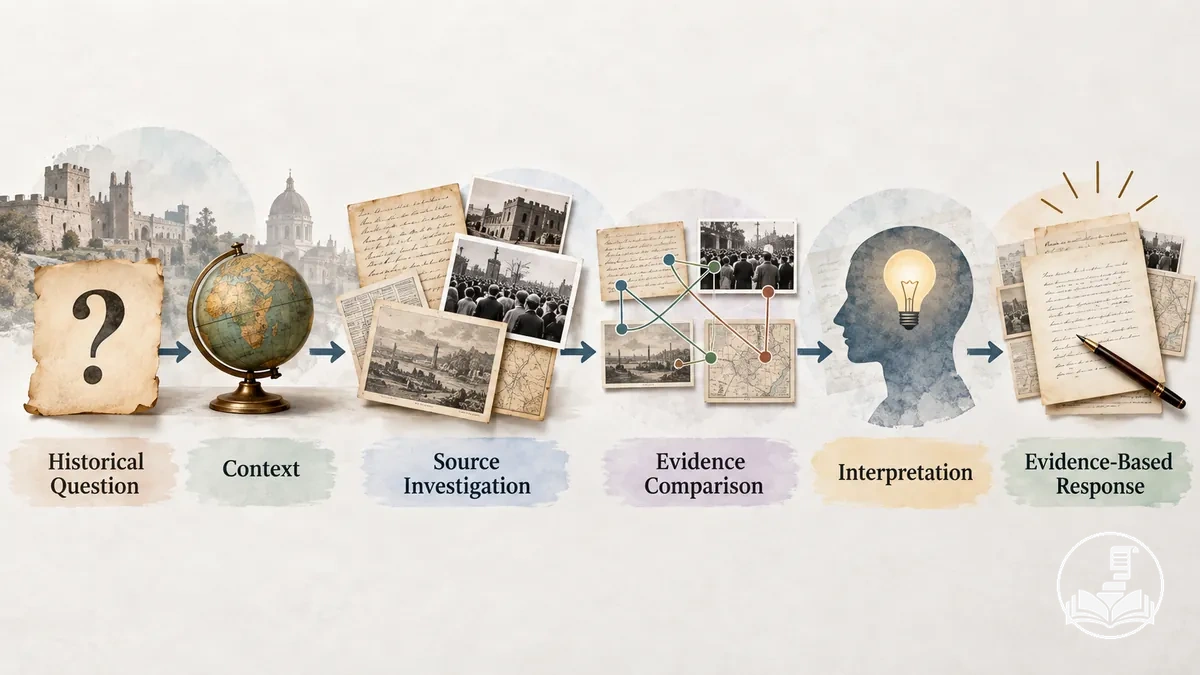
- Context and historical question: Establish the historical setting and the question that gives the investigation its purpose.
- Source investigation: Examine sources for evidence relevant to the historical question.
- Evidence comparison: Compare evidence across sources to identify agreements, differences, and relationships relevant to the inquiry.
- Interpretation: Use the compared evidence to develop a reasoned historical interpretation or claim.
- Response: Express an evidence-based response that answers the historical question using the evidence investigated.
Sourcing, contextualizing, and corroborating are evidence-handling practices that support source investigation, evidence comparison, and interpretation rather than goals that replace the central inquiry; the Digital Inquiry Group identifies these practices as strategies students use to investigate historical questions and make claims backed by documentary evidence.
Keeping the same historical question active across context, evidence work, interpretation, and response gives the lesson continuity even when the precise classroom routine varies.
Establish Historical Context and Introduce the Inquiry Question
Historical context should give students enough essential background and prior knowledge to understand the inquiry question and interpret the evidence, without supplying the conclusion they are meant to investigate.
How much background is enough varies with topic familiarity, source complexity, and students’ prior knowledge: too little context can leave evidence difficult to interpret, while over-complete context can reduce the need for investigation.
Begin with the essential background needed to orient students to the relevant time, place, event, or historical problem, then introduce the inquiry question that gives the evidence a purpose.
The historical context should establish what students need to understand before investigating, while leaving the central explanation, judgment, or interpretation unresolved.
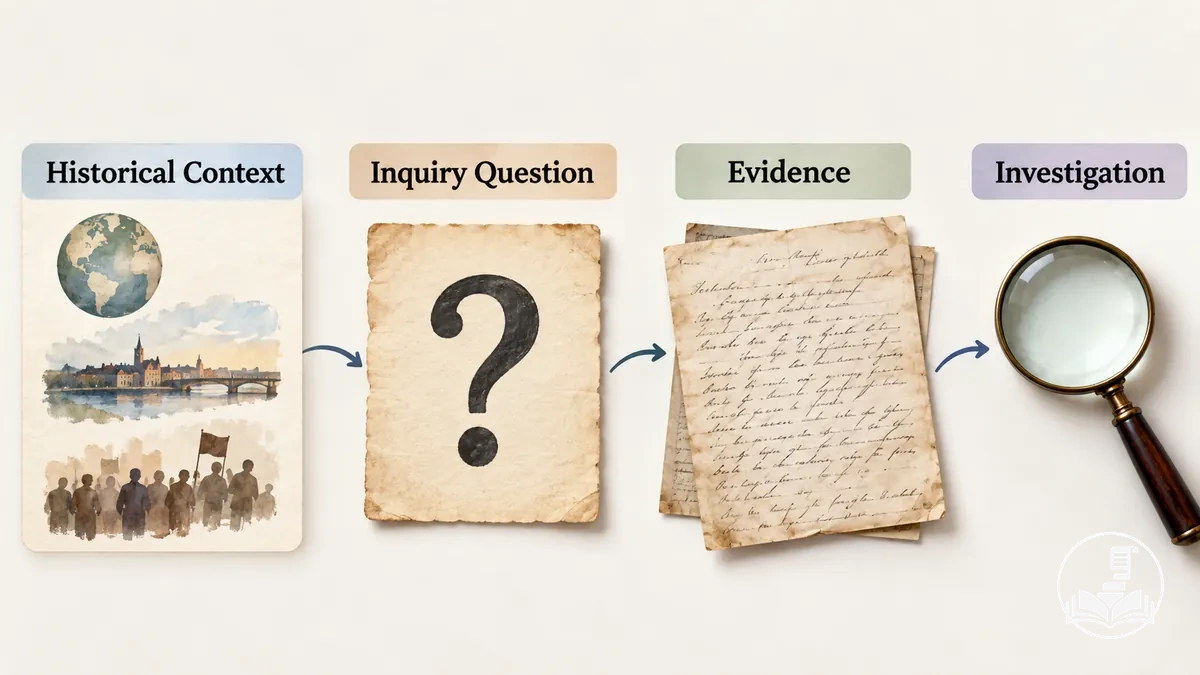
- Orient: Establish only the contextual background and prior knowledge needed to make the forthcoming sources intelligible.
- Pose the question: Introduce the inquiry question without embedding the conclusion students are expected to reach.
- Clarify the investigation: Identify what students must discover through evidence and what the source investigation needs to help them understand.
For example, an inquiry about why a historical protest developed could identify its time, place, participants, and immediate circumstances before students examine evidence, while leaving the causes and significance for students to interpret from the sources.
A useful final check is whether the historical context enables source interpretation while the inquiry question still requires investigation.
Have Students Investigate Relevant Historical Sources
Students should examine a deliberately selected set of historical sources for evidence that helps answer the inquiry question.
Primary sources and secondary sources can both contribute when their relevance is clear, their source context can be considered, and they provide evidence students can use rather than simply encounter.
Source quantity should therefore follow the needs of the investigation rather than the assumption that more sources are better.
- Relevance
- Each source should contribute evidence that bears on the inquiry question.
- Useful diversity
- Differences in perspective, source type or later interpretation should create a meaningful basis for comparison, not variety for its own sake. For example, a contemporary account can show how a participant represented an event, while a secondary source can add later historical interpretation or context.
- Manageability
- Source complexity and total source load should fit the available lesson time and the support students can use.
- Evidence use
- Students should be able to identify relevant information, consider source context and perspective, and extract evidence they can connect to the inquiry question.
Deeper instruction on sourcing and document analysis belongs within using primary sources in history lessons; at this stage, students need to gather evidence from the selected source set that can support later comparison and interpretation.
Compare Evidence and Develop a Historical Interpretation
Students develop a historical interpretation by comparing what evidence from different sources supports, conflicts with, or leaves uncertain about the inquiry question.
Compare each source's evidence alongside its source context and perspective rather than treating statements as interchangeable facts.
- When sources agree
- Relevant agreement can corroborate part of a claim, but it does not erase source limitations or uncertainty.
- When sources conflict
- Identify the tension and consider whether differences in context or perspective help explain it; qualify the claim when the conflict remains material.
- When evidence is incomplete
- Narrow the conclusion or certainty to what the available evidence can reasonably support rather than forcing a definitive interpretation.
- For the interpretation
- State the claim the evidence supports, acknowledge material tension or uncertainty, and limit the conclusion where the sources do not establish more.
Sourcing, contextualizing, and corroborating within historical thinking in lesson plans support this interpretive work, while the immediate task here is to keep each historical interpretation bounded by the evidence available for the inquiry.
Construct an Evidence-Based Answer to the Inquiry Question
An evidence-based historical answer begins with a clear claim that directly answers the inquiry question.
The claim should express the historical interpretation supported by the investigation rather than offer an unsupported opinion or merely restate what individual sources say.
Selected evidence should be relevant to the claim, and the reasoning should explain why that evidence supports the conclusion.
Evidence becomes useful when its significance is made explicit: students should connect the specific information they selected to the historical relationship, cause, change, perspective, or judgment expressed in the claim.
When evidence is incomplete, contested, or supports only a narrower conclusion, the response should include appropriate qualification rather than state more certainty than the evidence allows.
A strong evidence-based response therefore connects claim, evidence, reasoning, and any necessary qualification into one defensible answer.
- Directness: The claim answers the inquiry question rather than shifting to a general topic summary.
- Evidence relevance: The selected evidence contributes directly to the claim being made rather than appearing as an unrelated quotation or fact.
- Reasoning link: The explanation states why the evidence matters and how it supports the historical interpretation.
- Qualification: The claim is narrowed when uncertainty or contested evidence limits what can reasonably be concluded.
In a hypothetical example, “The policy increased opposition” is only a claim, while “The policy increased opposition because a petition records a coordinated response from affected groups, suggesting that resistance extended beyond isolated complaints” explicitly connects evidence to historical reasoning.
The final check is whether the response answers the inquiry question with a supported conclusion rather than summarizing sources or presenting evidence without explanation.
Worked Example: Turn an Inquiry Question Into a Lesson Sequence
Consider a worked inquiry lesson example on the causes of a historical protest, guided by the inquiry question, “Why did this protest develop when it did?” The question keeps the topic bounded around causal explanation and determines what the evidence set, source investigation, comparison, interpretation, and final response need to address.
The teacher selects an evidence set containing a small number of sources that contribute different information about the circumstances, participants, and stated concerns surrounding the protest.
Students conduct source investigation by identifying evidence relevant to the inquiry question, then compare what the sources agree on, emphasize differently, or leave uncertain.
The source load should remain manageable within the available lesson time and the level of scaffolding students need, rather than expanding simply because more sources are available.
The sequence maps the same inquiry question to evidence, investigation, interpretation, and response so each planning decision remains traceable to the purpose of the inquiry:
- Inquiry question: Investigate why the historical protest developed when it did.
- Evidence set: Select sources that provide relevant but not identical evidence about the circumstances and perspectives connected to the protest.
- Source investigation and comparison: Identify useful evidence in each source and compare where the evidence supports similar or different explanations.
- Interpretation: Develop a qualified historical interpretation based on the relationships the evidence supports rather than on one isolated source.
- Final response: Answer the inquiry question with a claim, selected evidence, and reasoning that explains why the evidence supports that conclusion.
With limited lesson time, this example could use a narrower evidence set and more scaffolding so students can complete the comparison and interpretation without excessive source load; with more available time and appropriate readiness, the same inquiry could support a broader evidence set and greater student independence.
The final response should remain bounded by the evidence students actually investigated and should explain why that evidence supports their interpretation.
Within this example, the sequence demonstrates alignment by keeping the inquiry question, evidence set, source investigation, comparison, interpretation, final response, lesson time, and scaffolding connected to the same historical problem.
Scaffold the Inquiry Without Controlling the Conclusion
Inquiry scaffolding is temporary support that enables students to access evidence and perform historical reasoning without supplying the conclusion they are expected to develop.
Support that enables reasoning
- Uses prompts or modelling to make an evidence-analysis move visible.
- Directs attention to relevant source features while leaving the interpretation to students.
- Can increase when source complexity or an unfamiliar reasoning demand exceeds current readiness.
Support that controls the conclusion
- Supplies the interpretation students are expected to construct.
- Performs the reasoning instead of helping students perform it.
- Continues unchanged after students can complete the inquiry move with less guidance.
Adjustment rule: match support to the gap between the task demand and current student performance, then fade that support as students demonstrate greater independence.
Match Source Load and Complexity to Student Readiness
Source load should match what students can realistically interpret during the inquiry while preserving the historical reasoning demanded by the core question.
Student readiness is task-specific: the relevant issue is what students can already do with the particular evidence and reasoning task, not a grade label alone.
When source complexity exceeds what students can manage independently, the evidence load or level of support can be adjusted without unnecessarily changing the inquiry question.
Calibrate the evidence demand by considering source-intrinsic demands first and classroom constraints alongside them.
Source length alone does not establish difficulty because vocabulary, required contextual knowledge, the number of perspectives, visual or textual complexity, and lesson time can change how much guided analysis students need.
- Source length: Longer sources increase the amount of material students must process, but a shorter source can still require substantial support when its language, context, or reasoning demands are difficult; adjust source quantity according to the combined demand rather than length alone.
- Vocabulary: Unfamiliar or specialised vocabulary can increase reading demand, so students may need vocabulary support, guided analysis, or a smaller evidence set while retaining the same inquiry question.
- Contextual knowledge: When interpreting a source requires historical context students do not yet have, provide the essential contextual knowledge or reduce competing source demands so the investigation remains accessible without supplying the interpretation.
- Perspectives: More perspectives can increase the comparison students must manage, so include enough perspectives to support the intended historical reasoning while limiting the number when comparison demands exceed current student readiness.
- Modality and source complexity: Dense textual structures, unfamiliar visual conventions, or sources requiring several kinds of interpretation may require more modelling or guided analysis; sources students can already interpret can allow greater independence.
- Lesson time: When available lesson time is limited, greater source complexity may require fewer sources or more focused support so students still have time to investigate, compare evidence, and develop an interpretation.
For example, if students can address the same inquiry question but struggle to interpret several context-dependent sources within the available lesson time, the teacher can retain the historical reasoning demand while using fewer sources, supplying essential contextual knowledge, and providing guided analysis for the most demanding evidence.
As students become able to interpret that evidence with less support, a broader evidence load or greater independence may become appropriate.
The calibration should therefore reflect readiness for the specific source and inquiry task rather than grade level alone.
Use Prompts and Modelling to Support Evidence Analysis
Prompts and teacher modelling should expose the reasoning used in evidence analysis without supplying the historical interpretation students are meant to construct.
A prompt can direct attention to relevant evidence, while modelling can make a reasoning move visible through a brief think-aloud.
Both forms of support should leave students responsible for deciding what the evidence supports in relation to the inquiry question.
Prompts can ask students to notice source features before deciding what those features mean, connect specific evidence to the inquiry question, and compare where accounts agree or differ.
Modelling can demonstrate how to move from an observation about a source to a reasoned interpretation without completing the interpretation for students.
When students develop a claim, a guided question such as “Which evidence supports this claim, and why?” directs attention to the connection between evidence and reasoning.
The amount of prompting or modelling can vary with student readiness and source complexity, but the support should remain focused on the evidence-analysis process.
- Reasoning-support prompt: “What does this source show, and which source features or details support your interpretation?” This prompt directs attention to observation and evidence while requiring students to perform the reasoning.
- Over-directive prompt: “Which detail proves that the author opposed the event?” This wording supplies an interpretation before students have established it from the evidence, narrowing the task to finding material that confirms the given conclusion.
The distinction is whether verbal support opens a reasoning move or closes it in advance.
A useful prompt or teacher model supports comparison, claim development, and explanation while leaving the conclusion to be justified from the evidence.
Reduce Support as Students Take Over the Investigation
Fade scaffolds when students demonstrate greater independence in the specific inquiry move, rather than after a fixed amount of time.
The gradual release of inquiry support should reduce guided support in response to observable performance while retaining verification of the quality of students' reasoning.
The progression moves from guided performance to lighter prompting and then independent use:
- Model or guide the move: Provide guided support for the specific inquiry move students cannot yet perform reliably, such as evidence selection, source comparison, or explaining how evidence supports a claim.
- Use a lighter prompt: Reduce direction when observable performance shows that students can carry out more of the move themselves, using a prompt to initiate or check the reasoning rather than performing it for them.
- Require independent use and verify it: Transfer responsibility when students can perform the move without the earlier guidance, then verify that their evidence selection, comparison, or explanation remains relevant to the inquiry before reducing support further.
Support levels can differ across inquiry moves because independence in one task does not establish independence in another.
For example, one group may handle the inquiry question independently while still needing guided support to interpret a difficult source; if its source interpretation becomes consistently relevant and adequately reasoned, that support can then be reduced.
Observable performance in evidence selection, source comparison, and reasoning about a claim provides the condition for adjustment, while continued difficulty indicates that support for that specific move should remain.
Fading is therefore conditional on demonstrated performance, not elapsed lesson time alone.
Verify the Inquiry Through the Final Historical Response
The final historical response verifies whether the inquiry has produced a defensible answer to the inquiry question.
It should present a claim that directly addresses the question and show that the conclusion is supported by the evidence and reasoning developed during the inquiry.
Verification should distinguish direct alignment with the inquiry question from the quality of the evidence and reasoning supporting the claim.
Evidence relevance concerns whether the selected evidence bears on the claim, while sufficiency depends on whether the available evidence adequately supports the scope of the defensible interpretation.
Reasoning should explain how the evidence supports the conclusion, and qualification should limit the claim when uncertainty, conflicting evidence, or evidentiary gaps do not justify greater certainty.
These dimensions can be checked through four verification conditions:
- Answers the inquiry question: The claim directly addresses the historical question rather than shifting to a general summary of the topic or sources.
- Uses relevant and sufficient evidence: The selected evidence relates to the claim and provides adequate support for the scope of the conclusion being made.
- Explains the reasoning link: The response explains why the evidence supports the claim instead of presenting evidence without connecting it to the historical interpretation.
- Qualifies claims where needed: The response acknowledges uncertainty, limitations, or contested evidence when those conditions restrict how strongly the conclusion can be stated.
A polished final response does not automatically demonstrate mastery of every historical skill involved in the inquiry because one completed response cannot independently establish every underlying process.
It can provide evidence that the inquiry reached a supported conclusion when the claim, evidence, reasoning, and qualification remain aligned with the inquiry question.
The final response should therefore be treated as evidence of inquiry completion rather than as a complete assessment system.
Check That the Response Answers the Inquiry Question Directly
A responsive conclusion must contain a claim that directly answers the inquiry question and matches its scope.
The wording and scope of the inquiry question define what the response needs to address, so a relevant claim should stay focused on that historical problem rather than drift into a broader topic summary.
Directness can be verified by checking whether the response claim remains aligned with the original inquiry question:
- Claim relevance: The claim addresses the historical issue posed by the inquiry question rather than introducing a different conclusion, because relevance determines whether the response is actually answering the question asked.
- Scope match: The scope of the claim matches the scope of the inquiry question; a narrowly framed question should not receive an unsupported broad conclusion, while a broader question should not be answered with an isolated detail.
- Explicit question connection: The response makes a direct connection between the claim and the inquiry question, so the conclusion clearly functions as an answer rather than leaving its relevance to be inferred.
- Tangent control: Additional facts remain within the scope of the claim and exclude unsupported tangents that could replace or obscure the direct answer.
A responsive claim states a conclusion that answers the inquiry question, whereas a topic summary may accurately retell events or describe sources without resolving the question.
Length, factual volume, and stylistic polish do not substitute for a direct answer when the claim itself does not match the question's scope.
Check the Link Between Claims, Evidence, and Reasoning
- ClaimDirectly answer the inquiry question at a scope the evidence can support.
- EvidenceSelect information that is directly relevant to the claim and sufficient for the scope of the interpretation.
- ReasoningExplain why the evidence warrants the claim; citation or quotation alone does not supply this link.
- QualificationNarrow the conclusion when conflicting, incomplete or contested evidence does not justify greater certainty.
Overreach correction: if the available sources represent only some participants or perspectives, replace a broad claim such as “The sources show that everyone opposed the policy” with the bounded claim “The available sources provide evidence of opposition among the groups represented in those sources.”
Claim strength should remain proportional to the relevance and strength of the evidence and the reasoning that connects them.