
Adapting History Lesson Plans for Different Grade Levels
To adapt a history lesson by grade level, keep the intended historical learning purpose stable where appropriate, then calibrate content and source complexity, background and vocabulary support, historical reasoning, student independence, and evidence/response expectations to the curriculum, task, prior learning, learner readiness, and school stage. Grade level is a planning context, not a fixed measure of every learner’s readiness, so individual differentiation may still be needed within the same stage.
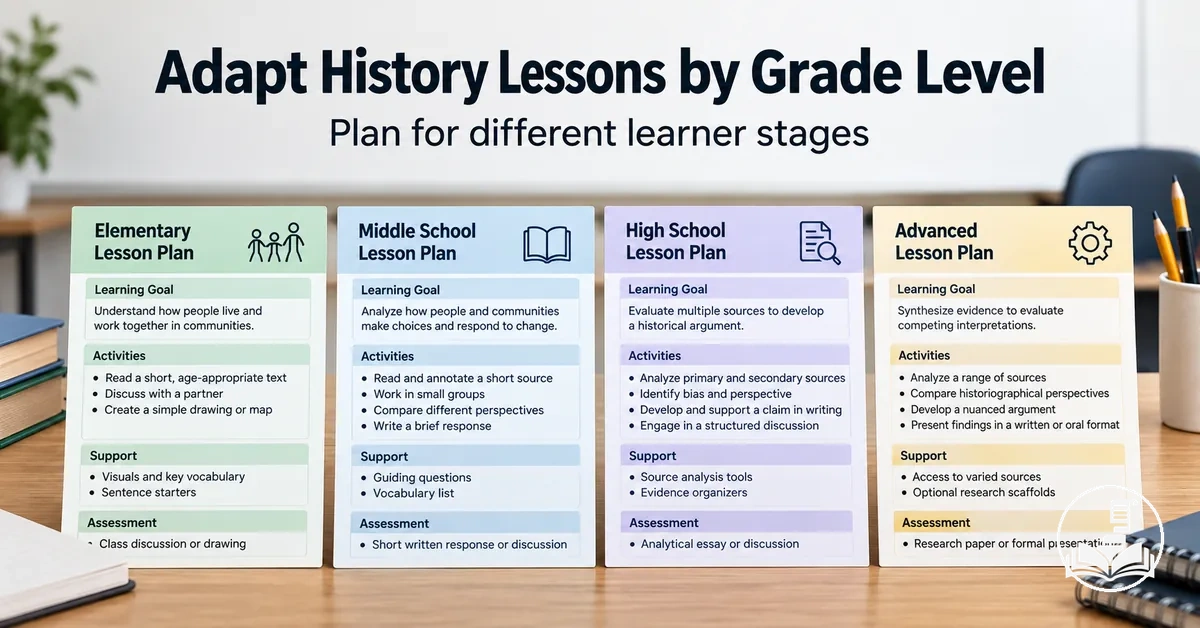
History lesson adaptation planner
Use the same decision sequence across school stages: preserve the historical learning purpose, identify the source of instructional demand, and adjust only the variables that need recalibration.
- Keep stable
- The intended historical understanding or reasoning, plus the evidence students need for the intended inference, where appropriate.
- Calibrate
- Content and background knowledge, reading and source access, reasoning, independence, scaffolding, and response expectations.
- Base decisions on
- The relevant curriculum, school stage, specific task, prior learning, source demands, and learner readiness.
- Define the learning purpose. State the historical understanding or reasoning the lesson is meant to develop before changing the task.
- Adjust content and background demand. Calibrate abstraction, chronology, assumed knowledge, and essential vocabulary without removing necessary disciplinary meaning.
- Adjust reading and source access. Change source length, excerpt boundaries, context, vocabulary support, or presentation only when those features create unnecessary access barriers.
- Calibrate reasoning and independence. Match sourcing, contextualisation, comparison, inference, synthesis, and prompting to the task and students’ preparation.
- Align evidence and response expectations. Set evidence selection, explanation, comparison, justification, and response structure so they still demonstrate the intended learning.
Decision rule: increase or reduce one or more demands according to the actual task and learner conditions; do not treat a grade label as a universal developmental threshold.
A lesson may require more scaffolding when students face unfamiliar vocabulary, demanding sources, limited prior knowledge, or a reasoning task that exceeds their current preparation; stronger prior learning can support more independent work with the same historical focus.
For example, a lesson on a historical protest might ask one group to identify the sequence of events and interpret a supported source excerpt, while a more demanding version can retain the same topic but require students to compare evidence and justify an explanation more independently.
Grade-level adaptation responds to broad school-stage expectations, while variation among individual learners may still require separate differentiation.
Table of Contents
How Grade Level Changes the Demands of a History Lesson
Grade level changes several interacting demands in a history lesson rather than setting one single level of difficulty.
Content complexity, text complexity, source complexity, reasoning, independence, and response expectations can each change the instructional demand, while the appropriate scaffolding depends on the curriculum, task, prior learning, and learner readiness.
These demands can be separated into two useful groups: material demand comes from the content, texts, and sources students must process, while student-task demand comes from what students must do with that material through historical reasoning, evidence use, independent work, and a response.
Within broader history lesson plans, changing either group can alter the overall instructional demand even when the historical topic stays the same.
The diagram groups these interacting demands around a history lesson plan to show how several dimensions, rather than grade level alone, shape the demand profile.

The main calibration criteria move from the material students encounter to the work they are expected to produce.
Each criterion links a source of demand to the learner condition that can increase or reduce the need for support, without implying a fixed developmental ladder.
- Content complexity: Denser chronology, unfamiliar concepts, or greater assumed background knowledge increase the connections students must make; limited prior knowledge may therefore require more explicit context or scaffolding.
- Text and source complexity: Unfamiliar vocabulary, greater source length, denser language, or a larger set of sources can increase the material demand; when these features obstruct access to the historical evidence, selected excerpts, vocabulary support, or clearer source framing may reduce that barrier.
- Historical reasoning: Tasks that require inference, comparison of evidence, or justification of an interpretation place greater reasoning demands than identifying explicit information; unfamiliar reasoning processes may therefore require modelling or guided prompts before more independent application.
- Student independence: Requiring students to select evidence, organise information, or plan a response with fewer prompts increases the independence demand; stronger prior learning and familiarity with the task can reduce the amount of step-by-step scaffolding required.
- Response expectations: Requiring a more developed explanation, more deliberate evidence selection, or explicit justification increases the output demand; the expected response should therefore reflect the school stage, taught content, task preparation, and evidence available to students.
Grade-level demands are calibration criteria rather than fixed age rules.
The appropriate combination of complexity, reasoning, independence, response expectations, and scaffolding depends on the relevant curriculum, the specific task, prior learning, and learner readiness.
Historical Content and Concept Complexity
Historical content complexity is the conceptual demand created by how a topic is framed through abstraction, chronology, causation, perspective, and the prior knowledge needed to understand their relationships.
Concept complexity therefore concerns the thinking required to connect and interpret historical content, not simply the quantity of information presented.
The same topic can carry a different conceptual demand when its framing changes.
Adding facts may increase the amount of information to process without requiring the same kind of thinking as tracing interacting causes, interpreting multiple perspectives, or reasoning with abstract concepts.
The comparison graphic shows this distinction through chronological, causal, and multi-perspective framings of one historical topic.
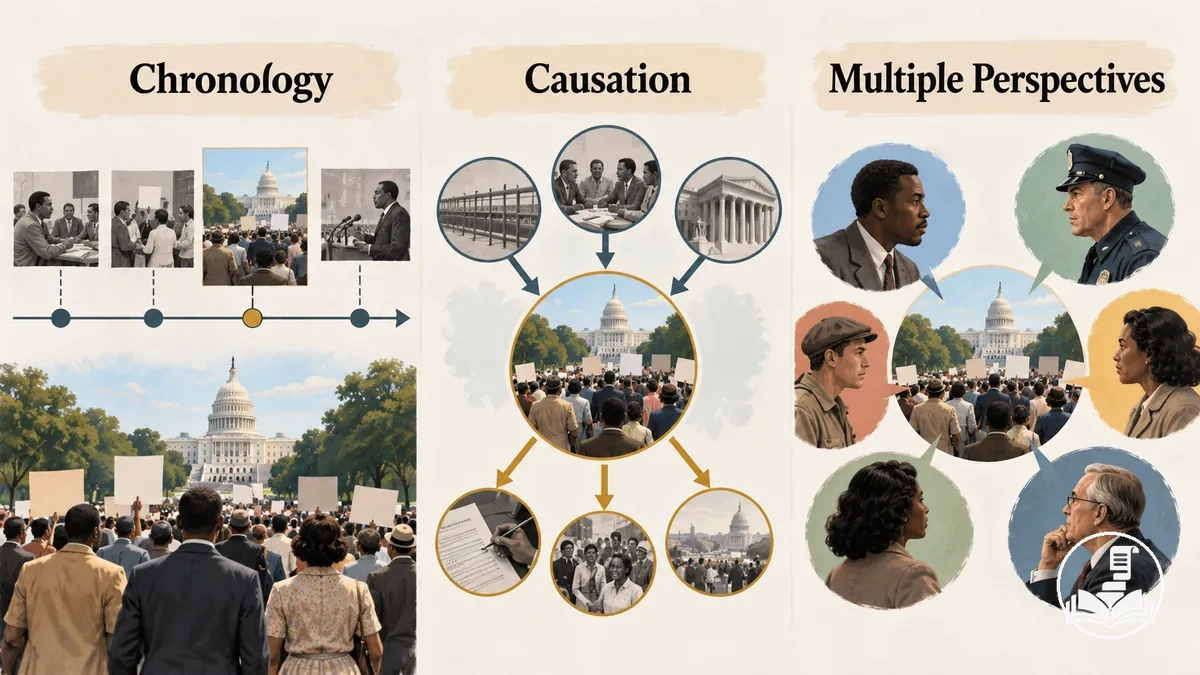
The attributes below separate different sources of conceptual demand and show their instructional significance.
- Chronology: A concrete sequence of events places emphasis on order and temporal relationships; when those relationships are unfamiliar or widely separated in time, students may need clearer chronological context to connect them.
- Prior knowledge: Historical content that assumes unfamiliar people, institutions, places, or earlier events increases the background knowledge required to interpret the topic; supplying essential context can reduce that prerequisite burden without changing the historical focus.
- Causation: A topic framed around one explicit cause and consequence carries a different conceptual load from one involving multiple interacting causes, conditions, and effects; greater causal density may require more support for distinguishing and connecting those relationships.
- Perspective: Historical content involving multiple viewpoints or interpretations increases the need to distinguish whose perspective is represented and how perspectives relate to the event; unfamiliar contexts may therefore require stronger contextual support.
- Abstraction: Concrete people, actions, and events can often be processed more directly than abstract ideas such as institutional change, legitimacy, or continuity; greater abstraction may require examples and background knowledge that connect the concept to observable historical evidence.
For example, the same protest can be framed as a sequence of events, as an explanation of interacting causes and consequences, or as an interpretation of how different participants understood the event; each framing changes the conceptual demand without relying on a universal grade threshold.
Reading and Source Complexity
Reading and source complexity in history lessons includes more than a nominal readability level.
Reading demand can come from text complexity such as vocabulary, syntax, and source length, while source complexity can also depend on genre, legibility, background knowledge, source information, and how clearly or ambiguously the document presents evidence for the task.
Linguistic load concerns how readily students can process the words and sentences, whereas historical interpretation load concerns what they must understand about the document to interpret its evidence.
Unfamiliar vocabulary, dense syntax, or greater source length can increase the reading load even when the historical context is familiar.
Conversely, two texts with similar readability can present different source complexity when one requires more background knowledge, contains unfamiliar genre conventions or difficult handwriting, or leaves the evidentiary meaning more ambiguous.
The main attributes below separate barriers to reading from barriers to historical interpretation and connect each difficulty with a support that may reduce the relevant access burden.
- Vocabulary: Unfamiliar words can interrupt comprehension; selective glossing may reduce that linguistic barrier while leaving the evidence-bearing language available for interpretation.
- Syntax: Dense or unfamiliar sentence structures can increase text complexity; brief language support or carefully selected excerpts may help students follow the passage without supplying its historical interpretation.
- Source length: A long document can increase reading demand beyond what the task requires; an excerpt may focus attention on relevant evidence when the omitted material is not necessary for the intended interpretation.
- Genre and legibility: Unfamiliar document forms, handwriting, layout, or degraded presentation can obstruct access; a legible transcription or concise explanation of the document type may reduce those barriers while keeping the source content available.
- Background knowledge: A source that assumes unfamiliar events, institutions, people, or circumstances adds contextual demand; a concise head note can supply essential context without resolving the evidentiary question for students.
- Source information and evidentiary ambiguity: Unclear authorship, date, purpose, audience, or circumstances can make the evidence harder to situate; clear source information can establish provenance and context while leaving students to interpret what the document supports.
Excerpts, head notes, glossing, and clear source information can reduce particular access barriers without removing the historical evidence students need to interpret.
The annotated example shows these supports around an evidence-bearing passage so that the distinction between access support and historical meaning remains visible.
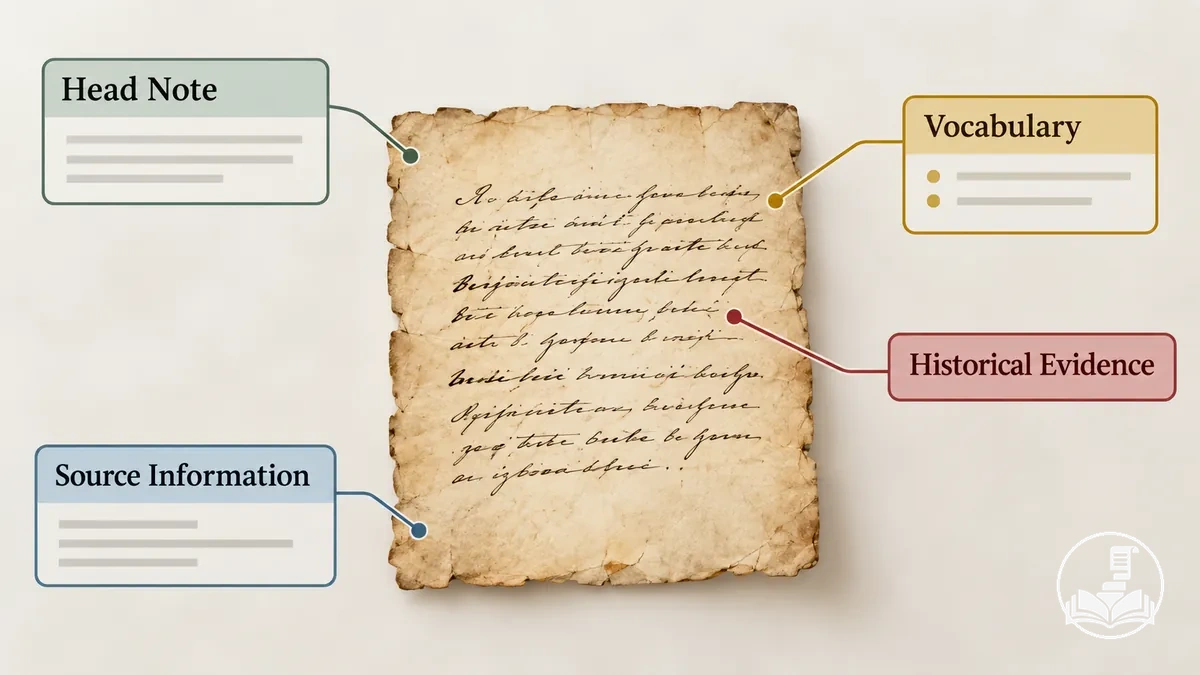
For example, an unadapted document might combine dense language, unfamiliar terms, and little contextual information, while an adapted version can present a relevant excerpt with a short head note, selective glossing, and clear source information while retaining the passage students must interpret as historical evidence.
Historical Reasoning and Evidence Expectations
Grade-level adaptation changes what students are expected to do with historical evidence, not only what they are expected to read.
Historical reasoning can involve identifying evidence with substantial guidance or using sourcing, contextualisation, corroboration, causal reasoning, perspective, evidence selection, and justification with greater independence when the task and preparation support those expectations.
Reasoning expectations should be calibrated to the course, specific task, prior learning, and support already provided rather than treated as a fixed progression.
The key distinction is between what students are asked to notice or identify and what they are expected to explain, compare, evaluate, or justify with evidence.
As the required response becomes more complex, the task can increase the level of independence expected in selecting, connecting, and using evidence.
The criteria below connect each historical reasoning operation with the support it may require and the implication for the expected response.
- Sourcing: Students may work from prompts that identify an author, date, purpose, or audience, while a more independent task can expect them to determine which source information matters and use it when interpreting the evidence.
- Contextualisation: Background information or guiding questions can support students in placing evidence within its historical circumstances; with sufficient prior learning, a task can expect students to connect relevant context to the evidence more independently.
- Corroboration: Guided tasks may direct students to specific similarities or differences between sources, while more independent reasoning can involve selecting relevant points of comparison and explaining how the sources support, complicate, or differ from one another.
- Causal reasoning: Prompts can identify causes or consequences for students to examine, while a more demanding response can require them to connect multiple factors and justify how selected evidence supports a causal explanation.
- Perspective: Guided questions may direct attention to whose viewpoint is represented, while greater independence can involve interpreting relevant differences in perspective and explaining their significance to the historical question.
- Evidence selection: A supported task may provide the evidence to use, while a more independent task can expect students to choose relevant evidence from the available material and connect that selection to a claim.
- Justification: Sentence prompts or specified evidence can support an initial explanation, while a more independent response can require students to construct a claim and justify it with relevant evidence and reasoning.
The comparison graphic uses the same historical question and evidence to show a guided prompt beside a more independent evidence task; it compares reasoning demand and the level of task support rather than assigning fixed ability to students.
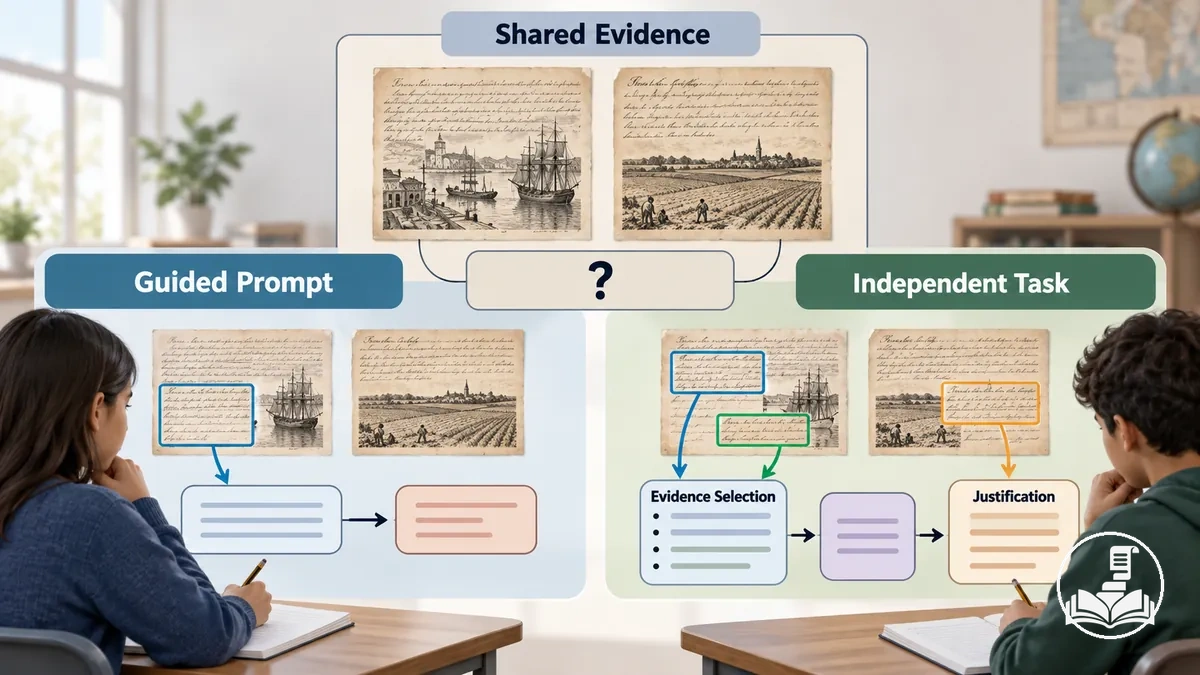
For example, a guided task might identify two passages and ask students what each says about a stated cause, whereas a more independent task can ask students to select relevant evidence from the same material and justify a causal claim.
The second formulation increases the reasoning demand and response complexity by requiring evidence selection and justification, but whether that level of independence is appropriate depends on the course, task, prior learning, and support provided.
How to Adapt the Same History Topic Across Grade Levels
The same historical topic can be adapted across grade levels by keeping the core learning purpose stable while changing content access, source support, activity complexity, independence, and evidence expectations.
The amount of adjustment should reflect the relevant school-stage demands, learner readiness, prior learning, and the demands of the specific task rather than changing the lesson aim simply to make the work easier or harder.
A five-step adaptation sequence organises these decisions without replacing broader history lesson planning principles.
Move from the stable learning purpose to school-stage demands, then adjust content and source access, calibrate the activity and support level, and align the required evidence and response complexity.
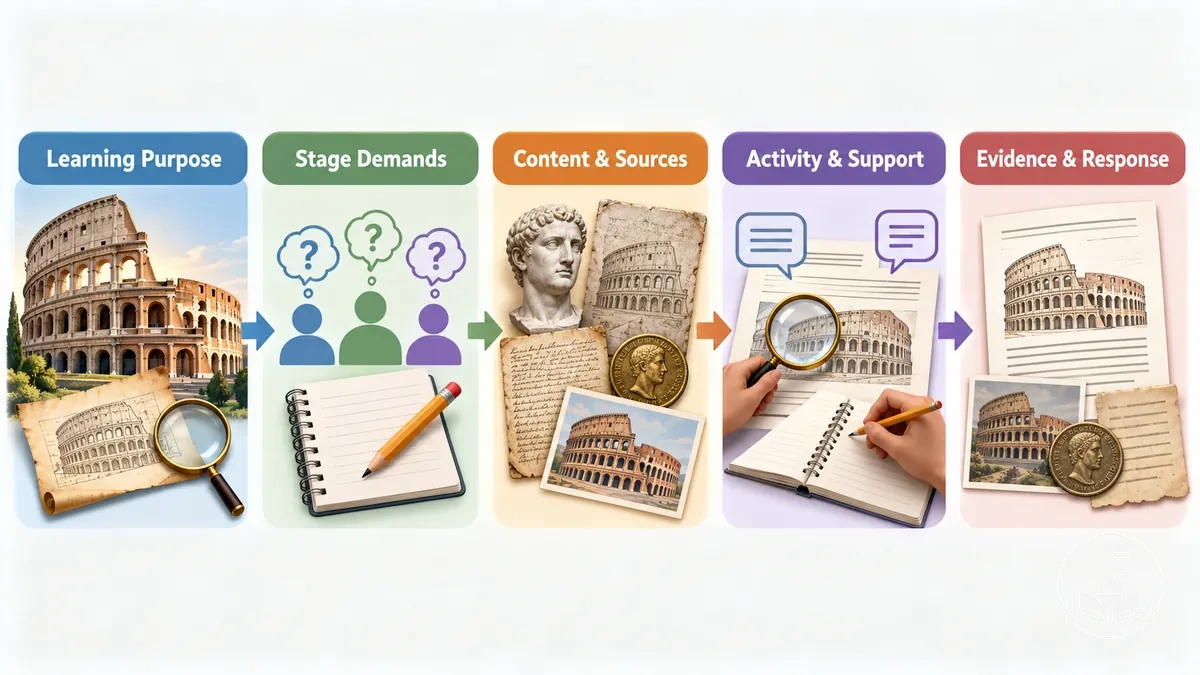
- Define the learning purpose: Identify the historical understanding or reasoning the lesson is intended to develop before changing the task. Keep that learning purpose stable where appropriate so later adaptations alter access and demand rather than unintentionally replacing the lesson aim; check that each version still addresses the same core historical focus.
- Identify school-stage demands: Estimate the content knowledge, literacy demand, reasoning, and independence expected for the relevant school stage, then consider learner readiness and prior learning. Use this estimate to determine where support or complexity may need adjustment; check that the task does not rely on untaught knowledge or unsupported reasoning.
- Adjust content and source access: Change content access and source support when vocabulary, source length, background knowledge, or document presentation creates demand beyond what the task needs. Excerpts, contextual information, or selective language support can reduce an access barrier while retaining evidence needed for the learning purpose; check that the adaptation has not supplied the interpretation students are meant to make.
- Calibrate activity complexity and independence: Adjust what students must do with the historical material and how much guidance they receive. A task may use modelling, prompts, specified comparisons, or selected evidence when more support is appropriate, while stronger preparation can support greater independence; check that activity complexity matches the reasoning expected rather than merely increasing the amount of work.
- Align evidence expectations, response complexity, and verification: Set the expected evidence use and response so they match the adapted activity, available sources, prior preparation, and intended degree of independence. A supported response may identify or explain evidence through prompts, whereas a more independent response can require evidence selection and justification when appropriate; verify that the final task still serves the original learning purpose.
For example, a lesson on a historical protest can retain the learning purpose of explaining why the event occurred while changing the surrounding demands.
One version might provide a short contextual introduction, selected source excerpts, and prompts that guide students to connect evidence with stated causes; another can use the same topic and purpose while expecting students to select relevant evidence and explain how several causes interacted with less prompting.
The historical focus remains stable, while content access, source support, activity complexity, evidence expectations, and response complexity are calibrated to the task, school-stage demands, and learner readiness.
Verification asks whether the adapted task still elicits the intended historical learning rather than merely changing workload.
If the adaptation changes the lesson aim or removes evidence needed for the intended reasoning, the task should be adjusted again; individual learner needs may still require differentiation beyond this school-stage adaptation.
Adjust Background Knowledge and Vocabulary Demands
Background knowledge and historical vocabulary should be calibrated so students can access the historical problem without losing the disciplinary language needed to understand it accurately.
Essential terms should be retained when they carry historical meaning, while the amount of context, pre-teaching, and other support should reflect what learners already know.
The key distinction is between essential disciplinary language and non-essential language load.
Historical vocabulary that names a necessary concept should remain explicit, with contextual support when prior knowledge is limited; wording that adds difficulty without serving the learning purpose can be reduced.
When students already have relevant background knowledge, less contextual support may be needed and the task can leave more of the interpretation to them.
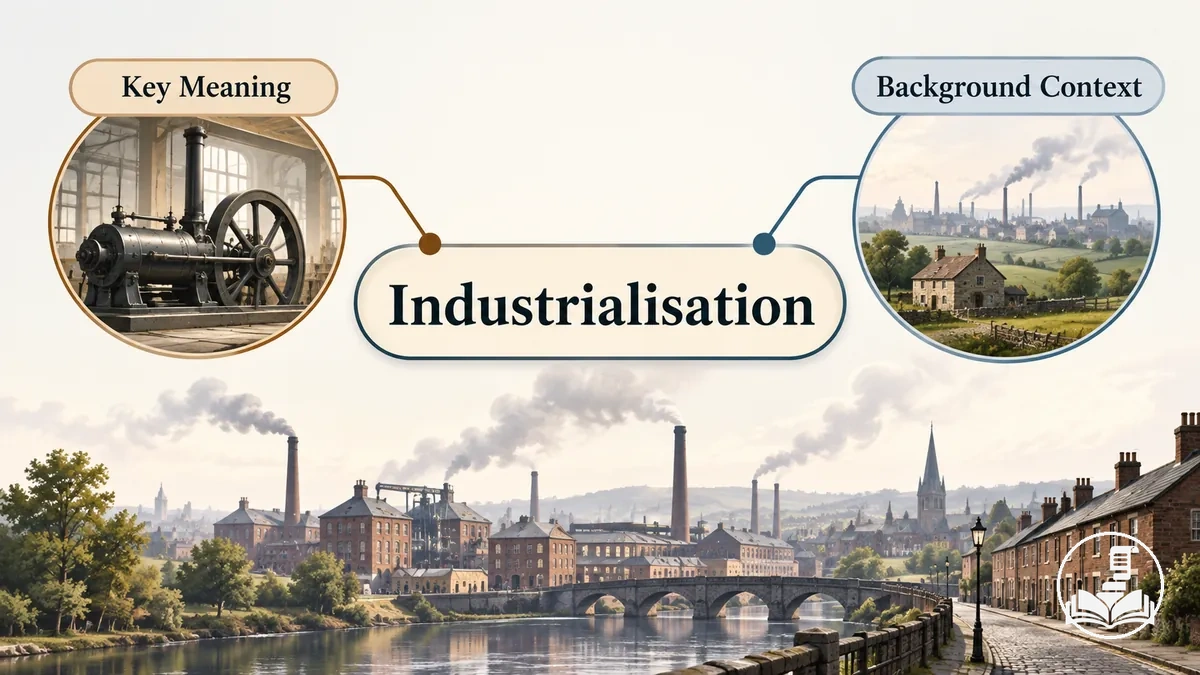
The annotated example shows how a key historical concept can retain its disciplinary term while a concise gloss and background-context cue provide access support.
- Activate prior knowledge: Identify relevant people, events, institutions, or concepts that students already know and briefly reconnect them to the new historical problem; this can reduce the amount of new context students must process at once.
- Pre-teach essential terms: Introduce historical vocabulary that students need to understand the topic or reasoning task, using concise explanations that retain the disciplinary meaning rather than substituting a less precise term.
- Reduce non-essential wording: Shorten or clarify language that adds difficulty without contributing necessary historical meaning; keep essential terms intact so improved access does not change the concept students are expected to understand.
- Supply concise context: Provide the prerequisite background knowledge needed to situate an unfamiliar concept, while leaving the historical interpretation students are expected to make unresolved.
For example, the concept of industrialisation can remain explicit while students with less relevant prior knowledge receive a short explanation of the economic and social changes the term describes; students who already understand that context may work with the same concept with less introductory support.
The appropriate support therefore follows prior knowledge relevant to the task rather than the grade label alone.
Adjust Text Difficulty, Source Length, and Scaffolding
Text difficulty and source access can be adjusted without removing the evidence students need for historical interpretation.
Adapt the specific source attribute creating unnecessary reading load while retaining the passages, language, and source purpose required for the intended inference.
The main adjustable variables are source length, source selection, excerpt boundaries, head notes, vocabulary support, and guiding prompts.
A long source may warrant a focused excerpt when its length adds reading load unrelated to the evidentiary task, while unfamiliar context may call for a concise head note.
Vocabulary support can clarify selected terms without interpreting the evidence for students, and a guiding prompt can focus attention on relevant evidence when additional scaffolding is appropriate.
Each option therefore targets a different access barrier rather than assuming that shorter or less demanding text is inherently better.
- Shorten source length: Use a shorter portion when document length creates unnecessary reading load, but retain enough surrounding material for students to interpret the evidence in relation to the source purpose.
- Select an evidence-bearing excerpt: Choose the passage that contains the evidence needed for the historical inference, while retaining enough context to avoid changing what the passage can reasonably support.
- Add a concise head note: Supply essential contextual information when unfamiliar people, events, institutions, or circumstances would otherwise obstruct interpretation, without stating the conclusion students are expected to reach.
- Provide selective vocabulary support: Clarify unfamiliar words that obstruct access to the passage while retaining historically significant language when its wording matters to the evidence.
- Use a guiding prompt: Direct attention to a relevant feature, comparison, or passage when students need scaffolding for the task, while leaving the required inference or interpretation for them to make.
For example, before adaptation, students might receive a long historical document with limited context and be asked to infer the author's explanation for an event; after adaptation, they can receive an evidence-bearing excerpt from the same document, a brief head note, selective vocabulary support, and a guiding prompt directing attention to the relevant passage.
The reading load and scaffolding change, but the evidentiary task remains interpreting the source to support the same historical inference.
Adjust Activity Complexity and Student Independence
Activity complexity should be calibrated with the amount of reasoning and student independence the task requires.
Increasing task demand can increase the need for teacher support when students must manage more decisions, sources, collaboration, or synthesis, while stronger preparation and familiarity with the task may support greater independence.
Activity complexity can change through the number of task steps, question openness, source count, research responsibility, discussion structure, and required synthesis.
More open questions or greater source selection can increase the decisions students must make, while structured prompts, assigned sources, defined roles, or staged task steps can reduce procedural demand without replacing the historical reasoning.
The appropriate guidance therefore depends on the task complexity, available material, prior learning, and learner readiness.
The options below pair each activity variable with the teacher support that may be useful as independence demands change.
- Task steps: A task with several connected steps increases the amount students must organise and monitor; sequencing the steps or providing interim prompts can support the process until students can manage the structure with greater independence.
- Question openness: An open historical question requires students to make more decisions about direction and evidence; narrowing the question or supplying decision prompts may provide guidance when that choice would otherwise obscure the intended reasoning.
- Source count and selection: Requiring students to work across more sources or choose sources themselves increases selection and organisational demands; teacher-selected material or a bounded source set can reduce those demands while retaining the intended evidence work.
- Research responsibility: Assigning responsibility for locating and organising relevant information increases student independence; defined research boundaries, supplied starting material, or staged checkpoints may provide teacher support when the research process is not itself the primary learning purpose.
- Discussion structure: Collaborative reasoning with less prescribed participation requires students to manage contributions, evidence, and responses to peers; defined roles, focused questions, or turn structures can support collaboration when additional guidance is needed.
- Synthesis: Requiring students to connect several sources, causes, perspectives, or findings into one explanation increases the reasoning and organisational demand; an organising prompt or specified synthesis focus can scaffold the task without supplying the final interpretation.
A guided version of the same historical task might provide a bounded source set, a focused question, defined discussion roles, and staged prompts before students construct an explanation; a more independent version can retain the historical problem while asking students to select relevant sources, organise the discussion, and synthesise evidence with fewer procedural prompts.
Neither version is inherently better: the appropriate activity complexity and teacher support depend on the intended reasoning, task conditions, prior preparation, and learner readiness.
Improving student engagement in history is a separate planning objective from calibrating activity complexity, so novelty or entertainment should not be treated as a measure of appropriate student independence.
Adjust Assessment Evidence and Response Complexity
Assessment evidence and response complexity should become more demanding only when the lesson's content, reasoning, and independence expectations support that increase.
A longer student response is not automatically more complex or better; the relevant demand also depends on what evidence students must select, explain, compare, and justify in relation to the learning expectations.
Calibrate output expectations by separating the amount of response from the quality of historical reasoning required.
Response length changes how much students must produce, while evidence selection, explanation, comparison, justification, and independence change what students must do with historical material.
A less demanding condition may provide evidence, prompts, or a bounded response focus, whereas a more demanding condition may require students to make more of those decisions independently when prior preparation and the assessment task support them.
The criteria below map each response attribute to a less or more demanding condition and the resulting expectation for assessment evidence.
- Response length: A brief response may be sufficient when the task requires a focused identification or explanation, while a sustained response may be appropriate when students must develop and connect several relevant points; greater length alone does not establish greater reasoning quality.
- Evidence selection: A less demanding task may identify the evidence students should use, while a more demanding task may require them to select relevant evidence from the available material and connect that selection to a claim.
- Explanation: A supported response may identify relevant evidence or state what it shows, while a more demanding response may require students to explain how that evidence supports a historical claim.
- Comparison: A less demanding condition may specify the sources, events, or perspectives to compare, while a more demanding condition may require students to identify relevant points of comparison and explain their significance to the question.
- Justification: A task with greater support may provide a claim or reasoning prompt, while a more demanding response may require students to construct a claim and justify it with relevant evidence and explicit reasoning.
- Independence: A supported assessment task may provide evidence, structure, or prompts, while a more independent task may require students to organise the response, select evidence, and determine how to use it with less guidance; the appropriate degree of independence depends on the lesson's learning expectations and prior preparation.
For example, one version of a task might provide two relevant pieces of evidence and ask students to explain how one supports a stated claim, while a more demanding version of the same historical task might ask students to select relevant evidence from the supplied material, compare what it supports, and justify their own claim.
The second response increases evidence selection, comparison, justification, and independence rather than merely requiring more words.
The appropriate expectation should remain aligned with the lesson goals and applicable local curriculum or grading requirements, which may differ across jurisdictions and school contexts.
How History Lesson Adaptation Changes Across School Stages
History lesson adaptation can combine the same variables differently across each broad school stage, including content complexity, source demands, historical reasoning, student independence, and response expectations.
Patterns across the primary years and secondary years provide a comparison framework, while the appropriate demand and support still depend on the curriculum, specific task, prior learning, and learner readiness.
The comparison uses the same criteria for Early primary, Upper primary, Lower secondary, and Upper secondary so changes in task demand remain comparable.
It summarises broad instructional tendencies rather than fixed developmental rules: what tends to change is the combination of complexity, reasoning, independence, and support, while the appropriate combination remains conditional on local learning expectations and the learners undertaking the task.
| School stage | Content and concepts | Sources and reading | Historical reasoning | Independence and response |
|---|---|---|---|---|
| Early primary | Tends to use more concrete historical framing, clear chronology, and limited assumed background knowledge. | May require short, accessible source material with substantial contextual and language support. | Can emphasise identifying relevant information and making guided connections between evidence and the historical question. | Often involves structured task steps, guided evidence use, and focused responses with substantial teacher support. |
| Upper primary | Can introduce more connected concepts, causes, consequences, and perspectives when prior learning supports them. | May use longer or more varied sources with selective vocabulary and contextual support according to source demands. | Can place greater emphasis on explaining evidence, comparing selected material, and connecting evidence to claims with guidance. | May allow greater student independence in organising evidence and producing explanations while retaining prompts where the task demand requires them. |
| Lower secondary | Can involve denser conceptual relationships, broader context, and multiple interacting causes or perspectives. | May use greater source complexity and a wider source set when reading demands and background knowledge are adequately supported. | Can require more sustained comparison, explanation, evidence selection, and justification in relation to historical questions. | May place greater responsibility on students to manage task steps, select relevant evidence, and construct more sustained responses with less procedural guidance. |
| Upper secondary | May involve more abstract concepts, contested interpretations, and complex relationships when these align with the course and task. | Can require students to work with denser, longer, or more varied sources with support calibrated to the material and learner readiness. | May demand more independent selection, comparison, interpretation, and justification of evidence when the learning expectations require it. | Can place greater emphasis on independent task management and sustained evidence-based responses, while teacher support remains appropriate where the task or preparation requires it. |
The table should therefore be read across each row as a combination of stage-level demands rather than as a prescribed progression in which every attribute must increase together.
A teacher can use the broad pattern to identify where content complexity, source demands, historical reasoning, student independence, or response expectations may need adjustment, then calibrate those demands to the curriculum, task, prior learning, and learner readiness.
Early Primary: Concrete Chronology and Guided Evidence Use
In an early-primary history task, students might place several events in sequence and use concrete examples to explain what happened before and after.
Framing chronology through familiar time concepts and sequencing can reduce unnecessary abstraction while preserving historical reasoning through guided evidence use.
Early-primary calibration at a glance
- Chronology and task structure
- Use familiar time concepts, shorter task sequences, and explicit sequencing prompts when abstraction or procedural load would otherwise distract from the historical relationship.
- Source and vocabulary access
- Simple images or objects can provide observable evidence where suitable, while brief explanations can remove unfamiliar vocabulary barriers without replacing the historical meaning.
- Evidence use
- Prompt students to notice relevant details and connect those observations to the historical question so guidance supports interpretation rather than supplying it.
- Response mode
- An oral explanation can be appropriate when the lesson is assessing what the evidence suggests rather than the student’s ability to produce extended writing.
- Teacher guidance
- Adjust source type, vocabulary load, chronology, response mode, and prompting together according to the task, prior learning, and learner readiness.
For example, a teacher might ask students to notice a detail in a historical image, identify it as observable evidence, and then give a supported explanation of what that detail suggests using a guiding question.
The appropriate balance of concrete chronology, guided interpretation, and teacher guidance can still vary within early primary according to the task, prior learning, and learner readiness.
Upper Primary: Cause, Perspective, and Supported Source Comparison
Upper-primary history lesson adaptation can increase causal reasoning, perspective taking, and supported source comparison while retaining explicit scaffolding.
Students can move from guided interpretation of one source to comparing contrasting sources or viewpoints, while support keeps the analytical demand focused on the intended historical question.
From guided interpretation to supported comparison
Guided single-source reasoning
Students identify relevant evidence in one source and explain what it suggests. A focused question or prompt can keep attention on the historical inference rather than on procedural decisions.
Supported comparison
Students compare contrasting sources or viewpoints, explain where evidence or perspectives converge or differ, and use evidence to address cause or perspective. Source labels and structured prompts can clarify authorship, context, viewpoint, and useful comparison points.
Support condition: adjust source labelling and prompting to source complexity, prior learning, task demands, and learner readiness rather than treating upper primary as a fixed threshold.
For example, students might compare two contrasting sources about the same historical event using source labels and guided prompts, then use evidence from the sources to explain one contributing cause or difference in perspective under teacher guidance.
This increases the reasoning demand through source comparison and evidence-based explanation, while the appropriate support can vary with the material, task, prior learning, and learners.
Lower Secondary: Contextualisation, Multi-Source Reasoning, and Greater Independence
Lower-secondary history lesson adaptation can increase contextualisation, multi-source reasoning, inferential reading, and independent task management while retaining support when sources are unfamiliar or textually demanding.
Greater independence can shift more responsibility for interpreting context, comparing evidence, and forming a supported conclusion to students without treating independent work as unsupported work.
Using several sources and a more open historical question increases task demands because students must decide which evidence is relevant and how sources relate to the question.
Greater source complexity may require contextualisation before students can make a sound inference, while guided prompts can focus attention on relevant evidence when the material remains difficult.
As students become familiar with the source set and reasoning task, prompts may be reduced so that source comparison, evidence selection, and organisation shift toward greater student responsibility.
The appropriate support therefore depends on source difficulty, prior learning, question openness, and learner readiness rather than on source quantity alone.
Upper Secondary: Independent Inquiry, Evidence Evaluation, and Sustained Argument
Upper-secondary history lesson adaptation can place greater weight on independent inquiry, evidence evaluation, synthesis, qualified claims, and sustained argument when the course demands, prior preparation, and learner readiness support those expectations.
Greater independence can require students to take more research responsibility for selecting, evaluating, and justifying evidence rather than simply completing longer work with less scaffolding.
More complex source sets can increase the need to evaluate provenance, relevance, and evidentiary conflict before using evidence in an argument.
Greater research responsibility may require students to select and verify useful material rather than work only from teacher-selected evidence, while conflicting sources create a need for synthesis and qualification rather than simple accumulation.
A sustained argument becomes more intellectually demanding when students must connect evidence to a claim, address tensions or limitations in that evidence, and provide justification across the response.
These demands distinguish greater intellectual complexity from merely reducing prompts or increasing reading and response length.
The criteria move from gathering and evaluating evidence toward constructing and sustaining a justified historical argument.
- Inquiry responsibility: Independent inquiry may place greater responsibility on students to identify relevant sources, make source selections, and verify that the evidence is suitable for the historical question.
- Evidence evaluation: Students can evaluate the relevance, context, limitations, and evidentiary conflict within a source set rather than treating each source as equally useful or mutually consistent.
- Synthesis across evidence: Students can connect evidence across sources, including points of agreement, difference, or tension, so that synthesis contributes to an interpretation rather than becoming a list of source summaries.
- Qualification of claims: A qualified claim can reflect evidentiary limits, competing interpretations, or conflicting evidence instead of asserting more certainty than the available material supports.
- Sustained justification: A sustained argument requires students to maintain a claim through relevant evidence and reasoning, justify how the evidence supports the interpretation, and account for significant complications where the task requires them.
For example, an inquiry task might ask students to evaluate competing evidence about why a historical event occurred, determine which evidence supports or complicates different explanations, and construct a qualified argument justified by the source set.
The task is more demanding because it combines independent inquiry, evidence evaluation, synthesis, qualification, and sustained justification; longer readings or a longer essay alone do not establish greater historical reasoning, and the appropriate degree of independence still depends on the course, material, prior preparation, and learner readiness.
Grade-Level Adaptation and Learner Differentiation Serve Different Needs
Grade-level adaptation responds to broad expectations and lesson demands associated with a school stage, whereas learner differentiation responds to learner variation within that stage.
The distinction is the adjustment trigger: one calibrates a history lesson for stage-level demands, while the other adjusts support or task conditions for particular learner needs.
The approaches can be compared through the reason for the change, the group being considered, the type of adjustment, and the resulting instructional implication.
Grade-level adaptation considers what demands are appropriate for the broader school stage, while learner differentiation considers variation in access, readiness, prior learning, or support needs among learners working within that context.
The comparison keeps the same history lesson planning dimensions visible while separating why, for whom, and how an adjustment is made.
| Comparison basis | Grade-level adaptation | Learner differentiation |
|---|---|---|
| Primary trigger | Broad school-stage expectations and the resulting lesson demand. | Learner variation within the stage and the resulting support needs. |
| Who the adjustment is for | The broader group working within the relevant school-stage context. | Particular learners or groups whose needs differ within that context. |
| Typical adjustment focus | Content and source demands, reasoning expectations, independence, and response complexity appropriate to the stage and task. | Access, scaffolding, task conditions, or support adjusted for learner-specific needs while preserving the intended historical learning where appropriate. |
| Can both apply? | Yes. A lesson can first be calibrated for its school stage. | Yes. The stage-adapted lesson can then receive differentiated support for particular learners when needed. |
For example, a historical source might be adapted for the whole school stage by selecting an evidence-bearing excerpt and calibrating its contextual information to the lesson demand, while particular learners may then receive further vocabulary or contextual support according to their needs.
This boundary is important when differentiating history lesson plans: the first adjustment responds to stage-level expectations, while the second responds to learner variation within that stage.
Grade-level adaptation and learner differentiation can therefore coexist in the same lesson when both adjustment triggers are present.