
Building Historical Thinking Skills Into History Lessons
Build historical thinking into a history lesson by making a specific reasoning operation—not fact recall—the task students must complete. Align the historical question, evidence, contextual knowledge and support, and expected response so students must use evidence to analyse significance, sources, change, causation, perspectives, or ethical dimensions and justify a defensible interpretation.
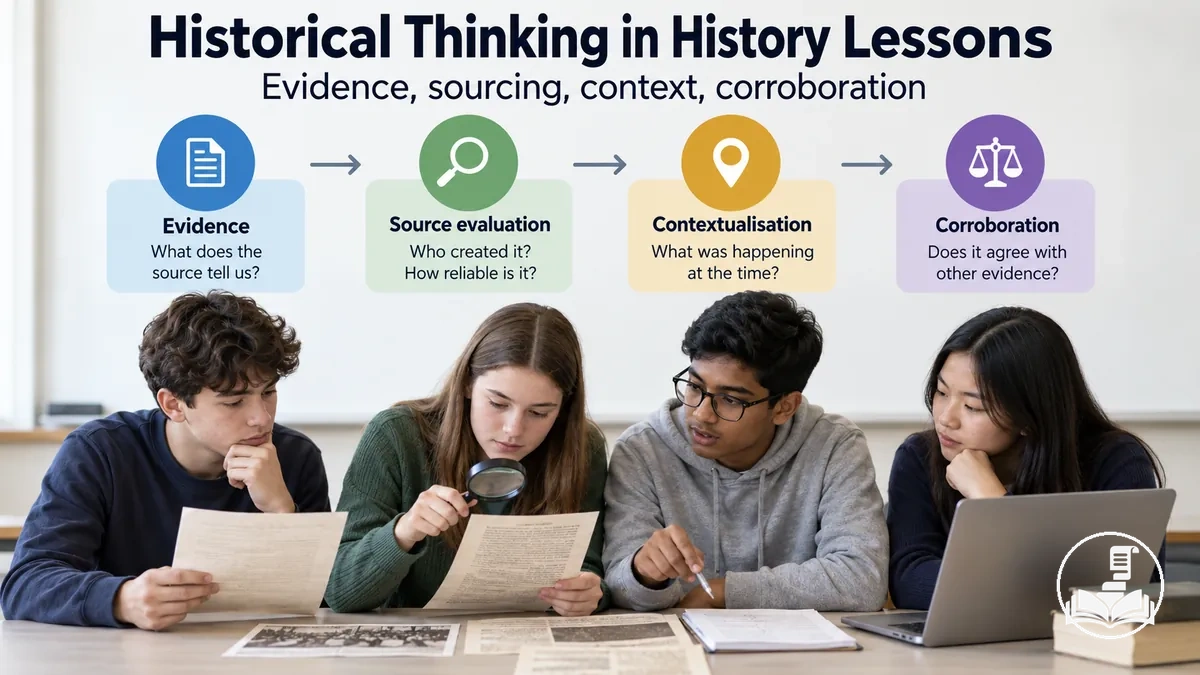
Historical thinking lesson design map
Use the reasoning job as the organising variable: the question should require it, the evidence should make it possible, and the response should make the reasoning visible.
- Choose the reasoning jobDecide whether students must judge significance, analyse evidence, trace continuity and change, explain cause and consequence, interpret historical perspectives, or make an ethical judgement.
- Frame the historical questionUse a question predicate that makes the target reasoning necessary rather than allowing recall or unsupported opinion to complete the task.
- Align evidence, context, and supportSelect evidence that can support the reasoning and provide enough contextual knowledge or scaffolding for students to work with it without supplying the conclusion.
- Require a justified responseAsk students to state a claim or interpretation, use relevant evidence, explain the reasoning link, and qualify the conclusion when the evidence is limited or contested.
Match the question to the skill
- What matters, and why?
- Historical significance
- What can these sources support?
- Primary source evidence
- What changed or persisted, for whom, and when?
- Continuity and change
- Which conditions and actions contributed to which outcomes?
- Cause and consequence
- How did historical actors understand their circumstances?
- Historical perspectives
- How should actions, responsibility, harms, and legacies be judged in context?
- Ethical dimensions
Task check: if students can succeed through factual recall alone or unsupported opinion, the lesson does not yet require the intended historical reasoning.
Factual knowledge remains necessary because students need accurate historical content to reason well, but recall alone does not demonstrate historical thinking. Curricula and scholarly frameworks group these skills differently, so the six-concept synthesis below is a practical lesson-building framework rather than a universal taxonomy.
Table of Contents
What Historical Thinking Means in Classroom Practice
Historical thinking in classroom practice is reasoning about the past by asking historically meaningful questions, evaluating historical evidence, interpreting historical context, and constructing a justified explanation.
It requires students to connect claims to evidence rather than treat accurate fact recall as sufficient historical reasoning.
Historical thinking therefore makes the reasoning behind an interpretation explicit.

Historical thinking involves examining evidence in relation to its time and circumstances, considering perspective, and explaining causation and change.
These attributes require students to judge what evidence supports an interpretation and how historical context affects its meaning.
Reasoned judgement connects these elements by requiring a justified explanation rather than an unsupported conclusion.
Identifies accurate historical information—for example, when an event occurred. That knowledge can support later analysis, but accuracy alone does not show how the student interprets relationships among facts.
Uses relevant evidence and historical context to make and justify a claim—for example, explaining why an event occurred and showing how the evidence supports that interpretation.
Boundary: historical thinking is specifically anchored in historical evidence and context; it requires the reasoning behind an interpretation to become explicit.
Common Historical Thinking Concepts to Build Into Lessons
Historical thinking concepts organise recurring reasoning functions that help students decide what matters, use evidence, trace change, explain causes, interpret perspectives, and make ethical judgements about the past.
The Historical Thinking Project uses six interrelated concepts, while other established frameworks may use different labels or groupings.
This section therefore uses these six concepts as a practical synthesis for lesson-building rather than as a universally fixed taxonomy.
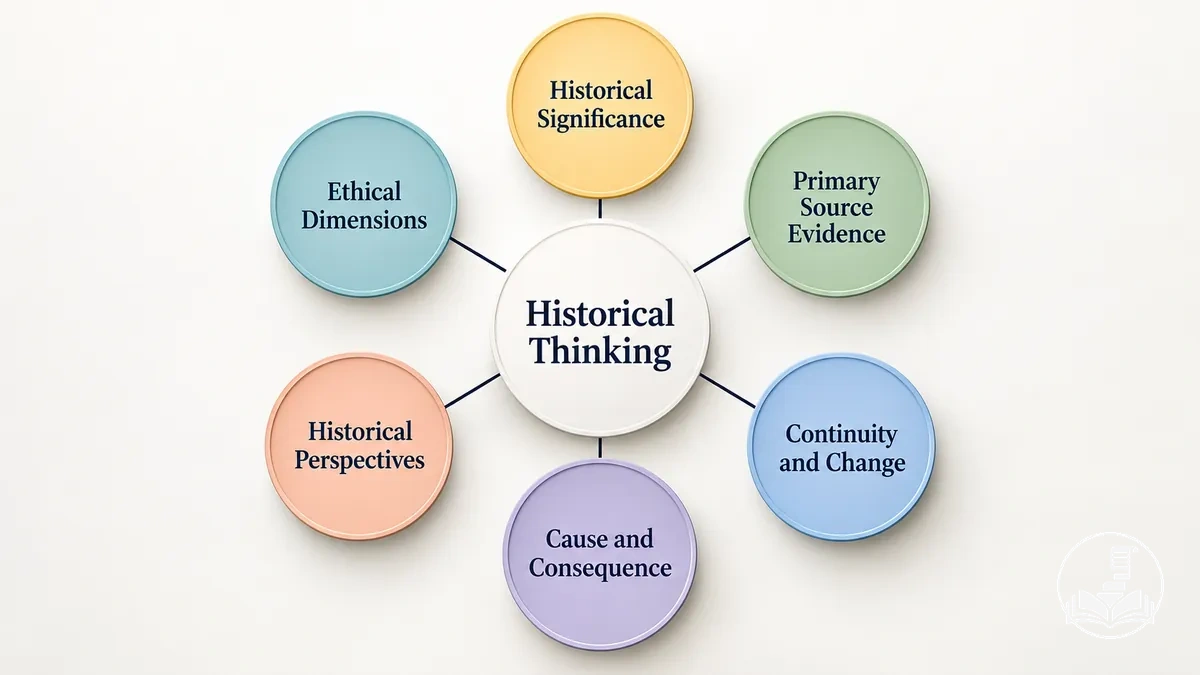
Each concept focuses attention on a different question students can ask of the past, so its value lies in the reasoning function rather than the label alone.
The six concept families used here are:
- Historical significance: asks what matters in the past and supports reasoned judgement about why an event, person, development, or experience is important.
- Primary source evidence: asks what historical evidence can support a claim, focusing attention on sources, their context, and how evidence is interpreted.
- Continuity and change: examines what persisted and what changed over time, helping students identify patterns, differences, and turning points.
- Cause and consequence: examines the conditions and actions that contributed to historical developments and the outcomes that followed.
- Historical perspectives: asks how people in the past understood their circumstances, requiring attention to historical context rather than assumptions based only on present-day viewpoints.
- Ethical dimensions: considers how judgements about past actions and historical interpretations can involve ethical questions while remaining attentive to historical context.
Several established frameworks organise historical thinking differently, so these concept labels should not be treated as interchangeable with every curriculum or framework.
For lesson-building, the useful distinction is the historical reasoning each concept foregrounds and the kind of question it enables students to investigate.
Analysing Evidence: Sourcing, Contextualisation, Corroboration, and Close Reading
Evidence analysis combines sourcing, contextualisation, corroboration, and close reading to examine different attributes of the same source.
Sourcing examines origin and circumstances, contextualisation situates evidence in historical context, corroboration compares it with other evidence, and close reading examines its internal language, claims, and details.
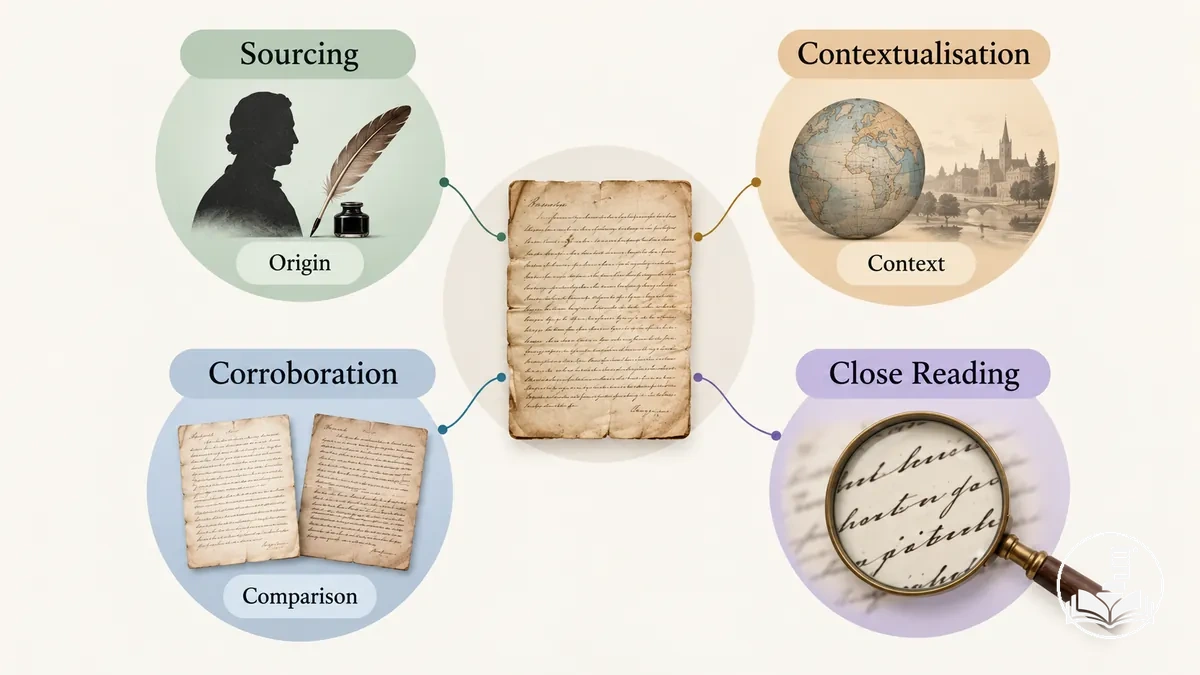
- Sourcing: examines the author or creator, origin, purpose, audience, and circumstances of a source, informing how its claims may be weighed for the historical question being investigated.
- Contextualisation: situates the source in its time, place, and wider circumstances, helping students interpret language, assumptions, and claims in relation to the relevant historical context.
- Corroboration: compares the source with other evidence to identify agreement, conflict, or additional information; disagreement can itself affect how competing accounts are interpreted rather than simply making one source unreliable.
- Close reading: examines the source's language, claims, details, and emphasis, helping students determine what the source communicates and what those internal features contribute to its meaning.
These moves can interact rather than follow a mandatory order, and their combined use can change the interpretive weight assigned to a source.
For example, a student might initially read a public speech as a straightforward account of an event, then use sourcing to recognise its intended audience and contextualisation to identify the circumstances in which it was delivered.
Corroborating the speech with another account and closely reading its wording can then support a more qualified interpretation of what the speech provides as evidence.
Historical Significance: Deciding What Matters and Why
Historical significance is a reasoned judgement about why a person, event, development, or idea matters within a particular historical question or interpretive frame.
Significance is evaluated through stated criteria and evidence rather than treated as an inherent property of the past.
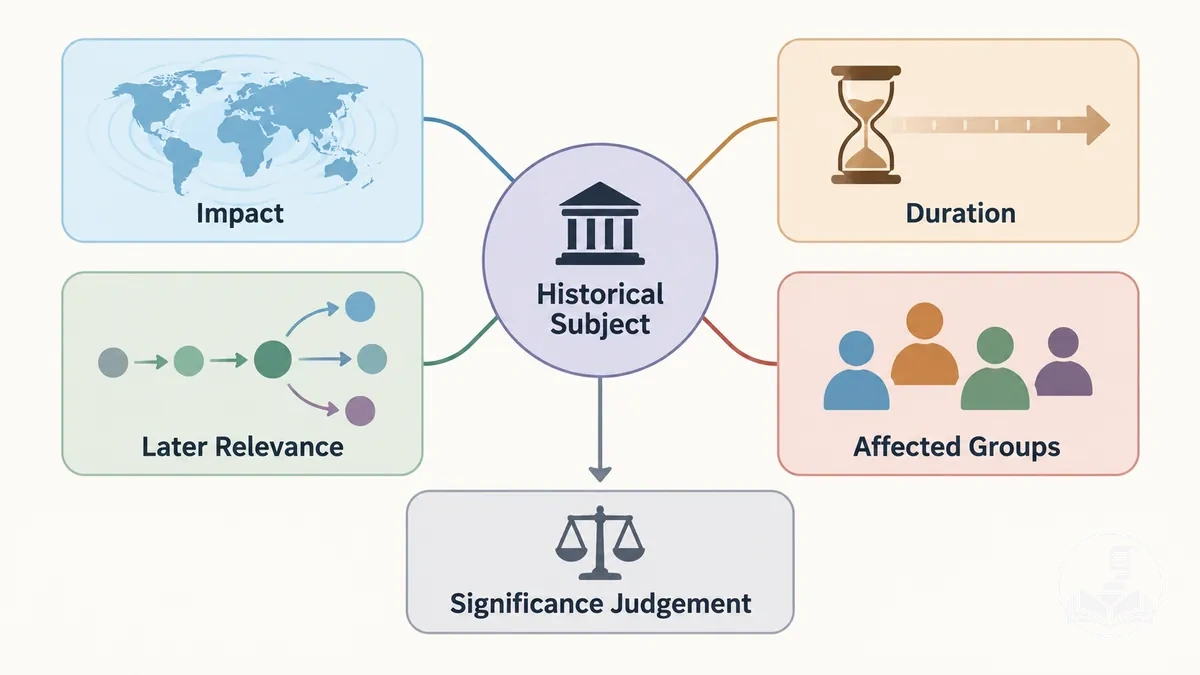
Significance criteria direct attention to different ways a historical subject may matter, and their relevance can change with the question, period, group, or perspective being examined.
No fixed weighting is implied: a judgement should identify the criterion being applied and the evidence that supports the claimed importance.
- Scale of impact: considers how widely a person, event, development, or idea affected people, institutions, places, or historical conditions; broader impact can support a significance judgement when that scale is relevant to the historical question.
- Depth or durability of change: examines how substantially something changed historical conditions and the duration of those changes; deeper or more persistent change can support significance when lasting effects are relevant to the inquiry.
- Relevance to later developments: considers whether the subject contributed to, shaped, or helps explain subsequent developments; evidence of that relationship can support a judgement extending beyond the immediate period.
- Significance to different groups: examines whom the subject affected and how its importance differed among groups; something with limited wider impact may still be judged significant for a particular community or perspective when evidence supports that conclusion.
For example, one judgement might treat an event as significant because its effects persisted and contributed to later developments, while another might emphasise its concentrated impact on a particular group even if its wider effects were limited.
Both judgements can be defensible when the relevant significance criteria are explicit and the claims are supported by evidence.
Continuity and Change: Tracing What Changes and What Persists
Continuity and change analyse a specific historical attribute across a defined time period: continuity identifies what persists, while change identifies what shifts in state, form, extent, or experience.
Both can occur within the same period because one attribute may change while another remains relatively stable.
Different groups may also experience different patterns of continuity and change across the same historical development.
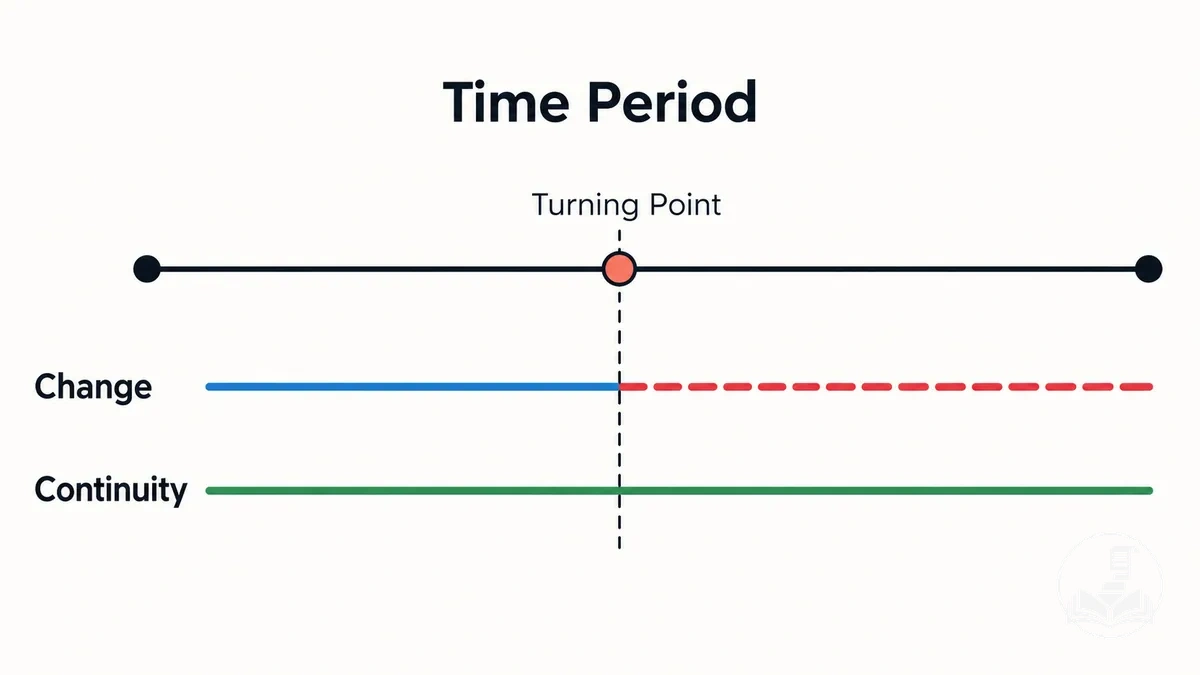
Temporal analysis distinguishes several dimensions of historical development rather than treating change as automatically uniform, linear, or beneficial.
The relevant pattern depends on the attribute being traced, the time boundaries, the evidence, and the group under examination.
- Rate of change: examines whether the tracked attribute changes rapidly, gradually, or at different rates during the time period.
- Direction: identifies how the attribute shifts over time without assuming that the change represents progress or decline for every group.
- Scale: examines how extensive the observed change is within the defined subject, period, or population rather than treating every shift as equivalent.
- Turning points: identify points at which the pattern or direction of the tracked attribute changes noticeably; what counts as a turning point depends on the attribute and evidence being analysed.
- Persistence: identifies features that remain relatively continuous across the time period, including when other attributes are changing around them.
For an illustrative timeline, a class could track two attributes of a generic institution across an early, middle, and later point in the same period: its decision-making structure might shift at the middle point, while its geographic location persists throughout.
The middle point would function as a turning point for the decision-making attribute but not for location, showing that continuity and change can coexist within the same historical development.
Cause and Consequence: Connecting Conditions, Actions, and Outcomes
Cause and consequence examine how historical conditions, decisions, actions, and events contribute to later outcomes.
Historical outcomes often emerge from multiple causes that interact over time rather than from one sufficient trigger.
The causal relationship therefore depends on how contributing factors interact, not simply on which event occurred first.
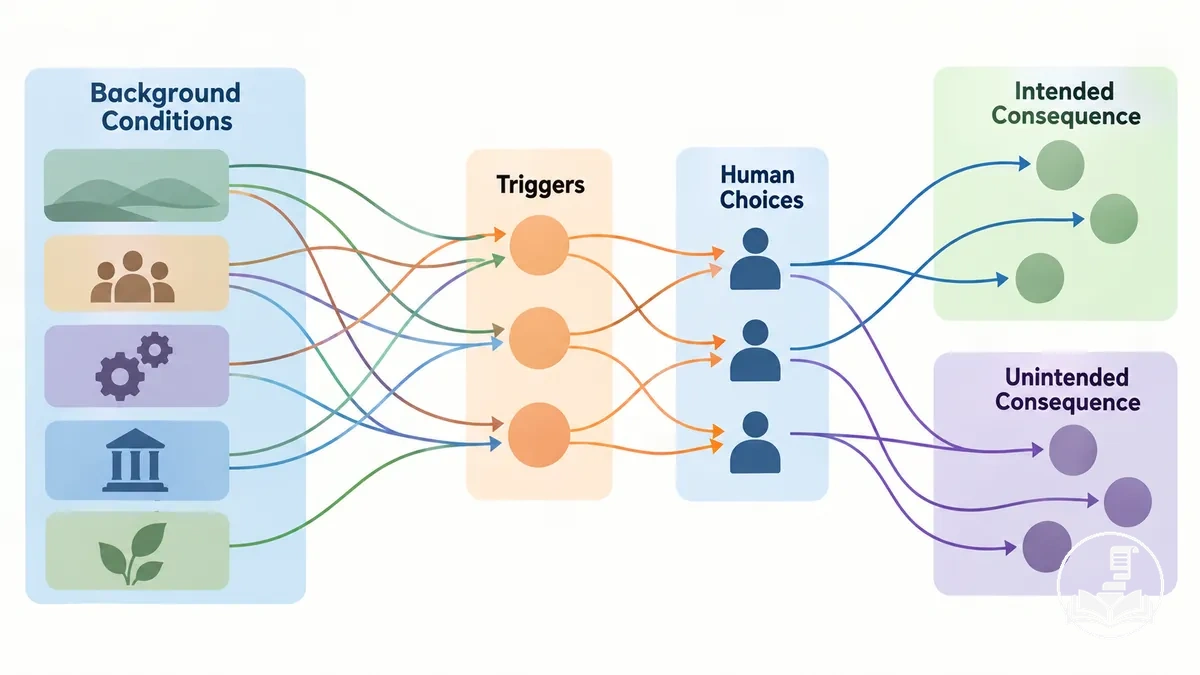
Causal analysis separates different roles without assigning them a fixed rank, then considers their temporal position, interaction, and relative contribution to an outcome.
These roles help distinguish background conditions from proximate triggers and human agency while recognising that consequences can take more than one form.
- Long-term conditions: background circumstances such as institutions, social structures, or prevailing ideas can shape the conditions within which later events and decisions occur.
- Short-term triggers: a proximate event or development can contribute to an outcome without being sufficient on its own to explain that outcome.
- Human choices: decisions and actions can alter how existing conditions and triggers develop, keeping human agency explicit within the causal explanation.
- Consequences: outcomes can be multiple and may include intended consequences as well as unintended consequences that emerge through interactions among conditions, events, and actions.
For a generic causal-chain example, a long-term institutional tension might create a background condition, while a later decision acts as a proximate trigger and prompts several groups to take different actions.
Those interacting factors could contribute to an intended policy outcome while also producing an unintended social consequence, illustrating why historical causation can involve multiple causes and contingent outcomes rather than inevitability.
Historical Perspectives: Interpreting the Past in Context
Historical perspectives interpret how historical actors understood and responded to their circumstances within the context available to them at the time.
A historical viewpoint is reconstructed from evidence about beliefs, available knowledge, social position, interests, location, and constraints rather than from imagined inner thoughts.
Ethical Dimensions: Reasoning About Judgements of the Past
The ethical dimensions of history involve reasoned ethical judgement about past actions, responsibility, harm, and legacies using evidence and historical context.
Historical context informs judgement by clarifying the norms, constraints, and choices surrounding an action, but it does not automatically excuse that action or eliminate responsibility.
A judgement therefore needs to consider both the conditions under which historical actors exercised agency and the consequences of their choices for different groups.
- Power and agency
- Consider what choices an actor could realistically make and how much capacity the actor had to influence events.
- Available alternatives
- Ask whether other courses of action were possible within the historical circumstances rather than assuming the eventual action was inevitable.
- Prevailing norms
- Use contemporary norms to explain what was accepted or contested at the time, but do not treat acceptance alone as a verdict on harm or responsibility.
- Consequences and harms
- Examine effects on different groups, including groups with less power, when assessing the action and its legacy.
These conditions do not carry a fixed or equal weighting; their relevance depends on the action, historical question, and available evidence.
For example, the Canadian Museum of Immigration at Pier 21 describes the Chinese Immigration Act of 1885 as discriminatory and exclusionary while situating successive Chinese immigration restrictions within periods when racial prejudice and concerns about foreign workers shaped Canadian society.
That historical context helps explain the conditions surrounding the legislation without erasing the discriminatory harm of the restrictions or the agency and responsibility involved in enacting them.
Ethical judgement is therefore strengthened when claims about an action, its context, available alternatives, harms, and consequences remain grounded in historical evidence rather than present-day assumptions alone.
Comparing the Five Cs With the Six Historical Thinking Concepts
The Five Cs and the Six Historical Thinking Concepts overlap in the historical reasoning they organise, but they are not interchangeable taxonomies.
The Five Cs identify context, change over time, causality, complexity, and contingency, while the Historical Thinking Project identifies historical significance, primary source evidence, continuity and change, cause and consequence, historical perspectives, and ethical dimensions.
Some elements correspond functionally, while others are distributed across several concepts or receive no separately named counterpart.
The comparison is therefore most useful for identifying shared reasoning functions and distinctive emphases rather than exact equivalents.
The rows compare each Five C with its closest six-concept connection, where one can be identified, and then state the important difference and classroom implication.
These connections describe functional overlap; they do not imply that either framework defines or organises historical reasoning in exactly the same way.
| Five C | Closest six-concept connection | Key difference | Classroom implication |
|---|---|---|---|
| Context | Historical perspectives; primary source evidence | The Five Cs foreground situating historical developments in their time and place, while the six-concept framework distributes contextual reasoning across interpreting perspectives and using evidence. | Ask students to contextualise both historical actors and the sources used to interpret them. |
| Change over time | Continuity and change | This is a close functional overlap, although the six-concept label explicitly foregrounds continuity alongside change. | Have students trace what changes and what persists across a defined period. |
| Causality | Cause and consequence | Both address causal reasoning, while the six-concept formulation explicitly names consequences as part of the analysis. | Require students to connect contributing causes with outcomes rather than identify causes in isolation. |
| Complexity | No single six-concept equivalent; operates across the six concepts | Complexity is named as a Five C, whereas the six-concept framework can express complexity through interacting evidence, causes, changes, perspectives, significance, and ethical dimensions. | Use more than one relevant concept when a historical explanation cannot be supported by a single line of reasoning. |
| Contingency | Cause and consequence; continuity and change | Contingency foregrounds that historical outcomes depended on prior conditions and were not inevitable; the six-concept framework does not name contingency as a separate concept. | Ask which conditions and choices made an outcome possible without treating what happened as predetermined. |
The closest overlaps are change over time with continuity and change, and causality with cause and consequence, but even these pairs place somewhat different emphasis on the reasoning task.
Context, complexity, and contingency show why forced one-to-one mapping is misleading, while historical significance, evidence, and ethical judgement are explicitly named in the six-concept framework without direct Five C counterparts.
Terminology and use can vary across institutions and curricula, so teachers can use either framework to make historical reasoning visible while preserving the distinctions built into the framework being taught.
Choosing the Historical Thinking Skill That Fits the Lesson Purpose
Choose a historical thinking skill according to the target reasoning students need to perform for the lesson purpose, rather than starting with a preferred activity or resource.
The historical question should make that reasoning job explicit, whether students need to judge significance, analyse evidence, trace continuity and change, explain cause and consequence, interpret perspective, or make an ethical judgement.
Skill selection therefore depends on the relationship between the lesson purpose, historical question, available evidence, student readiness, and expected output.
- Lesson purpose: identify the intellectual work the lesson is intended to develop; a purpose centred on explaining why an outcome occurred, for example, calls for cause-and-consequence reasoning rather than significance simply because both could be applied to the topic.
- Historical question: examine what the question requires students to determine, because questions about importance, evidence, change, causation, perspective, and ethical judgement call for different reasoning functions.
- Evidence demand: consider whether the available sources provide the type and complexity of evidence students need to perform the target reasoning rather than merely supply information about the topic.
- Student readiness: consider whether students have enough contextual knowledge and experience with the required reasoning and source complexity to undertake the task; readiness is a suitability condition rather than a fixed age or content threshold.
- Expected output: identify whether students must produce a claim, explanation, comparison, or interpretation, then select a historical thinking skill that supports the reasoning needed to produce and justify that output.
These criteria work together: the lesson purpose and historical question establish the target reasoning, while the evidence demand and student readiness condition whether the task is workable and the expected output makes the reasoning students must demonstrate explicit.
Skill selection is therefore a question of suitability within the lesson context, not a rule that every topic requires the same concept or that using more concepts necessarily makes a lesson more rigorous.
For example, a lesson on a political reform could ask why the reform occurred, making cause and consequence suitable because students must connect conditions, choices, and outcomes; the same topic could instead ask how different groups understood the reform, making historical perspectives suitable because the target reasoning has changed.
These examples change the historical thinking skill because the lesson purpose and historical question change, not because the historical topic changes.
Selecting the historical thinking skill is also distinct from choosing among broader history teaching methods: the former identifies the reasoning students need to perform, while the latter concerns how the learning experience is organised.
The useful aim is therefore a skill that fits the intended reasoning job, rather than a larger quantity of skills.
Designing a Lesson That Requires Historical Thinking
A lesson requires historical thinking when its task demand makes the intended evidence-based reasoning necessary rather than merely naming a skill in the objective.
Lesson design should therefore align the reasoning goal with the historical question students answer, the evidence set they examine, the instructional support they receive, and the student response they produce.
A task that students can complete successfully through factual recall or unsupported opinion does not require the intended historical reasoning, even if that reasoning appears in the lesson objective.
The reasoning goal identifies the intellectual work students should perform, while the historical question turns that goal into a task demand.
The evidence set should provide material that students can interpret, compare, contextualise, or use to support a claim as the reasoning goal requires.
Instructional support, such as modelling or prompts, can make that reasoning accessible without replacing the thinking students must eventually perform.
The expected student response should then make the reasoning observable through an evidence-based claim, explanation, comparison, or interpretation.
When these elements are misaligned, the task can shift away from historical thinking: a causal reasoning goal paired with a question that asks only for dates or names mainly elicits recall, while a perspective question without relevant evidence can invite unsupported opinion.
An evidence set that is too demanding for students' readiness may also prevent the intended reasoning from becoming visible unless instructional support reduces the access barrier without supplying the conclusion.
Alignment therefore concerns whether the question, evidence, support, and response collectively require and enable the target reasoning; it does not guarantee that every student will demonstrate mastery.
For example, instead of asking, “What happened during the protest?”, a task could ask, “Using the two accounts provided, what claim can you make about why participants understood the protest differently, and what evidence supports your interpretation?” The revised prompt changes the task demand from reporting events to interpreting evidence and justifying a historical claim.
This alignment method concerns the historical-thinking demand within a task; broader sequencing, timing, activities, and other decisions belong to the wider design of history lesson plans.
Set a Thinking Outcome Alongside the Content Outcome
A thinking outcome names the historical reasoning students will demonstrate, while a content outcome identifies the historical knowledge or subject matter through which they demonstrate it.
The thinking outcome should make the target skill observable through a reasoning verb such as analyse, compare, explain, interpret, or justify rather than using understand or know as the only performance verb.
The two outcomes remain distinct but aligned: one specifies the reasoning operation and the other specifies the historical content on which that reasoning operates.
“Students will understand the causes of a historical protest.”
“Students will explain how multiple conditions and actions contributed to the historical protest and justify their explanation with evidence.”
Connect the target skill + reasoning verb + historical content, then make the later task reveal the reasoning through a claim, explanation, comparison, or interpretation.
A clearly specified thinking outcome can then guide the later task demand so students are required to demonstrate the intended historical reasoning through the content.
Frame a Historical Question That Requires the Target Skill
A historical question should make the target skill necessary by asking students to perform a specific historical reasoning operation rather than simply retrieve a fact or state an unsupported opinion.
The question predicate establishes the reasoning demand: students might assess significance, explain causes, trace change, compare evidence, or interpret perspective.
That wording also shapes the evidence demand because students need evidence that allows them to construct and support the kind of claim, explanation, or interpretation the question requires.
For example, a recall question might ask, “What happened during the protest?”, while a reasoning question about the same historical content might ask, “Using the available accounts, compare evidence about the protest and explain which interpretation is better supported.” The second question changes the predicate from recalling an event to comparing evidence and justifying an interpretation, so students must use sources as evidence rather than merely reproduce factual information.
Framing the question in this way remains one part of task design; the broader sequencing and investigation process belongs to the design of inquiry-based history lessons.
Select Evidence That Requires the Target Reasoning
Evidence should be selected for the target reasoning it enables, not for topic relevance alone.
Evidence selection should connect a source or evidence set to the attributes students need to examine, such as origin, perspective, chronology, agreement, contradiction, causal relevance, or significance.
The appropriate evidence therefore depends on the reasoning demand, task, student readiness, and support available.
Five criteria help evaluate whether an evidence set creates the intended reasoning demand:
- Relevance: the evidence should contain information that bears on the historical question and supports the target reasoning, rather than merely referring to the same topic.
- Contrast: where the task requires comparison or corroboration, sources should provide meaningful agreement, contradiction, or differences in perspective that create a need to compare evidence.
- Complexity: the evidence should contain enough ambiguity, difference, or causal information to support the intended reasoning without exceeding what students can examine with their current readiness and instructional support.
- Accessibility: students should be able to access the evidence's language, context, and relevant features with appropriate support; otherwise, difficulty with the source can obscure the reasoning the task is intended to elicit.
- Sufficiency: the evidence set should provide enough relevant material to support a defensible claim or interpretation without assuming that a larger number of sources automatically produces better reasoning.
For example, a perspective task might pair two accounts of the same generic event from participants in different social positions with a contextual record that clarifies the circumstances surrounding both accounts.
Differences in perspective create a reason to compare the accounts, while the contextual evidence helps students support an interpretation rather than treating either source as self-explanatory.
Selecting an evidence set for this reasoning demand is distinct from the broader routines used in primary-source teaching.
Sequence the Task From Modelling to Independent Reasoning
Sequence historical reasoning practice from modelling to guided practice and then independent reasoning so cognitive responsibility shifts progressively to students.
Modelling should make the reasoning process visible without supplying a final interpretation for students to reproduce, while guided practice uses prompts and feedback to help students perform that reasoning themselves.
Independent application follows when students can carry out the target reasoning with less support and provide their own justification.
The pace of this gradual release should depend on student readiness and task complexity rather than a predetermined schedule.
Support should be reduced after students demonstrate the relevant reasoning with the current level of guidance, and it can be increased again when the evidence or reasoning task becomes more complex.
- Model the reasoning: demonstrate how to work through the target historical reasoning and make the decisions visible; for example, model how evidence from two accounts can be compared without giving students the interpretation they will later justify. Check that students can identify the reasoning being demonstrated before moving to guided practice.
- Practise with prompts: use guided practice with prompts that direct attention to relevant evidence, differences, and possible claims while students perform the reasoning. Check whether students can compare the evidence and explain how it supports an interpretation before reducing the prompts.
- Reduce support: remove or simplify prompts so students take greater responsibility for selecting relevant evidence, forming a claim, and explaining the relationship between them. Check whether students can sustain the reasoning with less guidance; if not, restore enough support to address the difficulty before reducing it again.
- Require independent justification: ask students to complete a comparable reasoning task independently and justify their claim with evidence. Check the quality of the demonstrated reasoning and justification rather than assuming that completing the earlier stages automatically establishes independence.
Adjust movement between these stages according to demonstrated reasoning, student readiness, and task complexity rather than assigning a fixed amount of time to each stage.
Teaching Students to Make Their Historical Reasoning Explicit
Explicit instruction makes historical reasoning observable by showing students how evidence is examined, how a claim is developed, and how that claim is justified.
Teacher modelling can make a reasoning process visible, while purposeful prompts and discussion elicit the student reasoning that would otherwise remain hidden.
The goal is not to supply an interpretation for students to reproduce, but to expose the reasoning moves they can use to construct and qualify their own interpretations.
- Model a reasoning move. Connect the move to specific evidence—for example, notice a difference between two accounts and explain why that difference matters for the historical question.
- Prompt the evidence relationship. Direct attention to relevant evidence and ask how it supports, complicates, or qualifies a possible claim.
- Discuss alternative interpretations. Let students articulate and examine different evidence-based relationships rather than treating the first plausible interpretation as final.
- Require student justification. Students state their own claim and explain how the evidence supports it; the Digital Inquiry Group similarly characterises historical inquiry as evaluating multiple perspectives and making historical claims backed by documentary evidence.
A concise think-aloud might model the process without closing the judgement: “These two accounts describe the same event differently, so I need to examine what each account says and consider which details could support an interpretation; I am not deciding the final claim yet.” Students can then use the evidence to construct and justify their own interpretation, with the level of prompting adjusted to the task and the support they need.
Prompt Claims With Evidence and Historical Context
A useful prompt requires students to state a claim, identify relevant evidence, and explain how that evidence supports the claim within its historical context.
Evidence becomes part of historical justification when students connect its relevant details and context to the interpretation they are advancing, rather than merely selecting a quotation or fact.
The reasoning link should also allow students to qualify the claim when the evidence supports a narrower or more conditional interpretation.
A weak prompt might ask, “What evidence supports your claim?” An improved prompt would ask, “What evidence supports your claim, what does its historical context tell you about its relevance, and why does that evidence support or qualify your interpretation?” The improved prompt adds a precise reasoning cue: students must contextualise the evidence and explain its relationship to the claim instead of stopping after evidence selection.
This keeps the justification focused on historical reasoning rather than treating the prompt as a rigid writing formula.
Ask Students to Compare, Reconcile, and Qualify Evidence
- Compare the evidence. Identify agreement, contradiction, differences in perspective, and differences in what each source can contribute to the historical claim.
- Explain convergence or divergence. Corroboration is more than counting sources: consider origin, context, audience, perspective, and relevance when asking why sources agree or conflict.
- Weigh what each source can support. Agreement can strengthen an interpretation and contradiction can complicate it; conflict does not automatically make either source false, and evidentiary weight depends on the claim being examined.
- Qualify the conclusion when needed. If conflicting evidence cannot be fully reconciled, narrow the confidence or scope of the claim and state what the evidence supports versus what remains uncertain.
A qualified conclusion makes that limitation explicit by distinguishing what the evidence supports from what remains uncertain.
For example, if one account describes strong public support for a generic reform while another contemporary account records organised opposition, students should not resolve the conflict by counting supporting sources or declaring one account false.
Differences in origin, audience, perspective, and context may instead warrant the qualified conclusion that the reform had substantial support among some groups while remaining contested among others.
Check for Historical Reasoning Rather Than Fact Recall
Historical reasoning is visible in how a student response develops a justified claim using relevant evidence, historical context, comparison, causation, perspective, and appropriate qualification rather than through factual correctness alone.
Fact recall supplies necessary historical knowledge, but recalling accurate names, dates, or events does not by itself show how a student interprets relationships among them.
Evidence of thinking appears when the student makes the reasoning connecting historical information to an interpretation explicit.
The following criteria are observable signs of reasoning rather than a scoring system, and no single item establishes mastery.
Factual accuracy remains necessary because reasoning based on inaccurate historical information can weaken the resulting interpretation, while these indicators show how students use accurate knowledge to construct and justify a historical explanation.
- Justified claim: the student states a claim that answers the historical question and provides a basis for justification rather than only reporting information.
- Relevant evidence: the student selects evidence that bears on the claim and uses it for a clear historical purpose rather than merely including a fact or quotation.
- Explicit reasoning: the student explains how the evidence supports, complicates, or qualifies the claim instead of leaving the connection implicit.
- Historical context: the student contextualises evidence, actions, or perspectives when that context affects their meaning or relevance to the interpretation.
- Complexity or alternatives: the student recognises relevant comparison, causation, differing perspectives, conflicting evidence, or alternative explanations when the historical question requires them.
- Qualification: the student limits or adjusts the conclusion when the available evidence supports a conditional, partial, or contested interpretation rather than an absolute claim.
For example, a factually correct response might state, “The reform was introduced after the protest.” A historically reasoned response might state, “The protest contributed to pressure for reform, but the timing alone does not establish that it was the sole cause; evidence about other political conditions and decisions is needed to justify the causal claim.” The second response retains factual accuracy while making causation, evidence needs, complexity, and qualification visible.
These indicators provide a lesson-level check for evidence of reasoning, not a complete grading system or proficiency judgement; broader decisions about criteria and evaluation belong to assessing historical thinking.