
History Lesson Plan Examples: Features of Effective Plans
An effective history lesson plan example aligns a clear learning objective with the student activities, historical evidence, and assessment used to demonstrate that same intended learning. The format can vary by topic, learner stage, and teaching approach, but the plan is coherent only when objective, activity, evidence, and assessment support the same historical task rather than operating as isolated fields.
What an effective example connects
Read the plan as one alignment chain. Each part has a different function, but every part should point to the same intended historical learning.
- 1 · Learning objective Defines the historical understanding or reasoning students should demonstrate. Example: compare two accounts and explain how perspective affects interpretation.
- 2 · Activities Give students practice with the same historical task named in the objective. Example: examine and compare contrasting accounts rather than complete unrelated recall work.
- 3 · Historical evidence Provides source material that is relevant, interpretable, and useful for the required reasoning. Example: use accounts whose provenance and perspectives give students a meaningful basis for comparison.
- 4 · Assessment Elicits observable evidence of the learning described in the objective. Example: ask for an evidence-based comparison and explanation, not only task completion.
Alignment check: the assessment should ask students to demonstrate the same historical reasoning that the activities let them practise using suitable evidence.
Table of Contents
What an Effective History Lesson Plan Example Includes
An effective history lesson plan example makes four core components explicit: the learning objective, lesson sequence and activities, historical evidence, and assessment. Each component has a distinct function, but all four should support the same intended historical learning.
Across broader history lesson plans, the topic, learners, and instructional approach can change the content and format without changing that need for functional alignment.
For example, if students are expected to explain why interpretations of an event differ, the activities can direct them to examine contrasting sources and the assessment can ask them to use that evidence in an explanation. Completeness therefore means that the parts work together, not simply that separate template fields have been filled.
The four components can be scanned by the function each performs and how it supports alignment:
- Learning objective
- states the historical understanding or capability students are intended to demonstrate, giving the other components a common learning target.
- Lesson sequence and activities
- organise the student activity through which learners engage with the historical task, with each activity supporting progress towards the objective.
- Historical evidence and sources
- provide the material students examine and use for historical reasoning, so the evidence should be relevant to both the activity and the intended learning.
- Assessment
- provides evidence of learning by asking students to demonstrate the intended understanding or capability in a way that aligns with the objective and preceding work.
The annotated example identifies where these components appear within one lesson design and shows how their positions and connections can be read as parts of the same plan.

A Clear Historical Focus and Learning Objective
The historical focus identifies the topic, context, or historical question the lesson is about, whereas the learning objective states the specific understanding or skill students should demonstrate.
The focus establishes the subject matter; the objective defines the intended student action and observable outcome.
This distinction prevents topic coverage alone from being treated as evidence of learning.
A paired example makes the distinction concrete by linking subject matter to an observable learning demand.
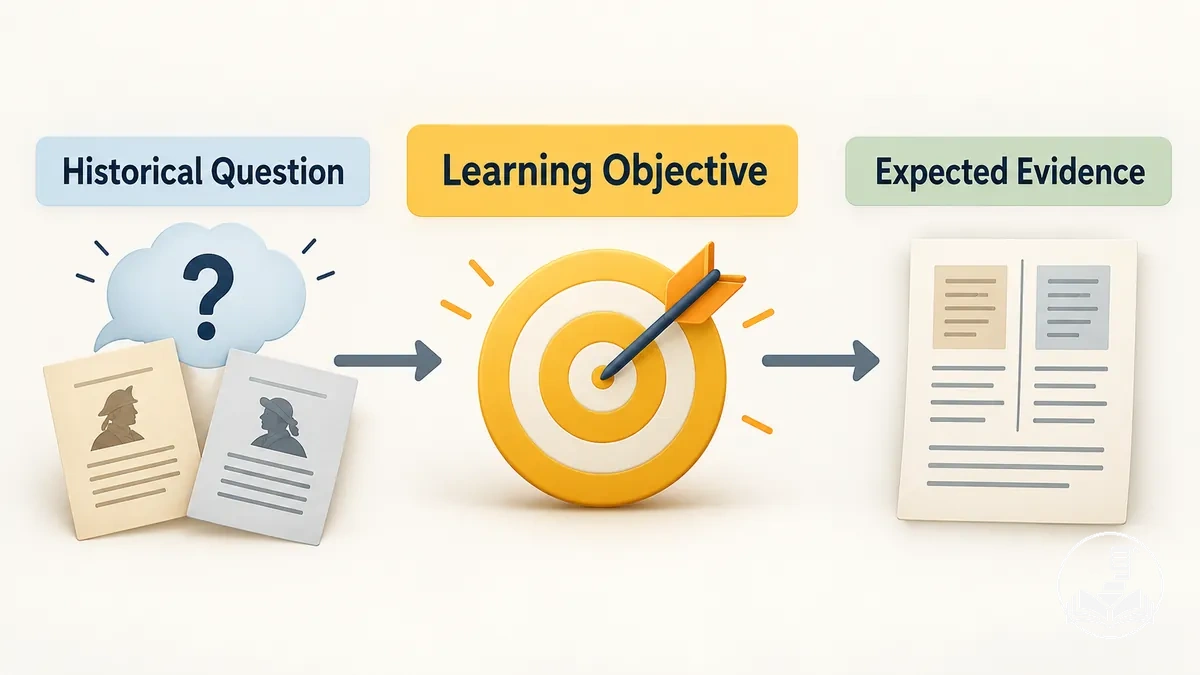
For example, a historical focus might ask why accounts of the same event differ, while the learning objective asks students to compare two accounts and explain how differences in perspective affect their interpretations.
The observable outcome is the student's evidence-based comparison and explanation, although an appropriate objective can vary with the topic, curriculum, learner stage, and available lesson time.
That expected evidence of learning can then guide which historical evidence students examine and what the assessment asks them to demonstrate.
The diagram separates the historical question from the learning objective and shows their connection to the student evidence expected from the lesson.
Activities and Lesson Sequence That Support the Objective
An effective activity sequence orders each student activity so that it supports the learning objective and prepares students for the work that follows.
Each phase has a distinct learning function within the lesson sequence rather than operating as an isolated task.
The order should help students move coherently from initial orientation into historical evidence work and then towards synthesis.
The teacher role can establish context and frame the historical task, while the student role shifts towards examining historical evidence and constructing a response tied to the objective.
Transitions should connect one learning activity to the next, and pacing should provide enough space for the intended work without treating any particular timing as universal; appropriate pacing varies with lesson purpose, learner needs, available time, and teaching approach.
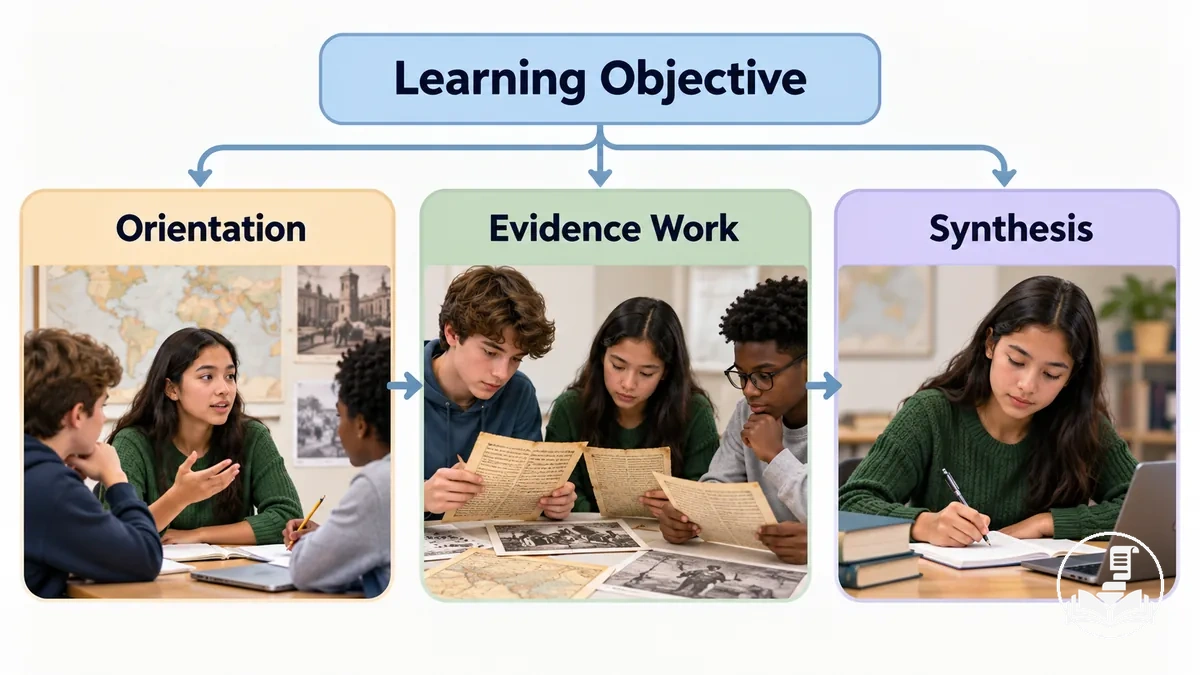
The following representative sequence organises three learning functions to show why their order can support a coherent progression towards the objective:
- Orientation and context: the teacher frames the historical question and relevant context, while students identify the issue they will investigate.
- Evidence work: students examine and compare relevant historical evidence, developing the reasoning needed for the stated learning objective.
- Synthesis and response: students bring their evidence and reasoning together in a response that demonstrates the intended learning.
This three-part progression is illustrative rather than universal; activities and pacing can change while their functions remain connected to the objective.
A fuller history lesson planning structure extends beyond this example-level sequence.
The image demonstrates how one coherent activity sequence connects the learning objective with student actions and evidence use, without presenting the sequence as a mandatory template.
Sources and Evidence Matched to the Historical Task
A source is useful for a history lesson when its attributes fit the historical task and learner context, allowing students to use historical evidence for the reasoning required by the learning objective.
Relevance connects the material to the question students are addressing, while provenance identifies its origin and context.
Accessibility, complexity, and evidentiary usefulness determine whether students can work with the source meaningfully for that particular task.
The evidence needed can change even when the historical topic stays the same because different tasks place different demands on student interpretation.
For example, identifying a viewpoint may require one source with a clear perspective, comparing viewpoints requires material that provides a meaningful basis for comparison, corroborating a claim requires evidence that can be examined across sources, and arguing requires an evidence set capable of supporting or challenging a position.
Instructional suitability therefore depends on what students need to do with the evidence and their capacity to interpret it, rather than on authenticity alone.
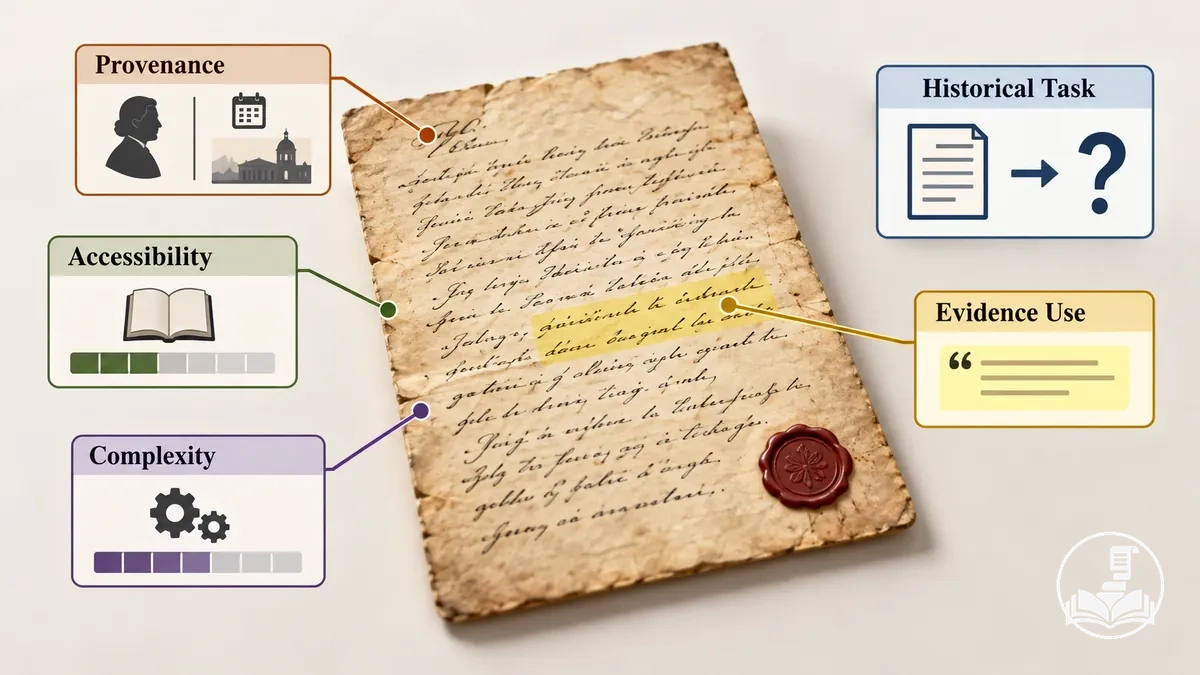
These five attributes help evaluate source-task fit by connecting characteristics of the source to the reasoning students need to perform:
- Relevance: the source addresses the historical question or issue closely enough to provide evidence students can use for the intended task.
- Provenance: information about the source's origin, creator, time, or context gives students a basis for considering how and why the evidence was produced.
- Accessibility: the source is presented in a form that the intended learners can examine with the support available, so access does not prevent engagement with the historical task.
- Complexity: the source places interpretive demands that are appropriate to the learners and task; greater complexity may challenge students but is not inherently more suitable.
- Evidentiary usefulness: the source provides material that students can interpret, compare, corroborate, or use in an argument as required by the task.
The annotated example shows how provenance, task relevance, accessibility, complexity, and potential evidence use can be examined together when judging whether one historical source fits a particular student task.
Assessment Matched to the Intended Learning
Assessment should elicit evidence of the same historical learning named in the learning objective and practised through the lesson activities.
The student response or product provides observable student evidence, while the assessment criterion identifies what to examine in that response.
Alignment therefore depends on whether the assessment checks the intended historical knowledge or historical reasoning rather than merely recording task completion.
The assessment criterion should connect the expected student evidence to an interpretation of the learning objective.
For example, if students have practised comparing historical accounts and the objective requires them to explain how perspectives differ, the assessment can ask for a comparison supported by evidence from the accounts and check whether the response identifies relevant differences and explains them using that evidence.
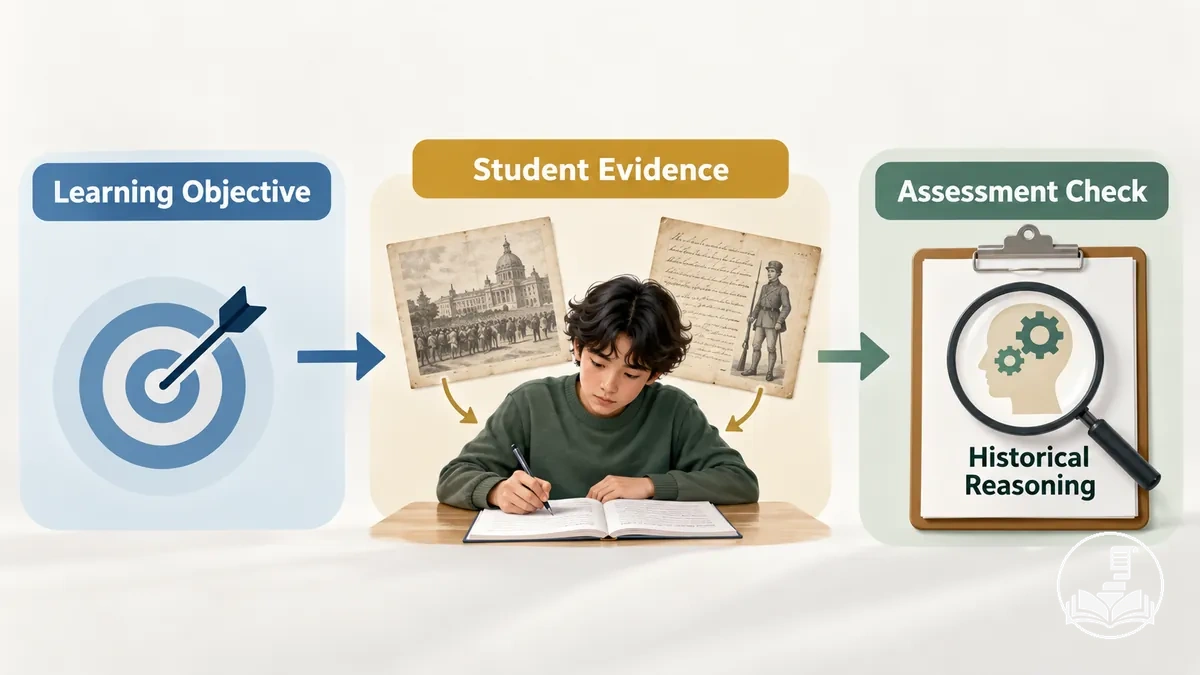
This objective-to-evidence example traces assessment alignment rather than cataloguing assessment techniques:
- Objective
- Explain how differing perspectives can produce different accounts of the same historical event.
- Student evidence
- A student response compares two accounts, identifies relevant differences in perspective, and supports the explanation with historical evidence from the accounts.
- Assessment check
- Check whether the response uses relevant evidence to explain how the identified perspectives relate to differences between the accounts; the response provides evidence of learning to the extent that it demonstrates the historical reasoning named in the objective.
Completing the comparison activity alone does not necessarily demonstrate the intended learning; the interpretation depends on what the student response shows against the assessment criterion.
The diagram traces this relationship from the learning objective through observable student evidence to the aligned assessment check.
How the Parts Work Together in a Complete History Lesson Plan Example
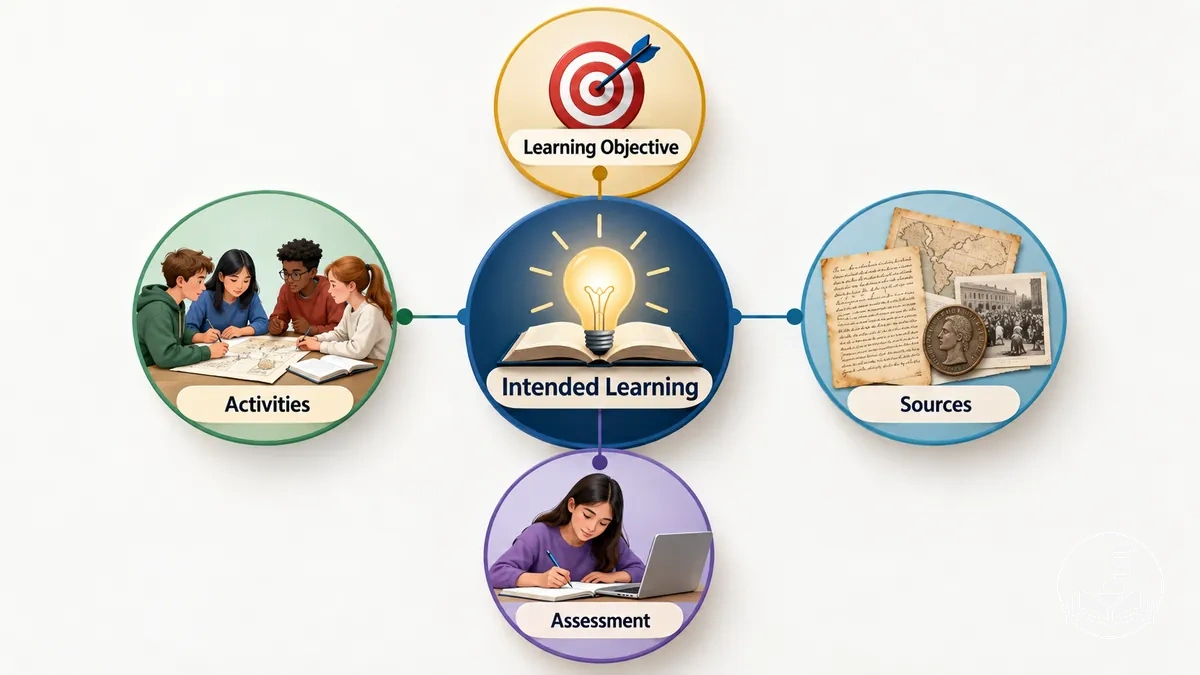
A complete history lesson plan has coherence when its learning objective, activities, sources, and assessment support the same intended historical learning without internal contradiction.
Alignment therefore concerns the relationships among the parts, not simply whether each component is present.
A plan can contain all four components and still be misaligned if they direct students towards different historical tasks or evidence of learning.
Four criteria help evaluate these alignment relationships across a complete plan.
Each criterion checks a connection between components and its implication for the lesson, while the relative importance of each connection can vary with the objective, learners, available time, and instructional context.
- Objective-to-activity alignment: the activities give students an opportunity to practise the knowledge or historical reasoning required by the learning objective; otherwise, the lesson work may not prepare students to demonstrate the intended learning.
- Source-to-task fit: the sources provide historical evidence that students can use for the historical task; poorly matched evidence can constrain the interpretation, comparison, corroboration, or argument the task requires.
- Activity-to-assessment continuity: the assessment checks knowledge or reasoning that students had an opportunity to develop through the activities, so the resulting student response can provide relevant evidence of learning.
- Sequence feasibility: the planned activities, source work, and assessment remain feasible within the available time and learner context; feasibility therefore depends on the demands of the particular lesson rather than on one universal sequence.
A miniature contrast shows the practical implication of these criteria.
Aligned plan
An objective asking students to explain why two accounts of an event differ is supported by activities that compare relevant sources and by an assessment requiring an evidence-based explanation of those differences.
Relationship: practice, evidence, and assessment all elicit the historical reasoning named in the objective.
Misaligned plan
The same objective conflicts with activities focused mainly on recalling dates and an assessment that checks factual recall.
Relationship: the completed tasks do not elicit the historical reasoning that the objective requires.
A complete plan should therefore be interpreted by the coherence of its relationships, not by the presence of its components alone.
The diagram maps the objective, activities, sources, and assessment around the intended historical learning so the alignment relationships across the complete plan are visible without turning them into a scoring system.
Common Variations Across History Lesson Plan Examples
History lesson plan examples can vary substantially in teaching approach, use of historical evidence, and learner complexity while retaining the same core requirement of purposeful alignment. The learning objective, activities, sources, and assessment should still support the same intended historical learning.
Teaching approach can change the activity pattern and balance between teacher guidance and student independence; evidence choices can change source use and reasoning demand; and learner complexity can change scaffolding, source demands, or expected independence. These are functional variations because they change how students work towards the objective.
Surface differences in template layout do not by themselves establish a meaningful difference in lesson design. Decisions about choosing a history teaching method belong to the neighbouring method-selection context rather than this variation framework.
The following grouping isolates three dimensions that can materially change lesson design while keeping alignment as the constant. The dimensions are not hierarchical; their significance depends on the lesson purpose, evidence demands, and learner context.
- Teaching approach: the pattern of activities, teacher guidance, and student independence may change, while the activities should remain aligned with the learning objective and intended historical task.
- Historical evidence: the type, amount, or use of sources may change with the reasoning demand, while the evidence should remain suitable for the task and connected to what the assessment asks students to demonstrate.
- Learner complexity: scaffolding, source complexity, and student independence may adapt to grade level, prior learning, and learner needs, while the lesson objective, activities, and assessment should remain coherent for that learner context.
Inquiry-Based Examples Use Historical Questions, Evidence, and Investigation
An inquiry-based history lesson example might ask, “Why did two people describe the same historical event differently?” Students investigate that historical question by examining a small set of contrasting primary documents rather than beginning with a predetermined answer.
The inquiry directs attention to evidence that can support different interpretations and gives students a reason to investigate how each account was produced.
Within this example, students use sourcing to identify who created each document and contextualising to consider the circumstances in which it was produced.
They then use corroboration to compare agreements, differences, and conflicting evidence across the documents before constructing an evidence-based response.
These actions support a lesson objective focused on historical reasoning, while the assessment can examine whether the student response uses relevant evidence to justify its interpretation.
The sequence below shows this local inquiry structure without treating it as a universal model.
- Historical question: investigate why two accounts of the same historical event present different perspectives.
- Evidence examination: examine contrasting primary documents for claims and details relevant to the historical question.
- Sourcing, contextualising, and corroboration: consider each document's provenance and context, then compare the evidence to identify agreements, differences, or conflicts.
- Evidence-based response: develop a reasoned conclusion that answers the historical question using relevant evidence from the investigation.
This compact example demonstrates how a historical question can organise investigation, evidence evaluation, and a reasoned response without defining the complete design process.
Broader inquiry-based history lesson planning extends beyond this example into decisions about how an inquiry is designed and structured.
Primary-Source Examples Centre Analysis of Historical Evidence
A primary-source-centred history lesson example might use a wartime propaganda poster to investigate the historical question, “How did governments try to influence public attitudes during wartime?” Students examine the primary source as historical evidence, considering its creator, intended audience, provenance, and historical context rather than treating the document as self-explanatory.
The source fits the example because its visual claims and context can support analysis of how a particular perspective was communicated.
The analysis prompt asks students to identify relevant details in the source and interpret how those details relate to the creator, audience, purpose, and historical context.
Students then develop a student interpretation supported by specific evidence from the poster, giving the assessment observable evidence of the historical reasoning targeted by the lesson objective.
The amount of support and the complexity of the source may need to adapt to the learners and task.
Authenticity establishes that the item is a primary source, while instructional fit depends on whether it can support the historical question and the required source analysis.
The example block traces how one primary source becomes a learning task by connecting the source to an analysis prompt, student interpretation, and evidence of learning:
This example remains focused on the instructional relationship between source, task, interpretation, and assessment rather than on complete primary-source pedagogy.
Deeper implementation of primary-source history lessons belongs to the neighbouring planning context.
Elementary and High School Examples Differ in Complexity and Student Independence
Elementary and high school history lesson plan examples may differ in cognitive demand, source complexity, scaffolding, student independence, and output complexity while retaining the same need for alignment.
The lesson objective, historical evidence, activities, and assessment should still support the same historical reasoning, even when the level of teacher support or task complexity changes.
Grade level therefore affects how the lesson is structured for a particular learner group rather than creating a fixed rule about what every student can do.
Elementary example
- Sources
- A small set of accessible sources related to the historical event.
- Support
- Guided questions and teacher modelling, with selected excerpts, vocabulary support, or a structured response frame where useful.
- Student independence
- Bounded by the scaffolding provided for the historical task.
- Assessment evidence
- A concise explanation that uses relevant evidence to identify and explain one or more contributing factors.
High school example
- Sources
- More complex or conflicting sources on the same historical topic.
- Support
- Less direct scaffolding where learners can manage the greater reasoning demand.
- Student independence
- Greater responsibility for selecting, comparing, and evaluating evidence.
- Assessment evidence
- A more sustained evidence-based response that may require comparison, corroboration, or extended historical reasoning.
Important condition: these are illustrative differences, not fixed grade rules. Learners within the same grade level can require different levels of support and challenge, so source complexity, scaffolding, independence, and output complexity should be adjusted to the learner context.